 Richard Strauss’s Die Frau ohne Schatten (The Woman without a Shadow) premiered at Vienna State Opera (October 10, 1919). Critics and audience had problems, as I did, with Hofmannsthal’s complex and heavily symbolic libretto. The opera is still a challenge to stage even for major opera houses, requiring a huge orchestra, and elaborate sets. Outstanding Vienna State Opera productions include Clemens Kraus, Bohm and Karajan. M D Franz Welser- Möst’s, in a revival of Robert Carsen’s 1999 production, must bear comparison.
The opera is set in a mythical empire. The Empress is not human, a spirit captured as a gazelle. She assumes human form, mastered by the Emperor. But she still has no shadow, a symbol of her inability to have children. She must gain a shadow, or be reclaimed by her father, and the Emperor turned to stone. The Empress descends, accompanied by her Nurse, disguised as humans, seeking a woman willing to sell her shadow: a Dyers Wife is contracted and promised lovers and luxury. But ultimately the Empress ‘will nicht’; she refuses to deny the wife her unborn children. (The Empress’s renunciation liberates herself and reconciles both couples.)
Taken literally, the story is both over-complicated and preposterous. But seen as a psycho drama, its language is embedded in ‘unconscious’ symbolism. The opera is, rather, a tale of motherhood from the perspective of Freud’s psycho analysis, (explains Ian Burton) Thus, out of guilt feelings for her father, the Empress is made barren. She casts – the symbol for it – no shadow. In her efforts to create this shadow, she undergoes a series of painful tests.
Hofmannsthal’s libretto is full of dreams and dream symbolism . Characters are constantly explaining their dreams, and repressed wishes and desires. In Die Frau ohne Schatten the dream of the Empress is central to the plot. And the whole of the third Act could be seen as a continuous dream world.
Further, Hofmannsthal was influenced by Otto Rank, Rank’s concern being with the individual ‘self’, and the threat of its annihilation in death. Man seeks to annul this fear through erecting a series of myths of Unsterblichkeit, man’s immortality.
The theme of man’s self-renewal – staying young through our children – is central. Also Rank (Doppelganger, 1914) argues for the significance of the shadow – derived from oriental sources- as a symbol for the soul in art and literature.
Rank himself acknowledged the material for Strauss’s opera and Hofmannsthal’s libretto. The complicated psychic experience of the Empress runs from her dream of the Emperor turning to stone; and lets her find the reason for her dejection, finally in her relationship to her mysterious father Kerkobad. The Empress, by refusing the wife’s shadow, discovers her own self, her humanity, ‘new birth’. (Burton)
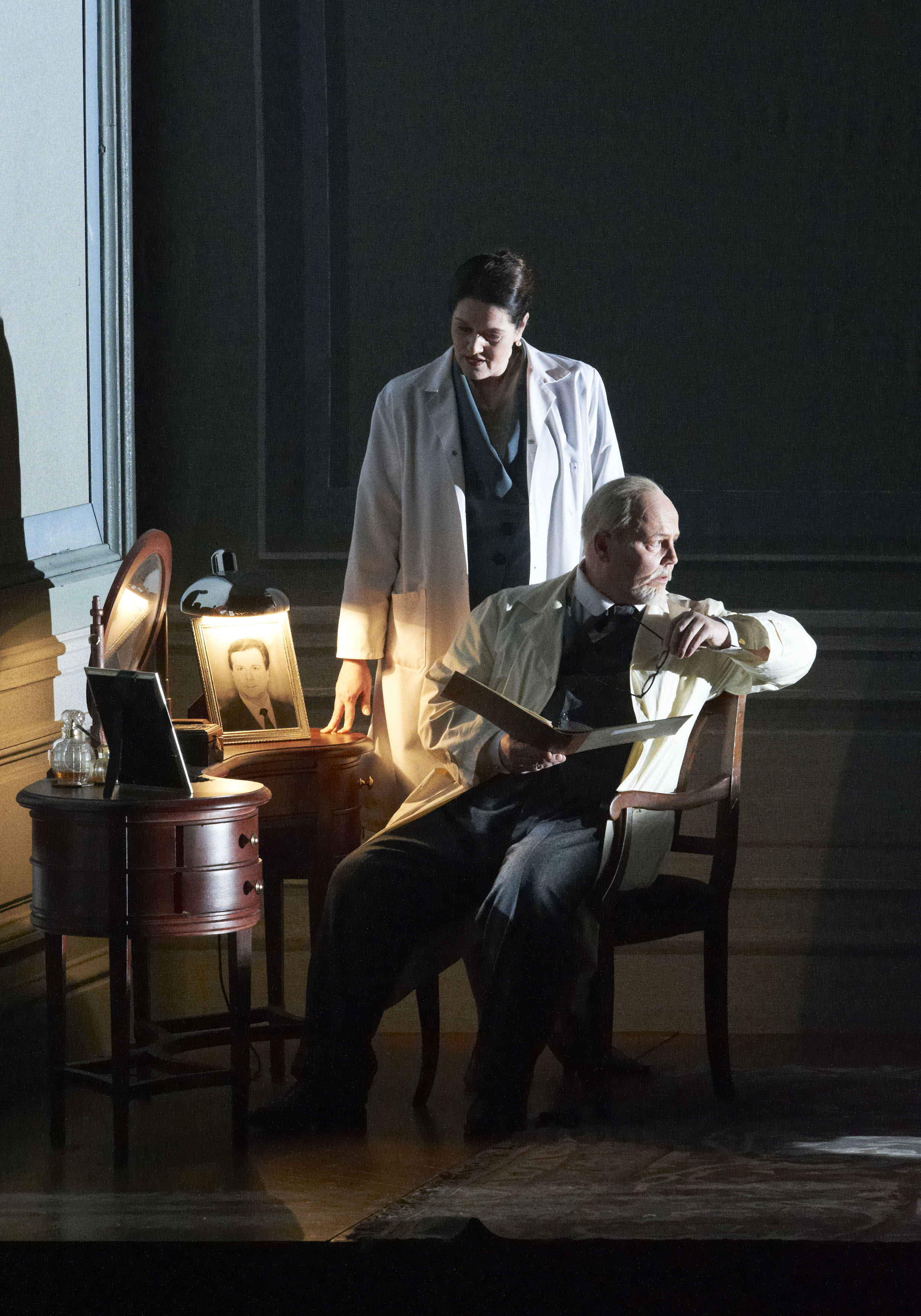
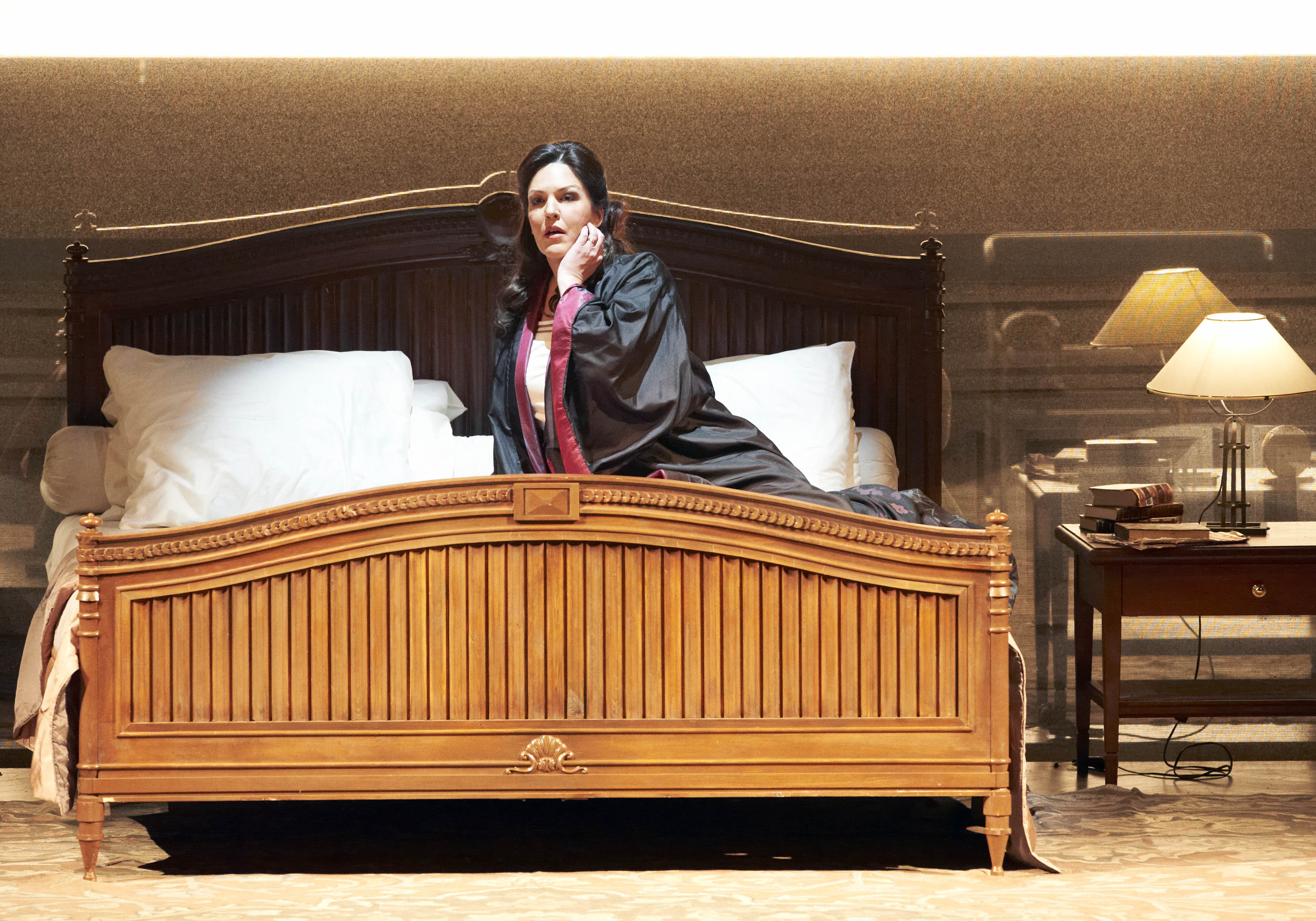
So the stage design needs to hint at this ambiguous sub-text. Vienna State Opera’s set, with rich jugendstil early 20th Century furnishings, reminded me of an enlarged psychoanalysts’s study: the art nouveau bureau on the left, the oriental carpet foreground. And the bed, ornately embellished is centre stage in Act 3, perhaps suggesting a living nightmare. By no coincidence, the Priest (Wolfgang Bankl), bears an uncanny resemblance to Freud, wearing similar spectacles and white coat- as does the Nurse (Birgit Remmert), also carrying a medical folder.
A screen divides the stage, as if to mirror the front half of the set. The sides of stage are white to reflect the shadow of the Emperor in Act 1. Phantom shadows effect a nightmare quality, reflecting the subconscious of the protagonists.
Surrealism is also evidenced (Act 1) in a recreation of a silent 1920s surrealist film, the Empress’s face is seen in close up, as she trembles. The image enlarges, blown up frighteningly – reminiscent of Dali/ Bunuel’s Un Chien Andalou.
The Empress (Adrianne Pieczonka) immediately entrances with her high, bird-like dramatic soprano, (with extended coloratura passages of trills and runs from the first solo). Hers is a purer, sweeter soprano- in contrast to the more frenetic, highly strung Evelyn Herlitzius (dyer’s wife). The Empress has a bird-like enchantment, as befits her previous life as a gazelle, and metamorphosing spirit of nature.
Evelyn Herlitzius’s soprano is also a thing of wonderment, her immense power needed against Strauss’s heavy orchestration. But with a nervy quality, sometimes shrill, a voice for the 20th century, attuned to troubled times. Herlitzius is phenomenal, but unsettling: a major dramatic performance. The parts of Dyer’s Wife and Nurse (Remmert) are practically unsingable without some cuts- sanctioned by Strauss himself- second and third Acts being especially difficult. No five singers worldwide can sing these scores in their entirety, argues conductor Franz Welser-Möst.
Of the male principals, American tenor Robert Dean Smith, formidable as Emperor capably handles the many passages requiring his uppermost range, especially Act 2’s extended solo scene.
Wolfgang Koch (Barak) the distinguished dramatic baritone is perhaps too mellifluous as the old Dyer; but Barak’s is a therapeutic, healing role.
In the closure there is a fantastic moment as light enters the stage through a high back door. The Emperor and Empress embrace , as if they’ve come through some psychic trauma. Barak and his wife are reunited and she regains her shadow. Young couples – their unborn children – form a circle around the stage. The stage is flooded with white light , perhaps exorcising the dark world the of subconscious doubts and trauma. The coming together of both pairs is as if ushering in a Brave New World: mankind devoid of its destructive elements. And Strauss’s use of C Major in the Finale -the purest key in music – enhances this heavenly idealisation.
Welser-Möst describes how Strauss takes the listener by the hand from room to room in this fantastic fairytale world. Everything is highly characterised by orchestral colour to lure us into this dream world. The music of the Emperor and Empress is made unworldly through unusual instruments, glass harmonica, and celesta; likewise the Falcon music is highly colourful; by contrast earthy, simply structured, for Dyer and his Wife. Strauss challenges the conductor to bring together these divergent musical worlds seamlessly. In a performance in a thousand , Welser-Möst elicited passionate, luxuriant sounds from his Vienna State Opera Orchestra.
20.03.2012
Franz Welser-Möst, interview Oliver Lang ; Ian Burton, Traume und Geschichte
Photos: Adrianne Pieczonka (Empress); Wofgang Bankl (Priest), Birgit Remmert (Nurse); Evelyn Herlitzius (Dyer’s Wife), Adrianne Pieczonka (Empress)
(C) Wienerstaatsoper/ Michael Pöhn
Monthly Archives: April 2012
Simon Boccanegra
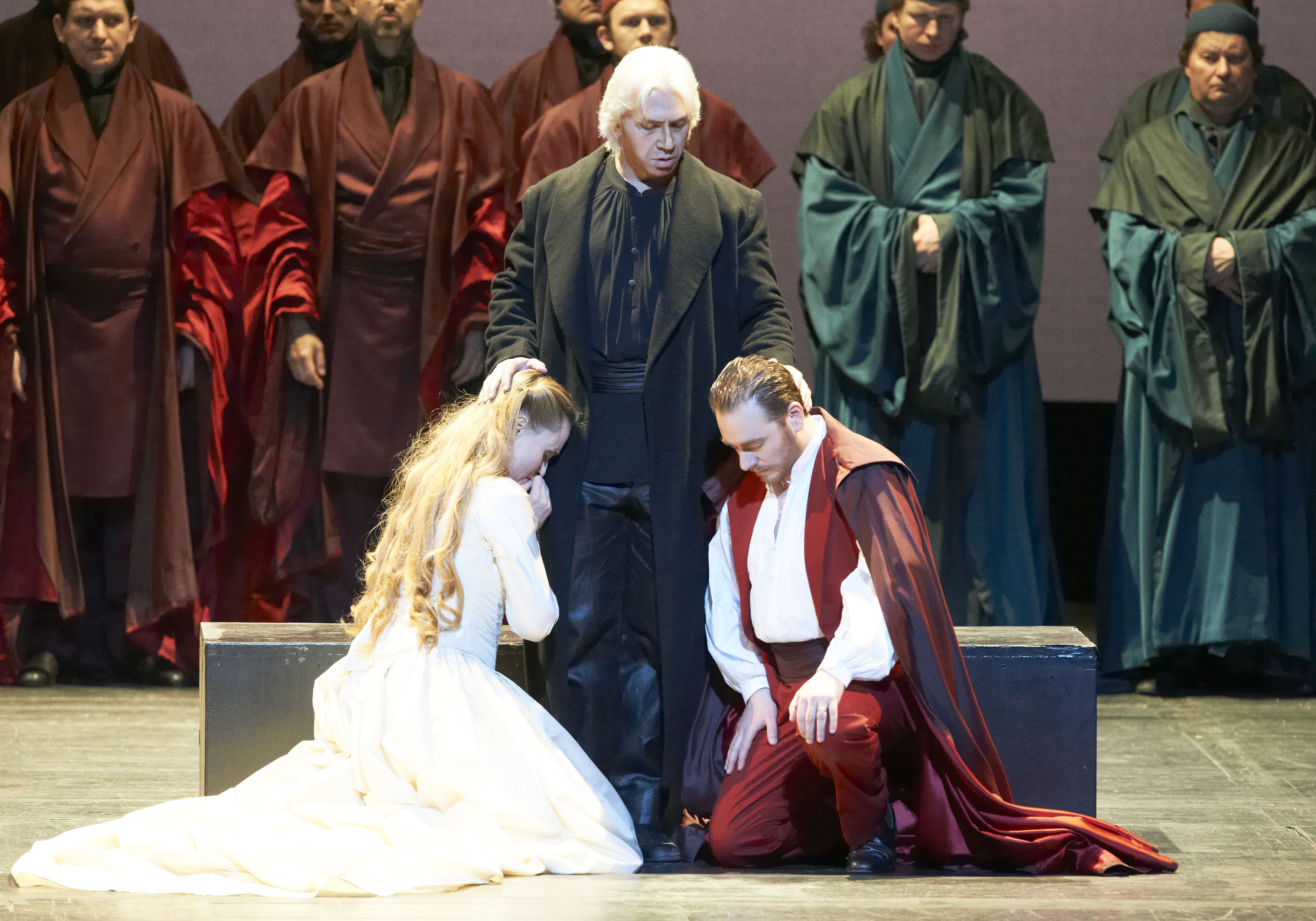 Those unfamiliar with Verdi’s Simon Boccanegra may find the plot unduly complicated. The Corsair Simon Boccanegra, elected Doge of Genoa, hopes to marry Fiesco’s daughter Maria who bears his child. But Maria dies and Fiesco swears revenge, claiming his grandaughter, now mysteriously disappeared. Cut to 25 years later. Maria, ‘Amelia’ orphaned as Grimaldi, has fallen in love with Gabriele Adorno. The Doge Boccanegra intends to marry her to his henchman Paulo, not realising ‘Amelia’ is his daughter, until their chance first meeting – an operatic highlight. Revengeful Paulo abducts Amelia; jealous Gabriele plots against Boccanegra , unaware the Doge is Amelia’s father; Simon is poisoned by Paulo…
The political intrigues to Simon Boccanegra may seem irrelevant, mere spice to the plot. Except that the patchwork of feuding nation states- the background to Verdi’s operas- describes ‘Italy’ before unification in 1863. And Verdi identified with the Risorgimento; and his tuneful choruses, as the Prisoners’ march in Nabucco, were adopted as its anthems. The dying Simon Boccanegra exclaims ‘Let my grave be be an altar to the peace of Italy’. Simon has to be sacrificed to enable a new beginning to be inaugurated (under Adorno.) The Old Order has to be swept away- tainted with enmity, mistrust , the crimes of its rival parties.
The themes of forgiveness and reconciliation underly the opera, especially between Simon and the embittered Fiesco . Fiesco stalks the opera. He disappears after the Prologue , reappears later under another name, only to resurface at the end. Fiesco, Verdi’s jealous (Rigoletto) father role intransigently opposes Boccanegra’s marriage to Maria.
Also there are generational tensions. Some of the opera’s most powerful scenes deal with Gabriele’s raging jealousy of Simon, unwittingly suspecting older man and Doge of desiring and abusing Amelia. But in the closure Simon blesses his daughter’s marriage to Adorno. And Simon and Fiesco, ‘the father of Maria’, finally embrace tearfully. Symbolically, Fiesco, now the ‘messenger of peace’, gives his blessing to Amelia’s marriage to Adorno. So the opera, superficially, is defined by intrigues and strife, but its greatest scenes are full of humanity, its characters sympathetically drawn.
The highlights of this outstanding Vienna State Opera production were in the complex interaction of characters, the psychological insights revealed. So in the first confrontation of Simon Boccanegra and Fiesco, operatic titans meet head on. Dmitri Hvorostovsky as Simon was quite outstanding. As his counterweight, bass Ferruccio Furlanetto- who’s appeared with all the major opera houses since 1974- chillingly authorative.
Simon, in his opening scene agrees to be Doge- hitherto prevented – to win over Maria. Furlanetto, Verdi’s inconsolable father, echoes the depths of the ‘tormented spirit, who must suffer shame and grief’. In death ‘the merciful heavens have awarded Maria a martyr’s crown’. Fiesco thinks Simon has come to torment him. The irony is that Simon wanted to make ammends to Maria, ‘the innocent victim of his happy love’. But too late! she’s dead. Simon seeks peace. Fiesco’s replies, ‘there can be no peace until one of us is dead’. Thus, in the tragedy, the unrelenting Fiesco’s curse casts a shadow over the entire work.
In Verdi’s dramatic masterstroke, Simon finally confront the terrible truth, a palace in darkness. Fiesco, dagger raised, is poised for revenge. But the crowds rush in, lifting Simon shoulder high proclaiming him Doge. ‘Long live Simon , elected by the people!’
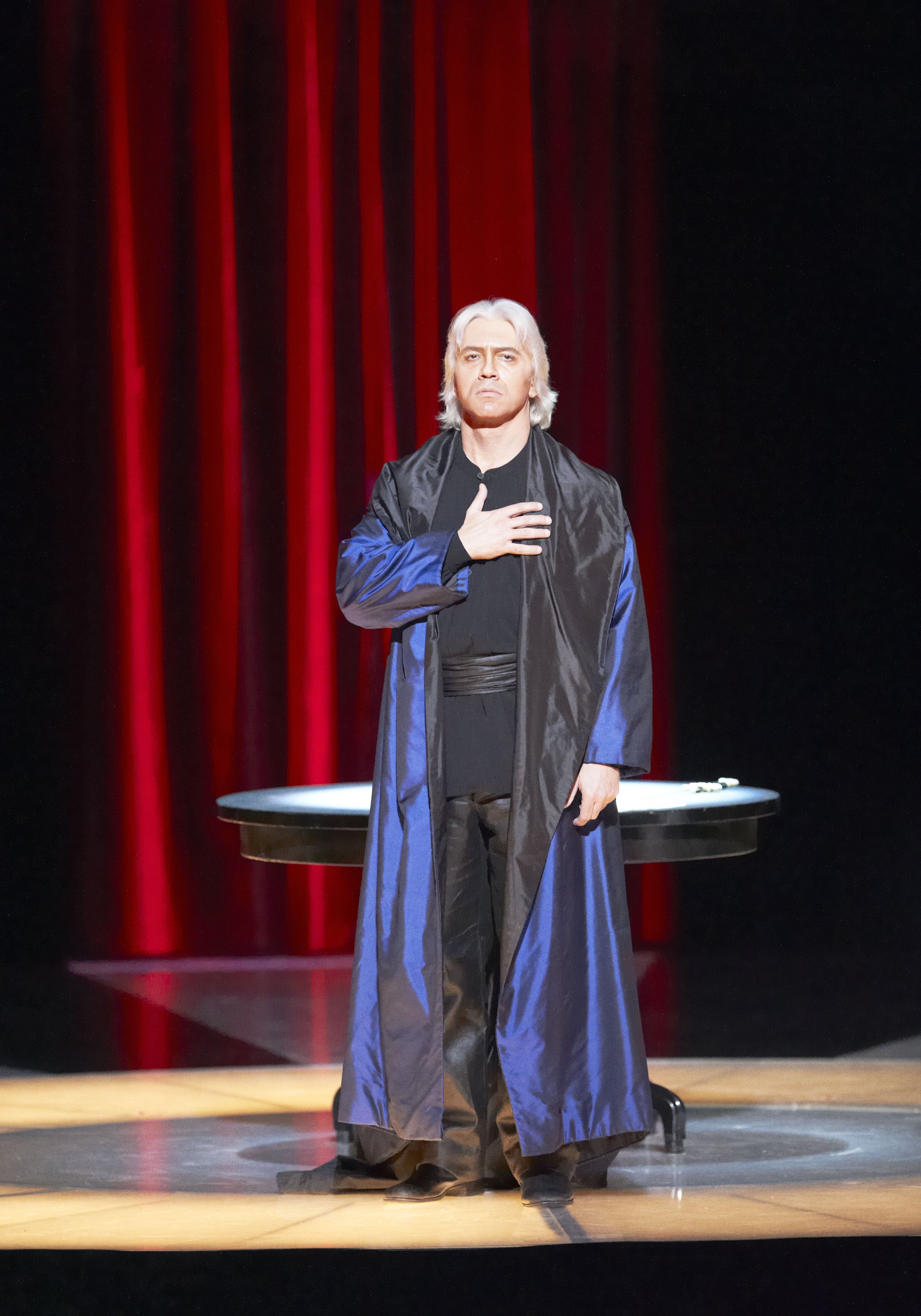 Hvorostovsky enacts a moving study of Doge corroded by power. ‘Even water tastes bitter to the lips of a sovereign’-ironically drinking the poison chalice.’How heavy my heart is; how my limbs ache’. The sea offers him solace; dying, the sight of it reminds him of glory and fame.
Hvorostovsky’s Simon, white haired, majestic, deep timbred baritone, is contrasted to the youthful tenor Francesco Meli: virtuoso tenor against steadfast baritone. The impulsiveness of Gabriele- reflected by the glamour of the tenor- must be brought to order. Meli’s Gabriele was the other ‘matinee idol’. His Act 2 lament pleads merciful heaven to have pity on his suffering. He weeps, and begs on his knees. Meli’s rich, light tenor seems at times to croon; there are momentary woops in the voice. There was huge applause.
Amelia (Maria Poplavskaya)- new to me , not to ROH, the Met, Berlin, Zurich- is a superb soprano. She first appears, to pizzicato strings and horn accompaniment: day is breaking, and she hasn’t seen her beloved yet. In her (Act 1) Aria, ‘a heart without love is a heaven without joy’. Poplavskaya, a beautiful blonde with long tresses, is dressed in a white satin gown, In their Act 1 duet she’s described by Gabriele as ‘an angel come down from paradise’. But Amelia is shrouded in mystery. In Act 2, now in a scarlet gown to suggest her ambiguous virtue (to Gabriele), she begs Gabriele to keep her secret for a little longer: to banish fears from his heart.
Amelia is the agent of goodness and conciliation in the opera. In the ‘reunion’ between father and daughter, she promises ‘in sad times she will dry his tears; together they will enjoy supreme happiness’. Audience, moved to tears by Hvorostovky and Maria, fumbled discreetly for handkerchiefs.
The set pieces and crowd scenes are spectacular. In reconstruction of Doge’s palace, Simon (Act 1) in white robes sits isolated on Doge’s throne: overlooking opposing red and green ranks of councellors. At the moment (Prologue) when Fiesco draws his sword, the crowd rush the stage in support of their new Doge. The mood changes from high drama to street celebration and carnival. Vienna State Opera Chorus were thrilling.
Simon Boccanegra, though not as popular as Rigoletto , Traviata, and Aida , is considered by opera buffs Verdi’s most beautiful, (as in its lyrical orchestral opening.) Vienna State Opera orchestra, conducted by Paulo Carignani, were outstanding and authentic. Carignani has been conducting Vienna Opera since 1997. The handsome sets were traditional – elaborate panels side stage, white screen backstage showing palace facades. Director Peter Stein’s long-running production has proved its worth.
The 2011/2012 season debuted with Placido Domingo as Boccanegra. Notwithstanding, this production could hardly have been bettered. The applause was enthusiastic. Hvorostovsky, in spite of a pre-announced cold, returned again and again to acknowledge his fans. The encores lasted for a good 15 minutes.
11.03.2012
Photos: Maria Poplavskaya (Amelia), Dmitri Hvorostovsky (Simon Boccanegra), Francesco Meli (Gabriele Adorno);
Dmitri Hvorostovsky (Simon Boccanegra)
(c) Wiener Staatsoper/ Michael Pöhn