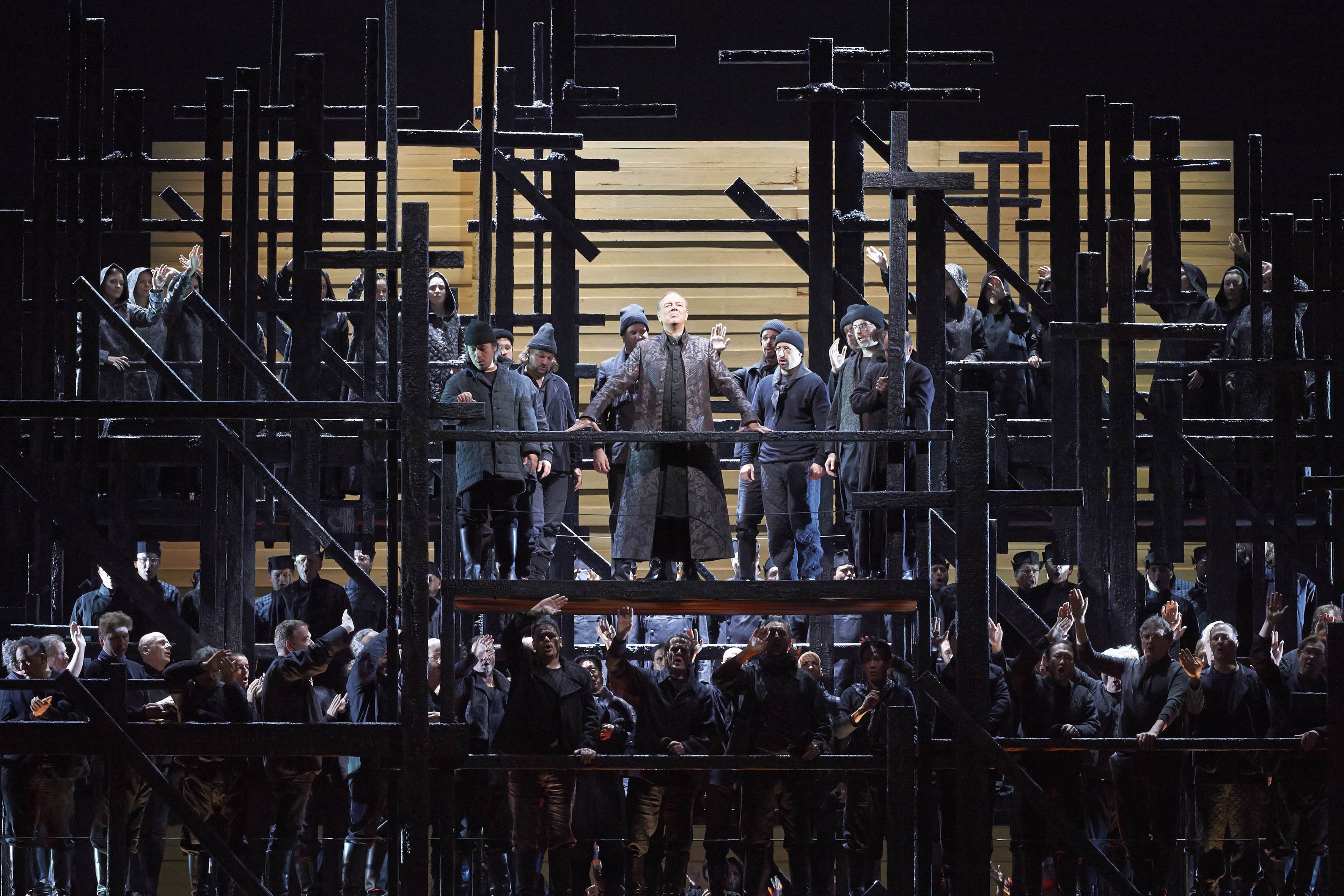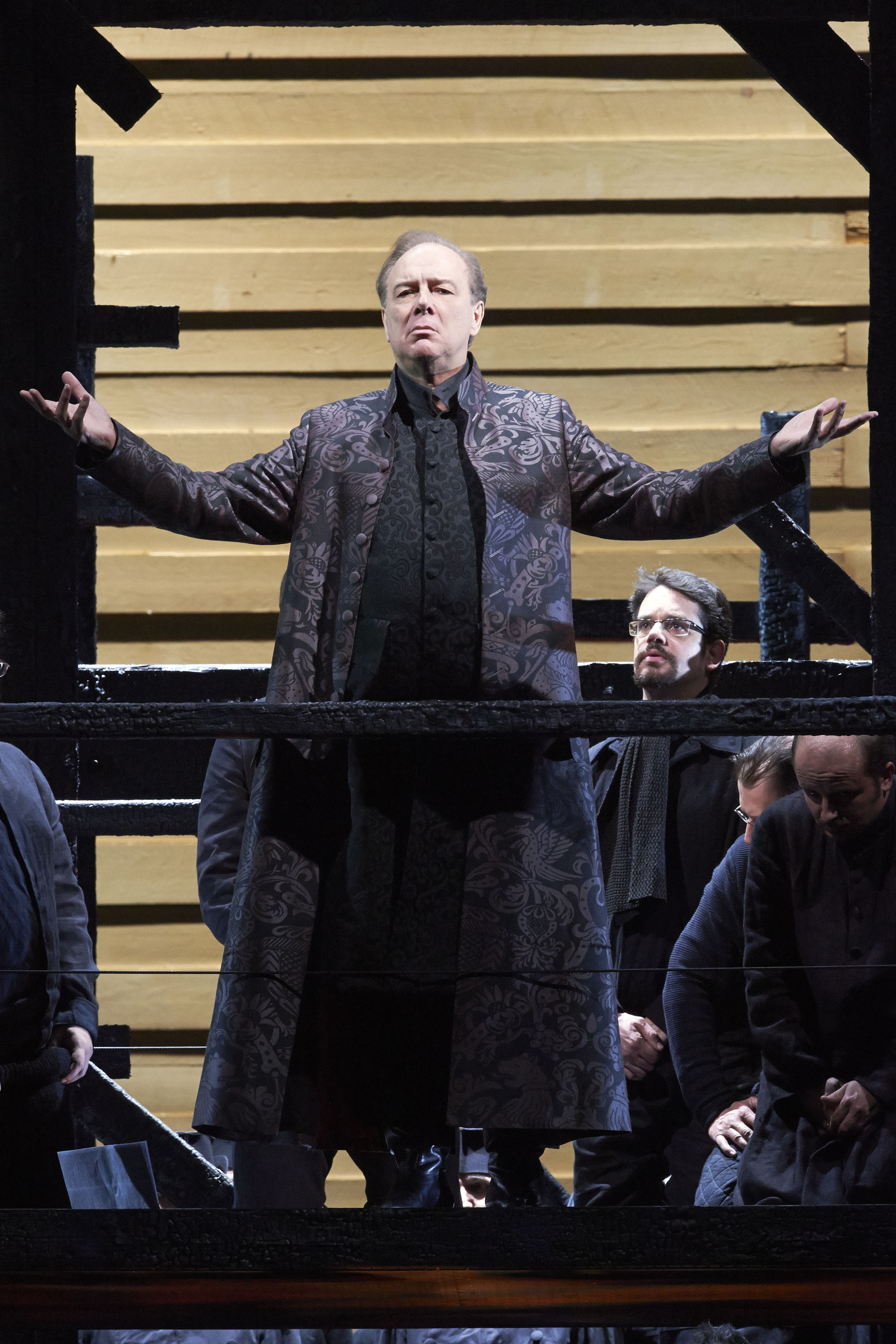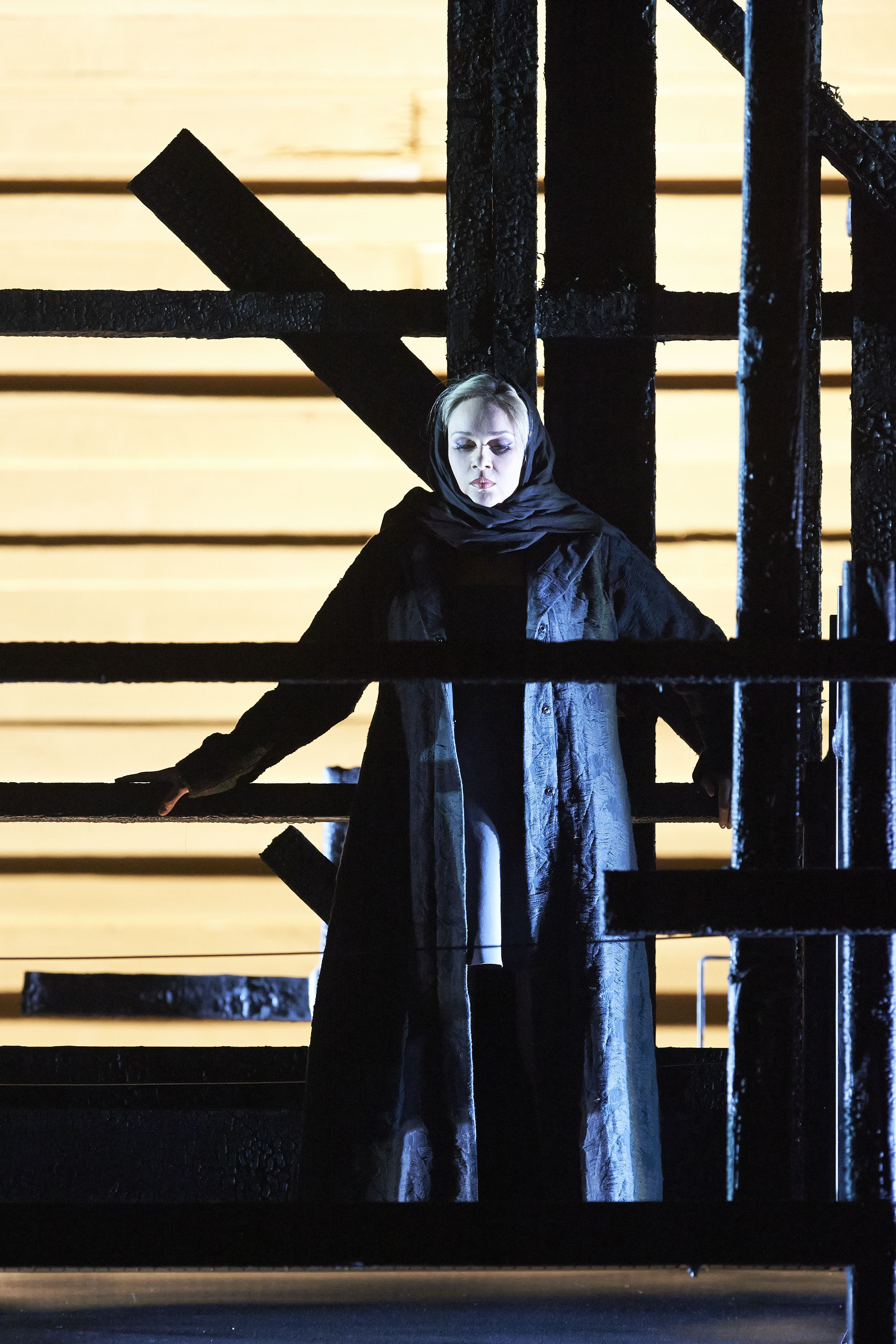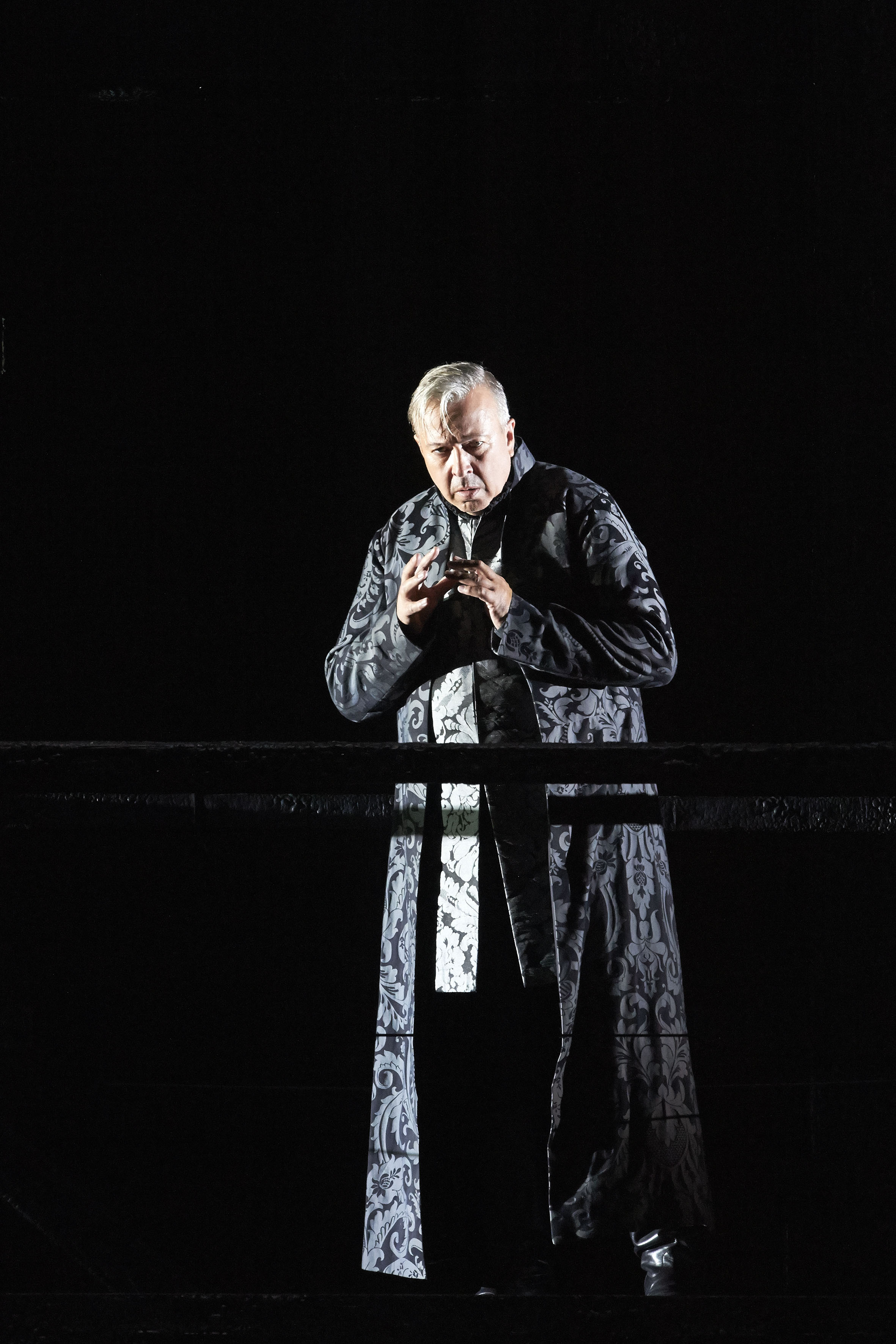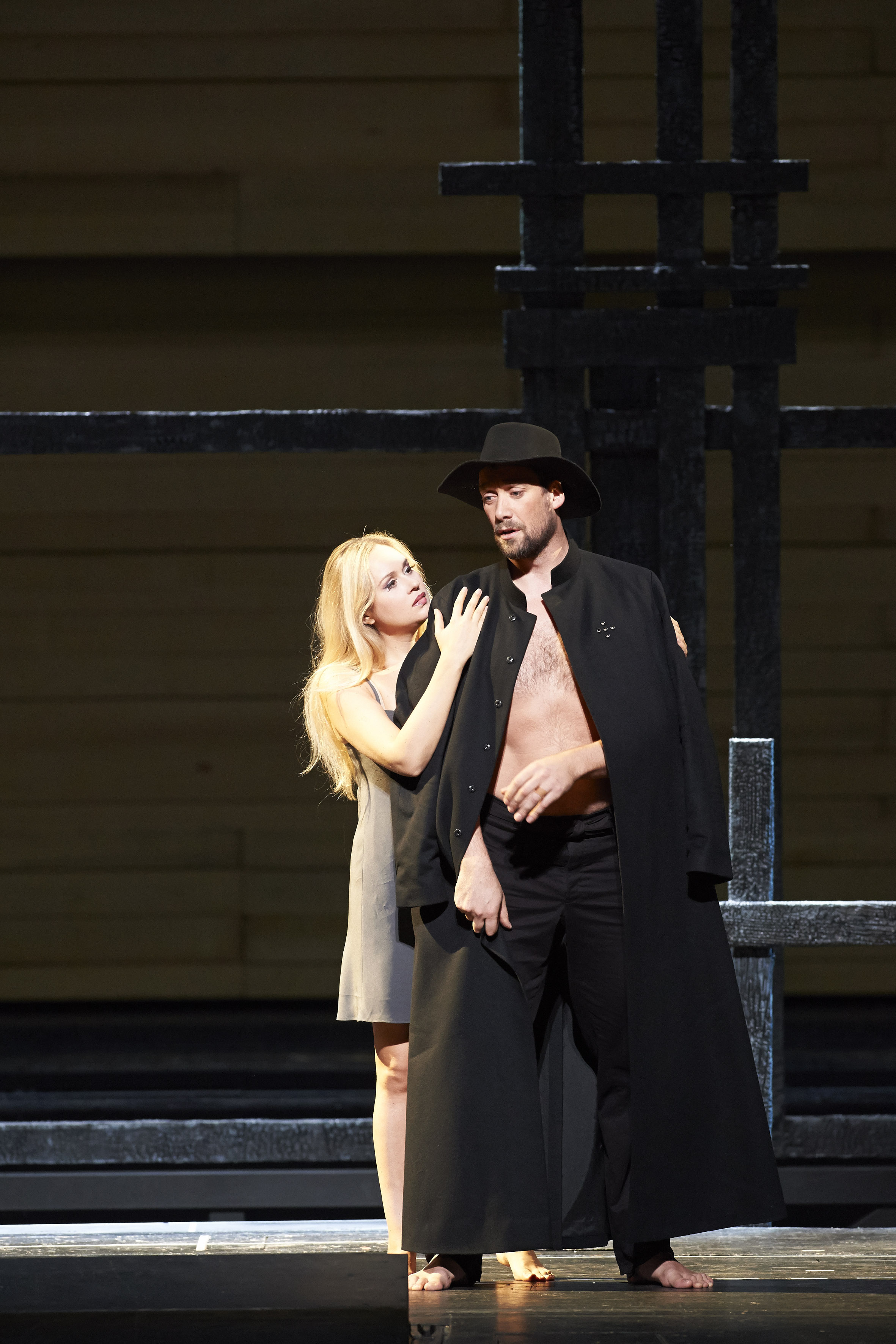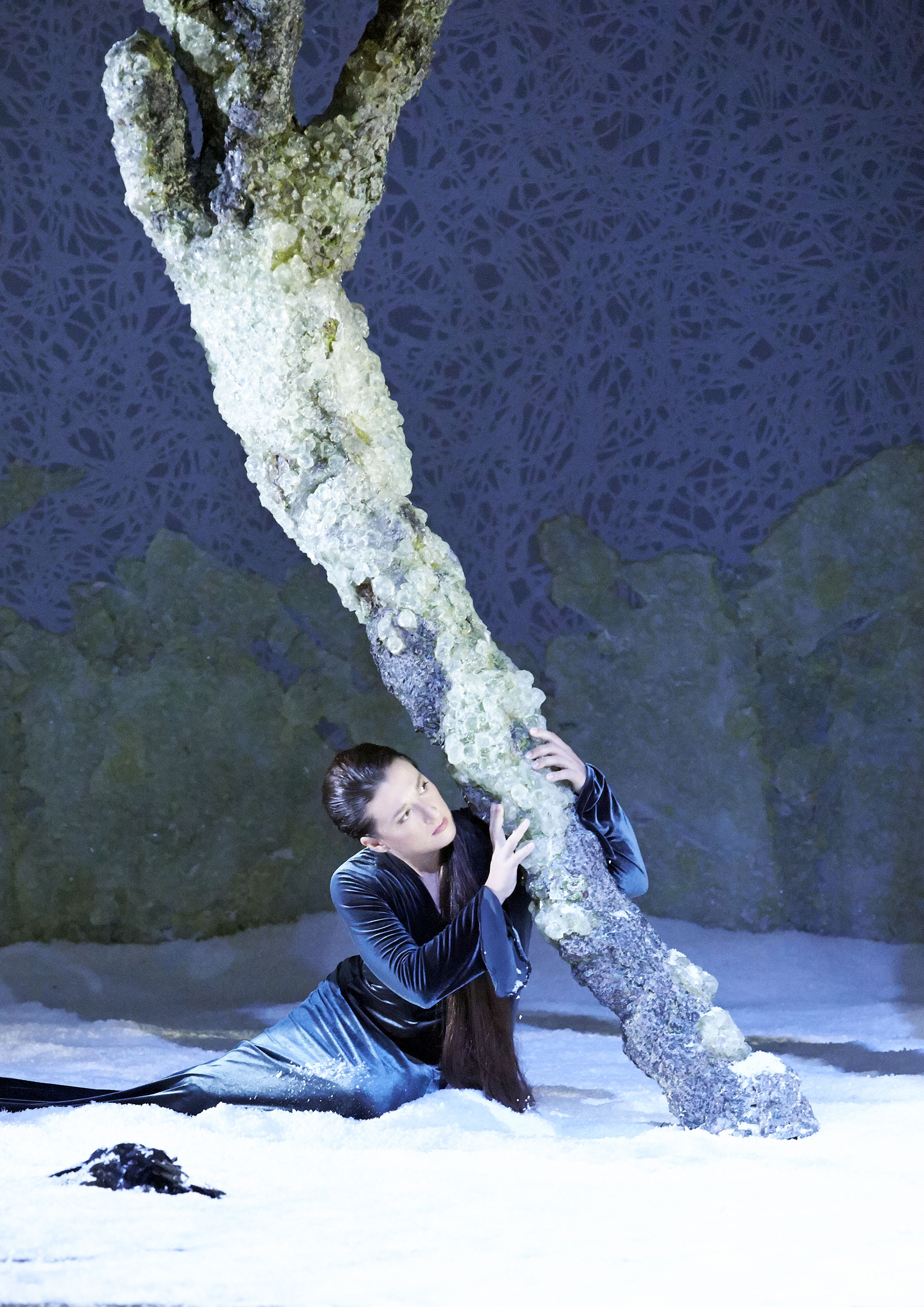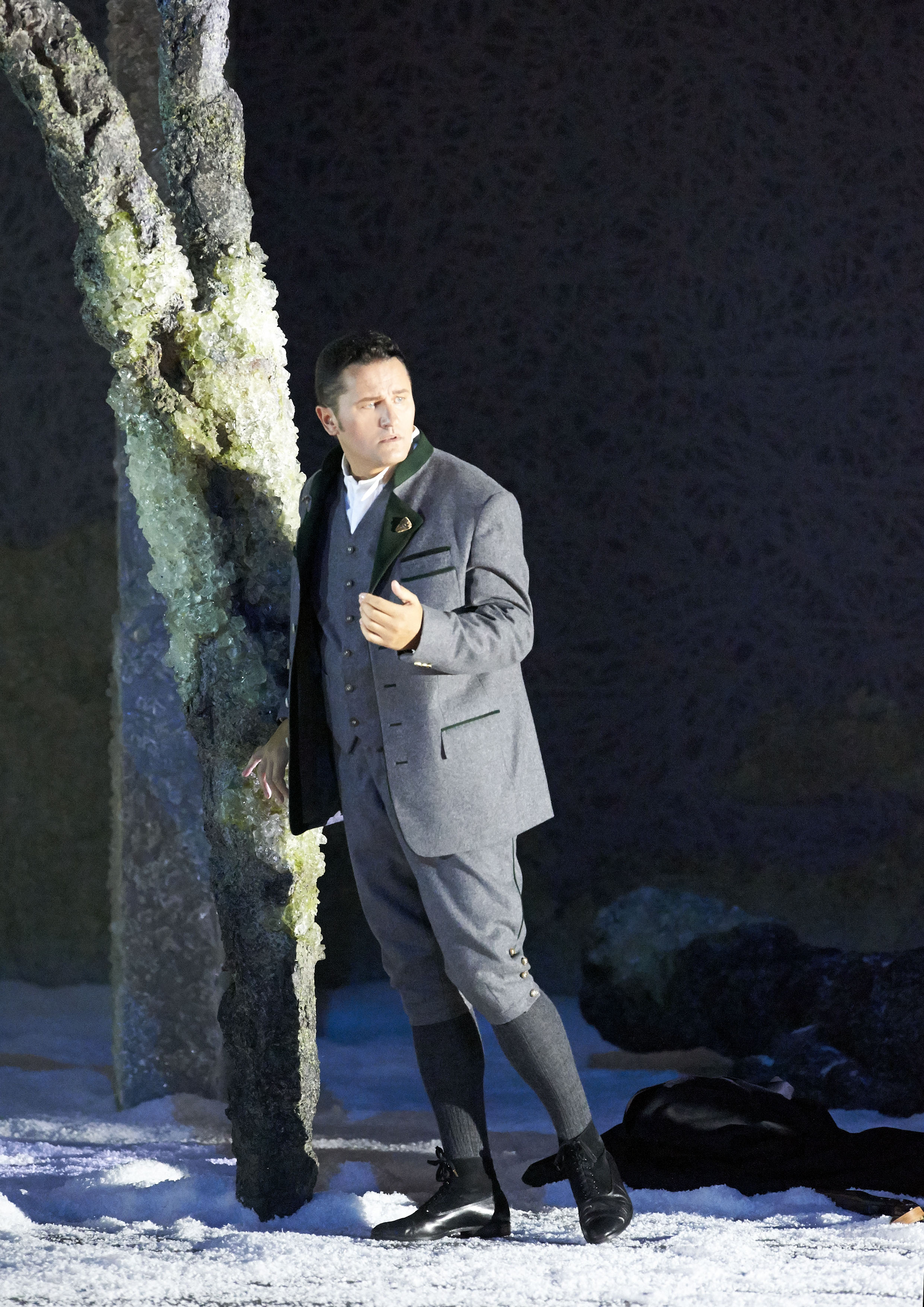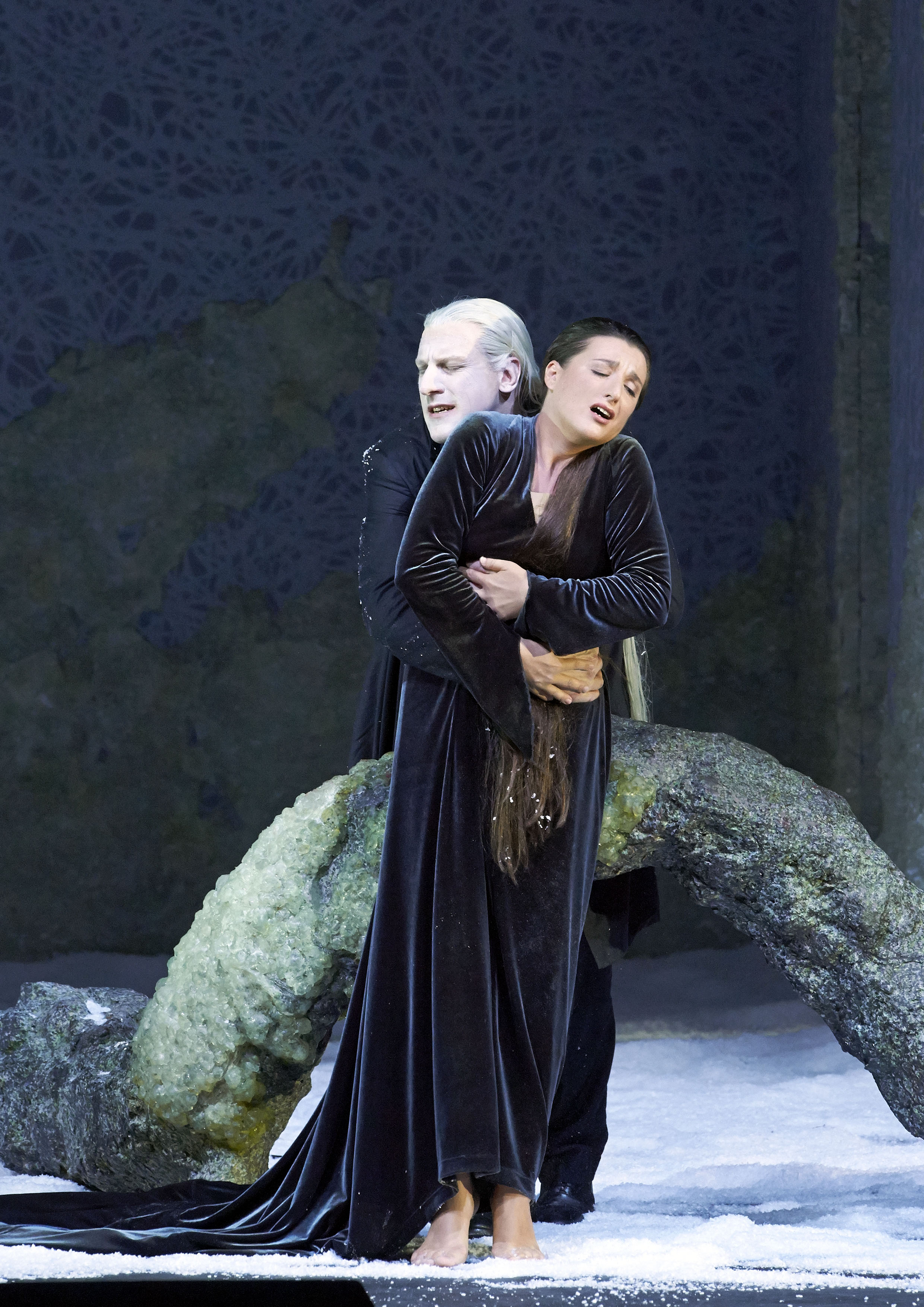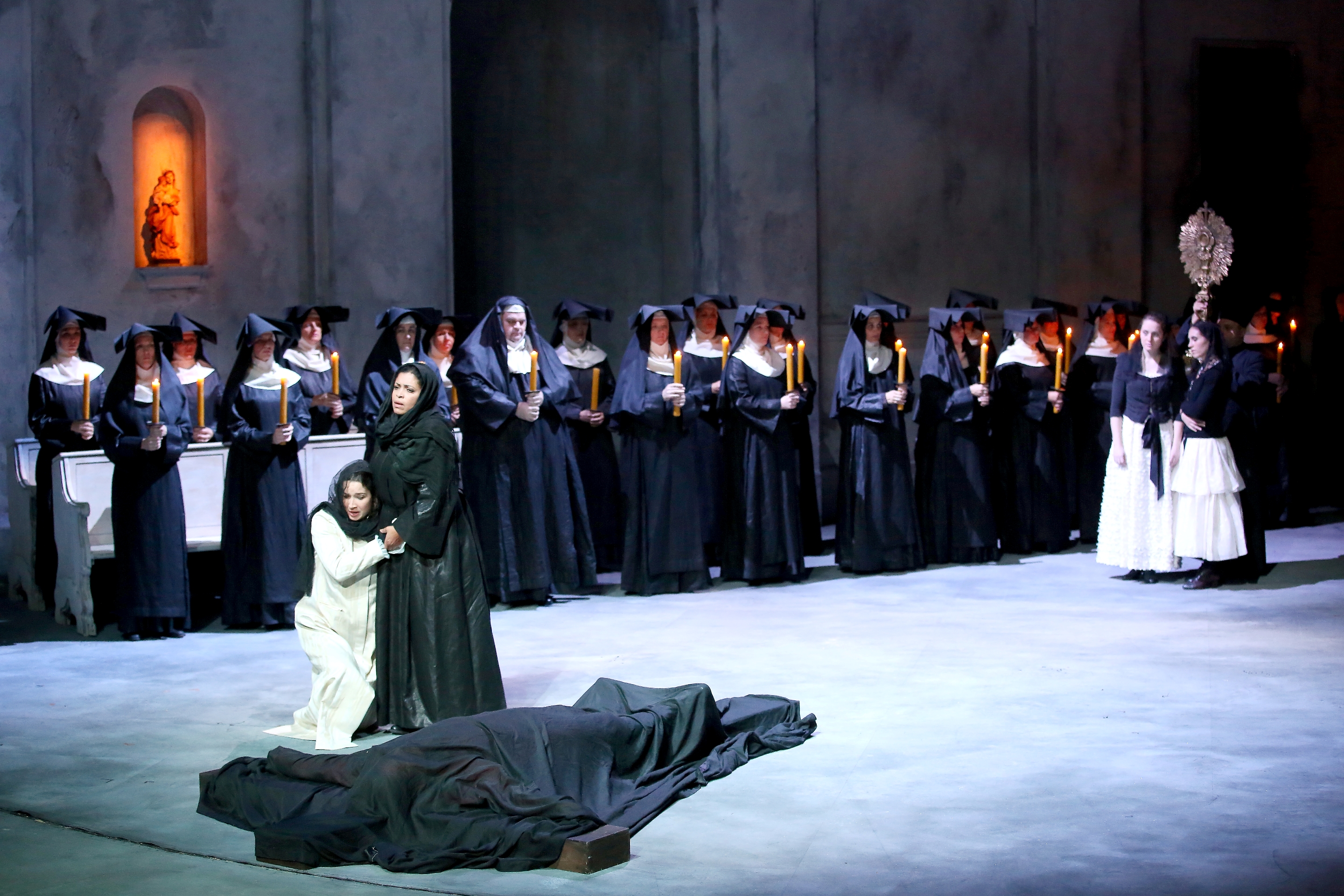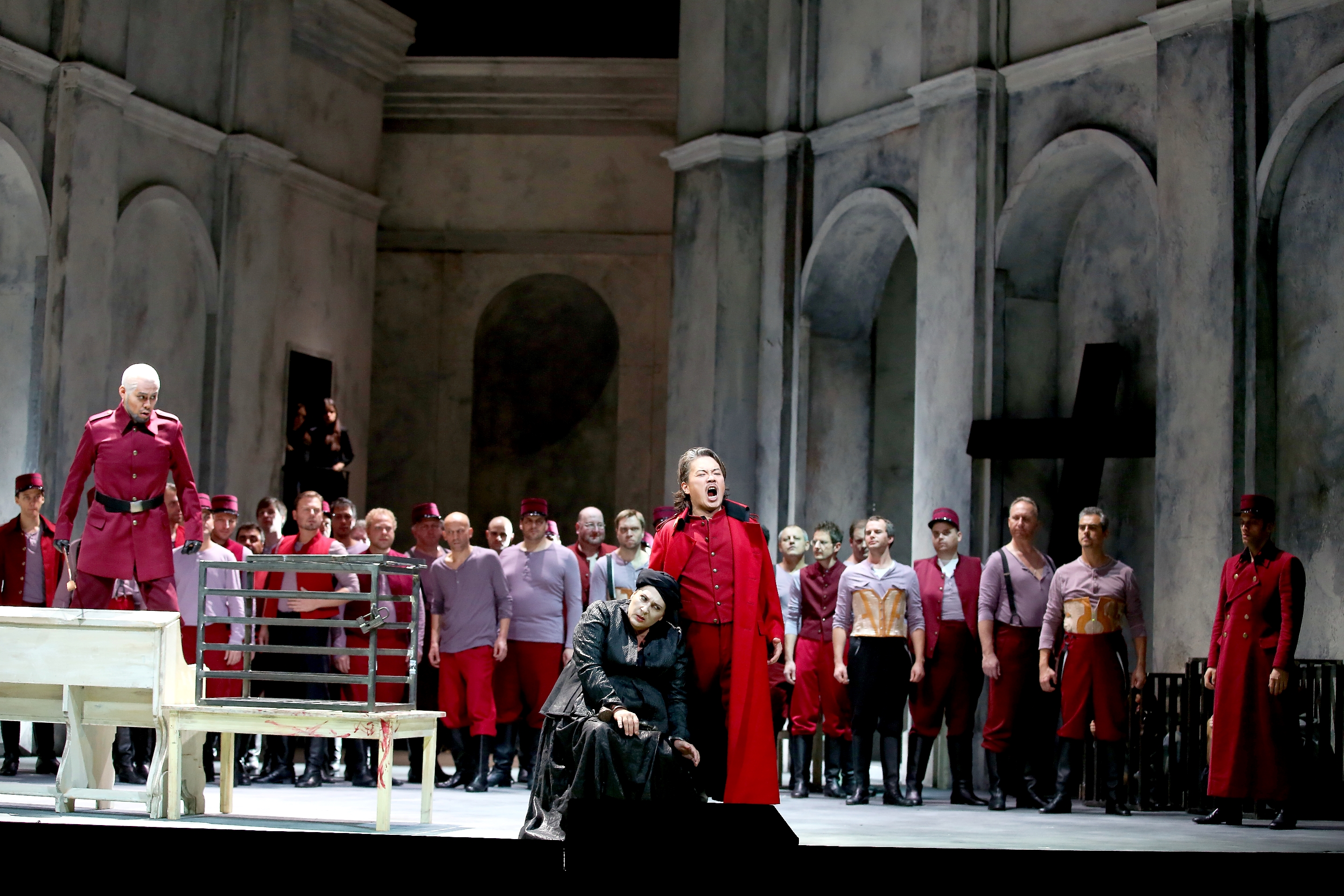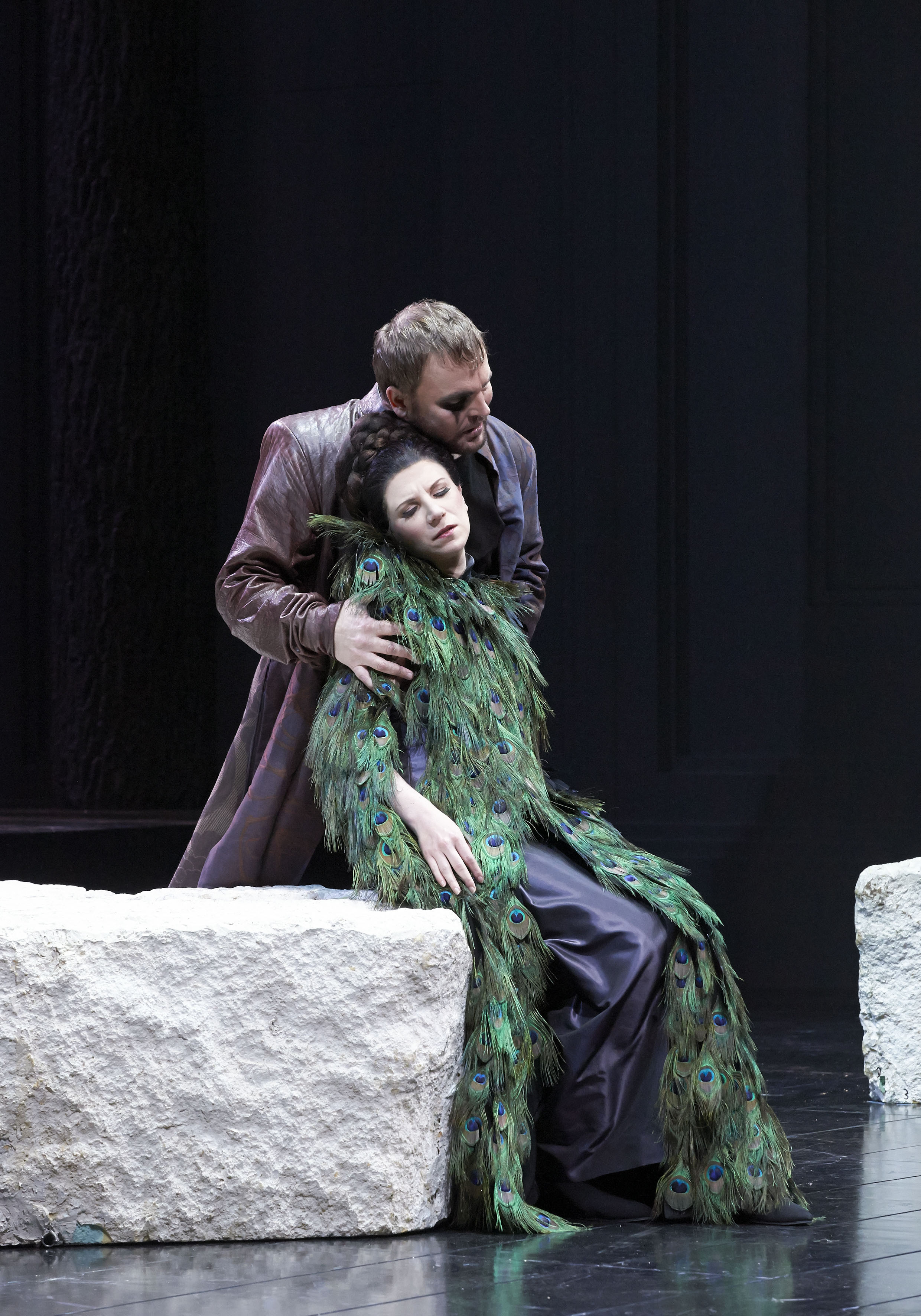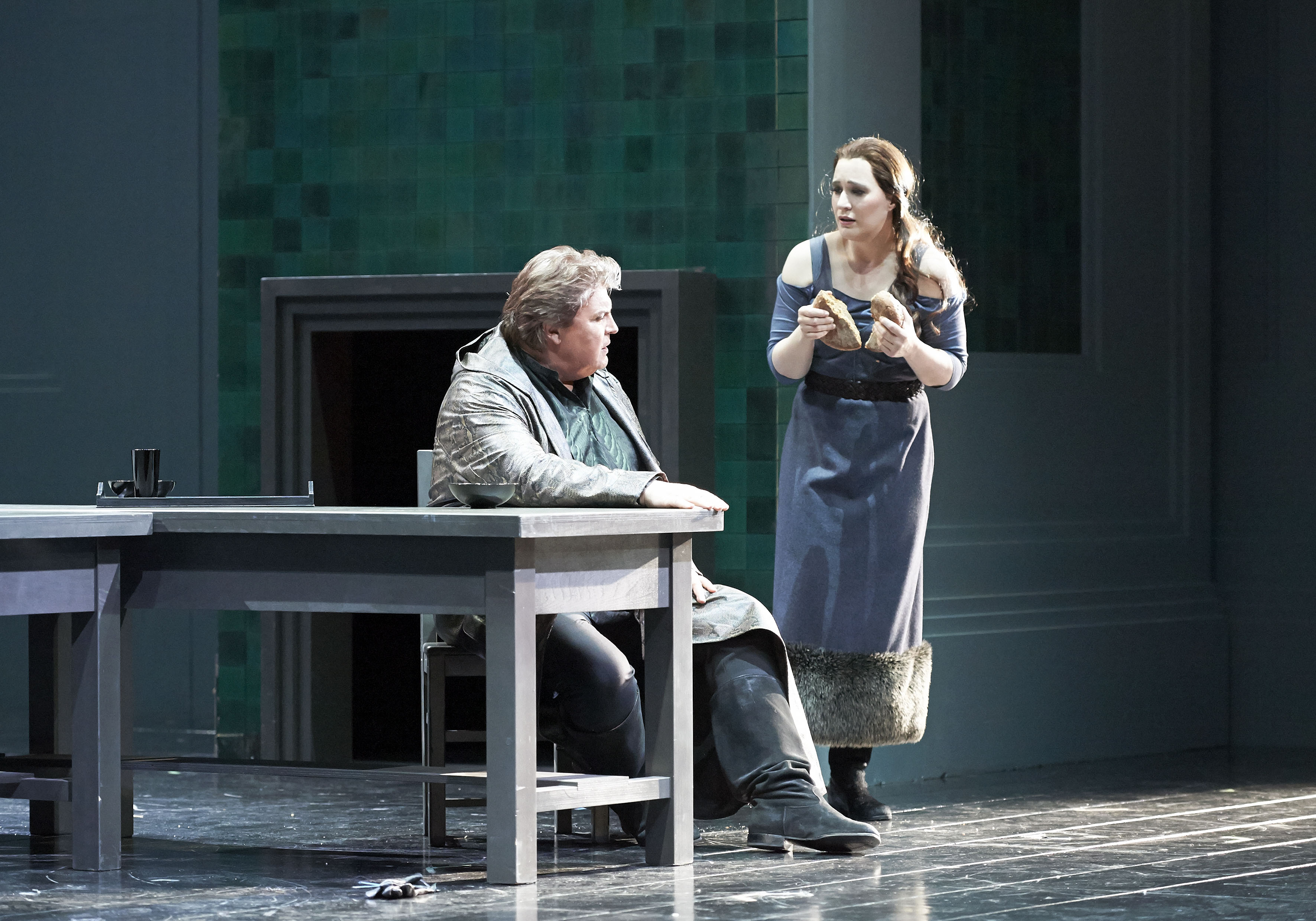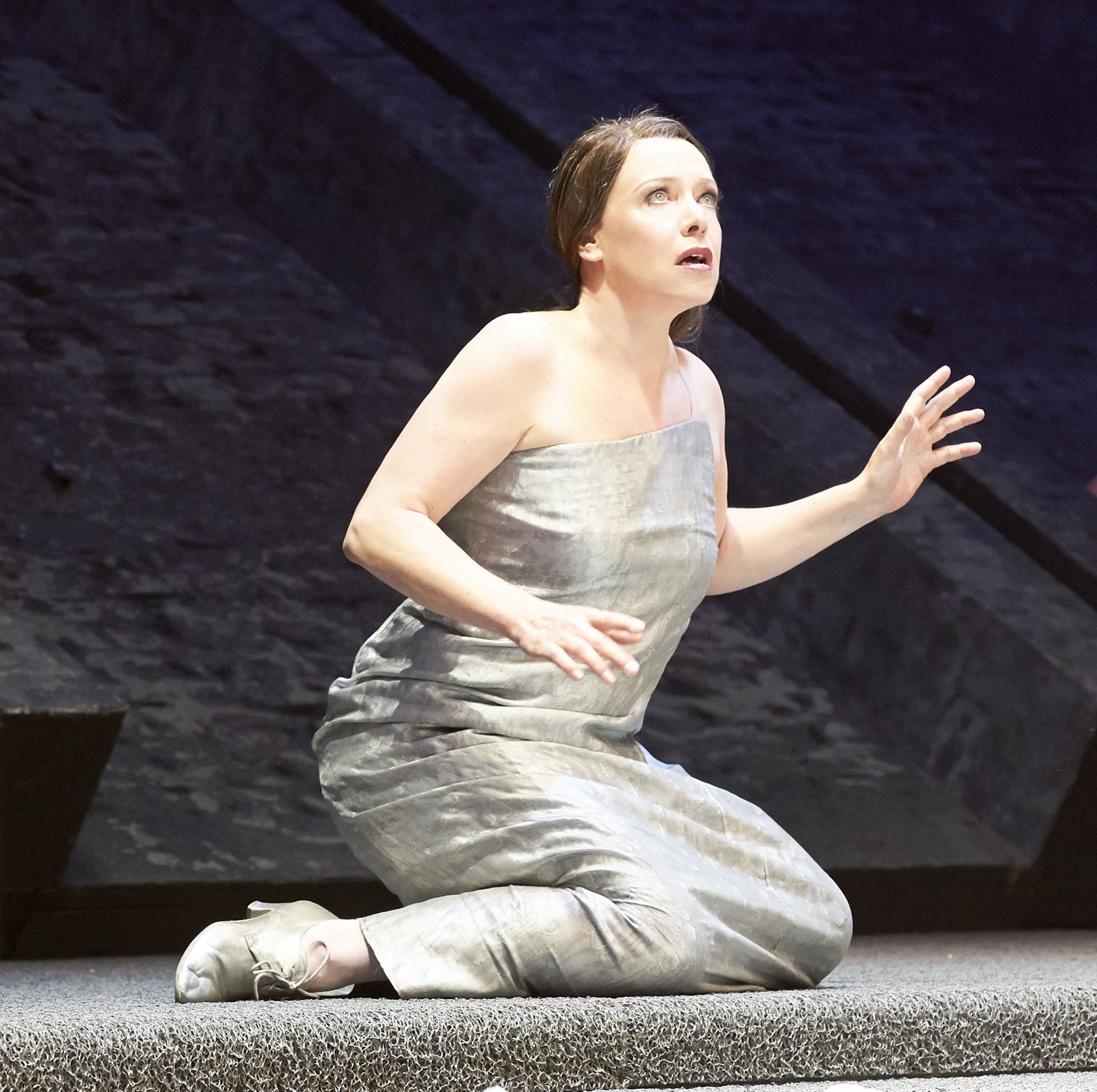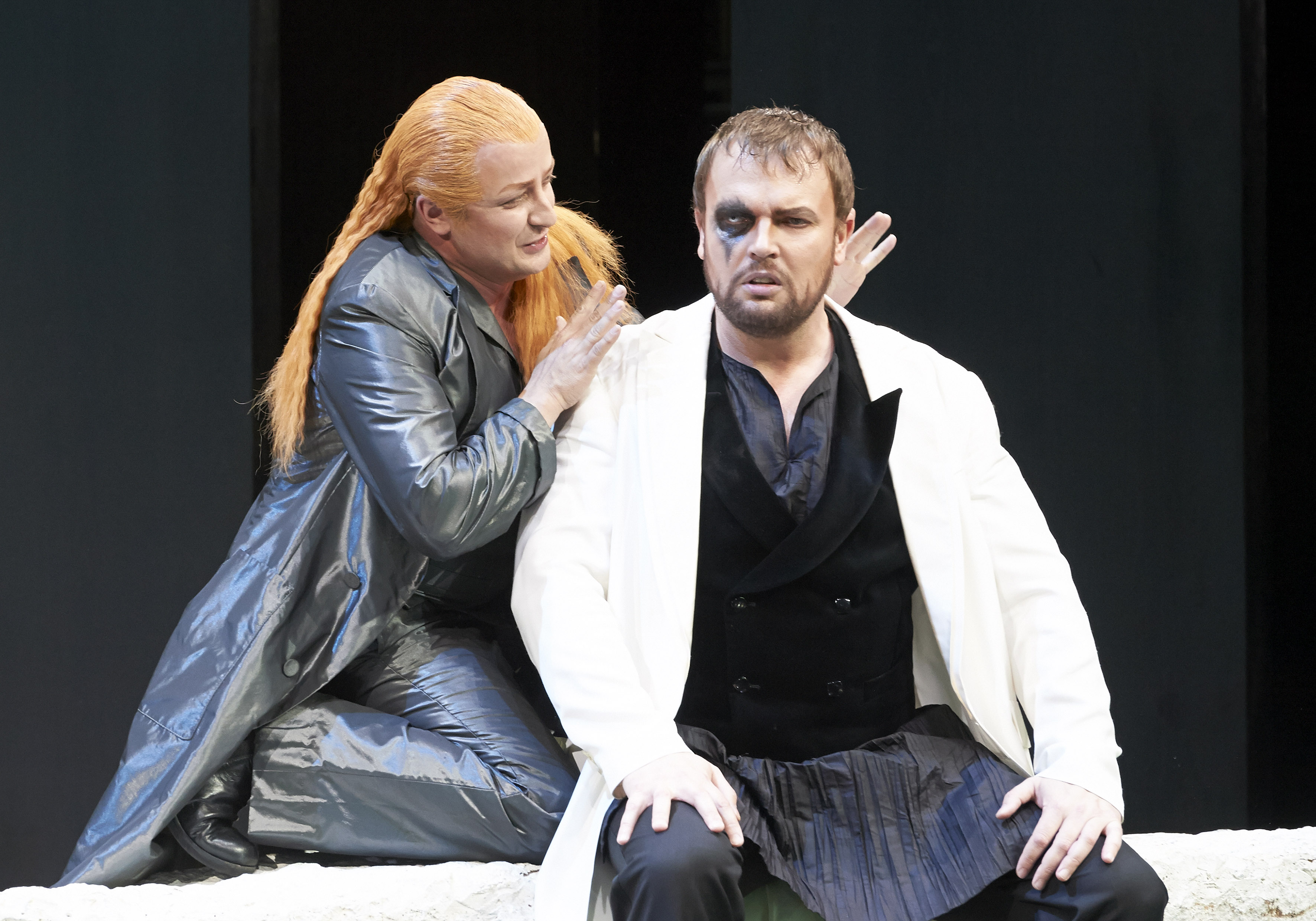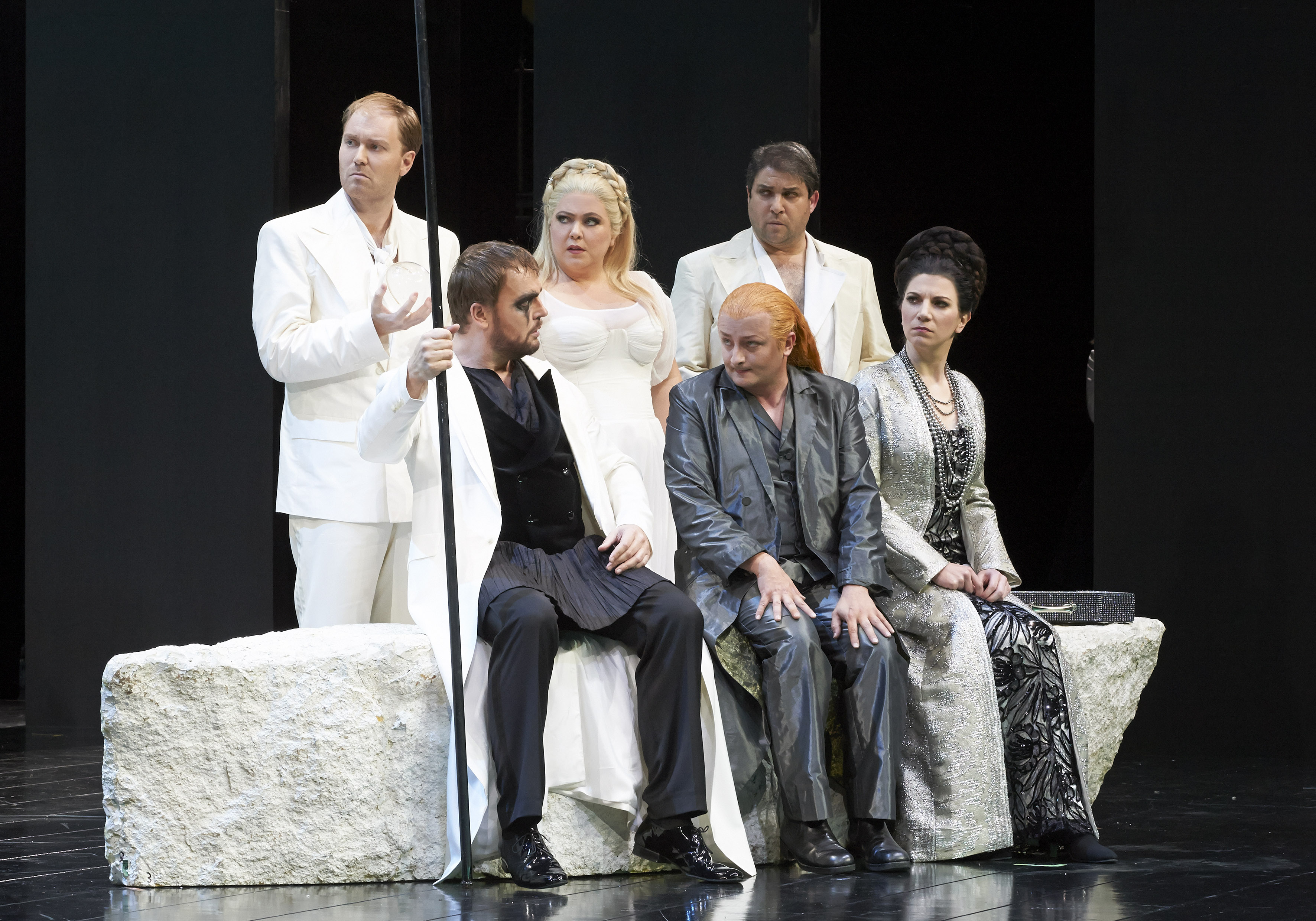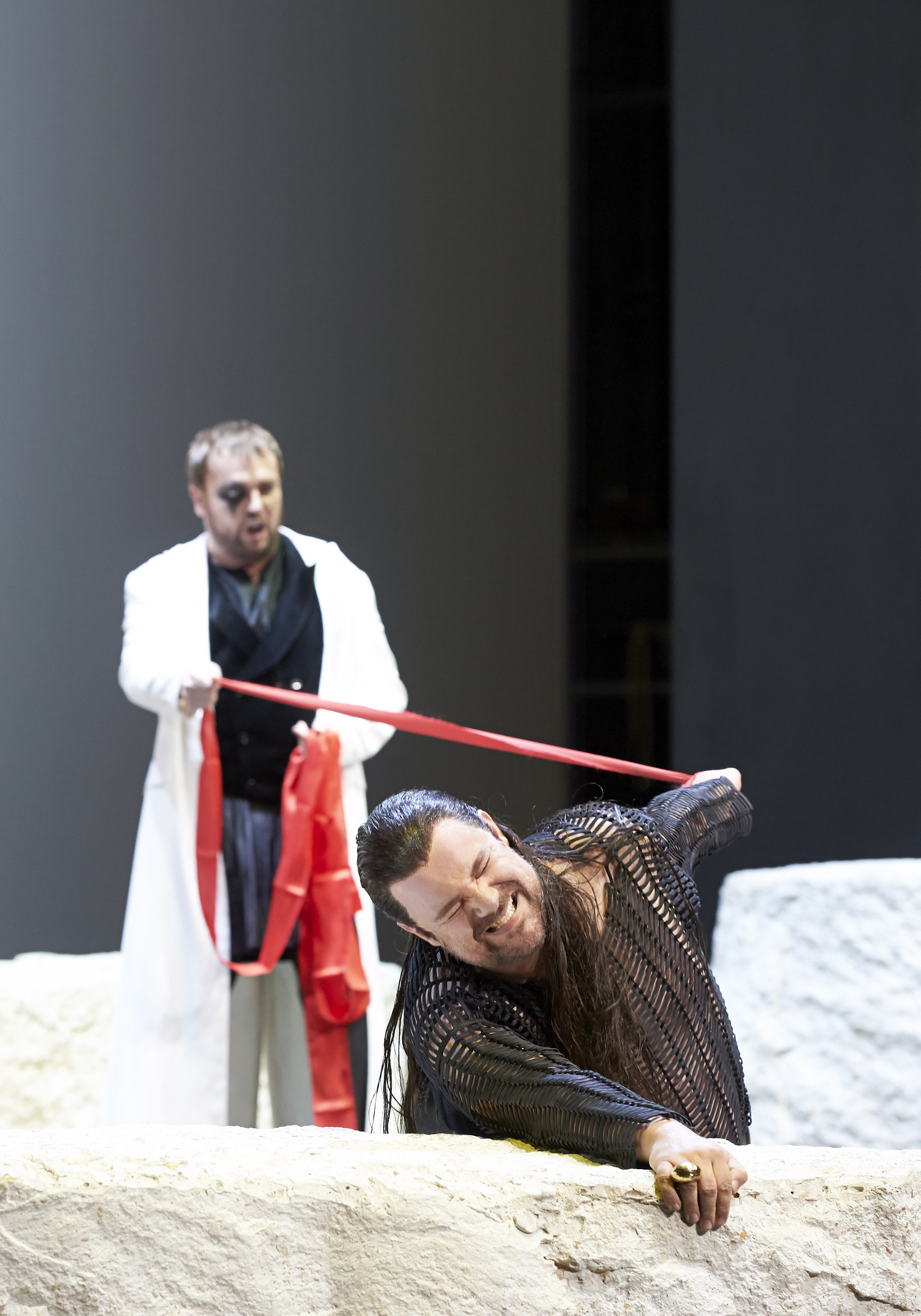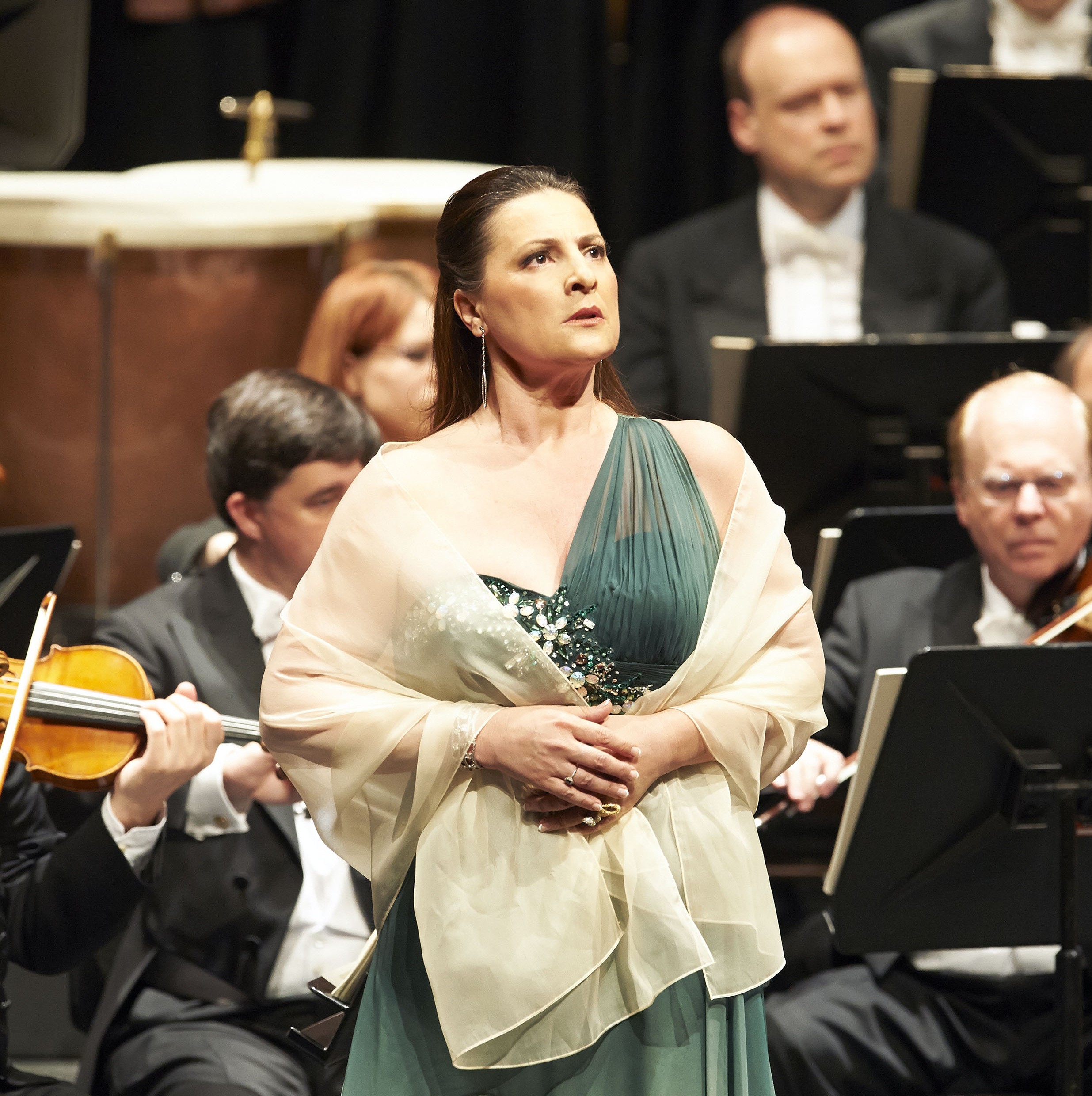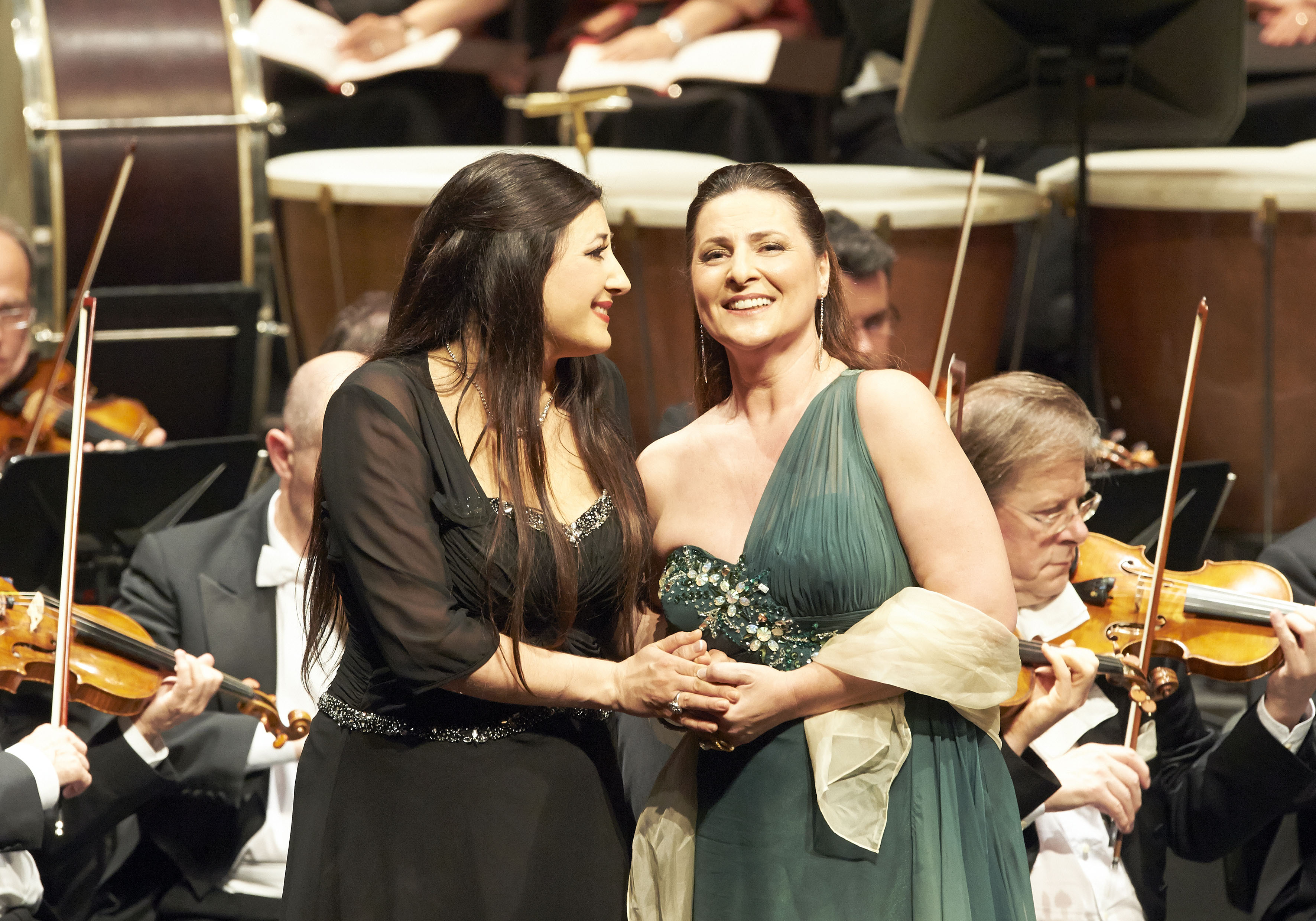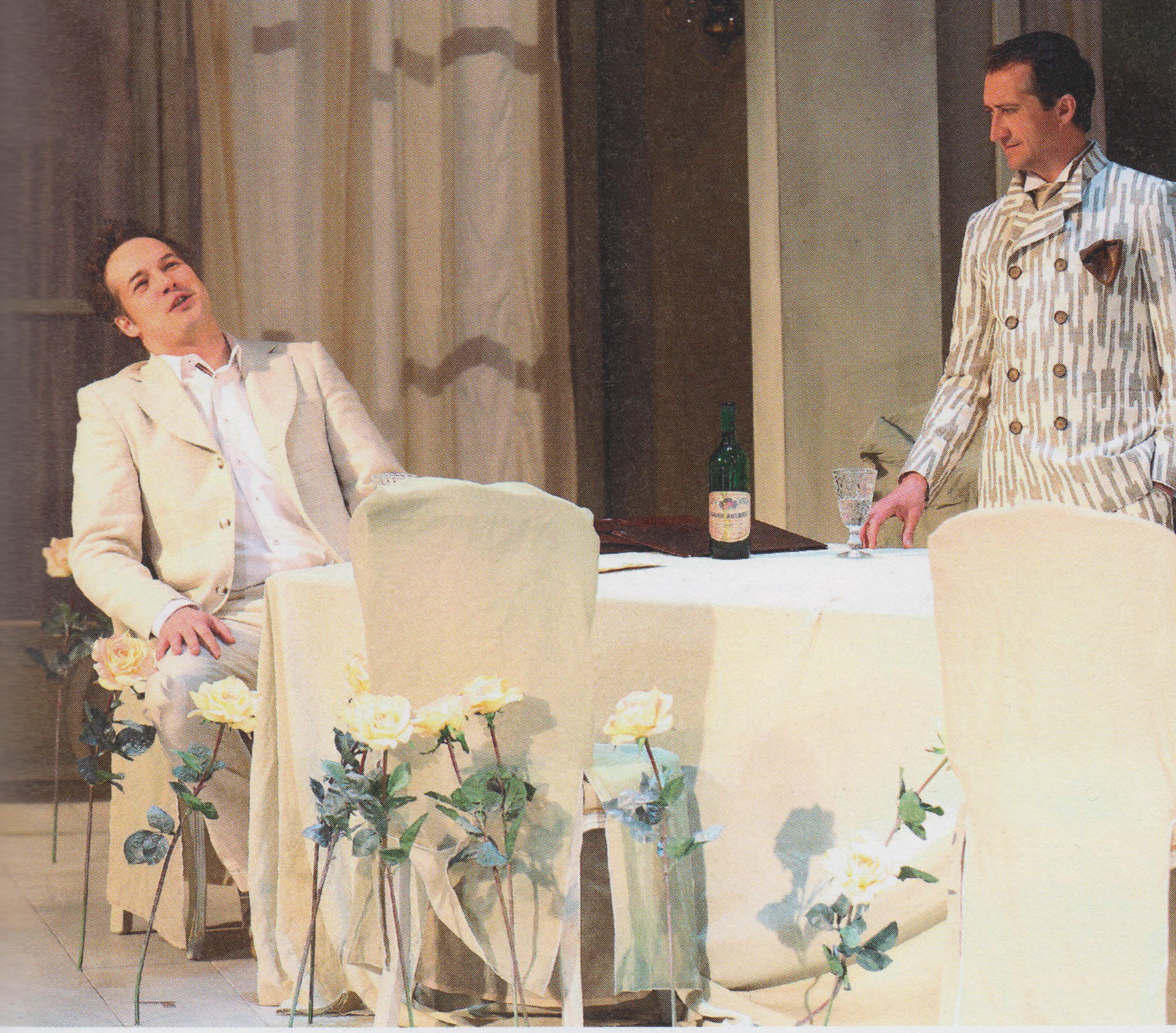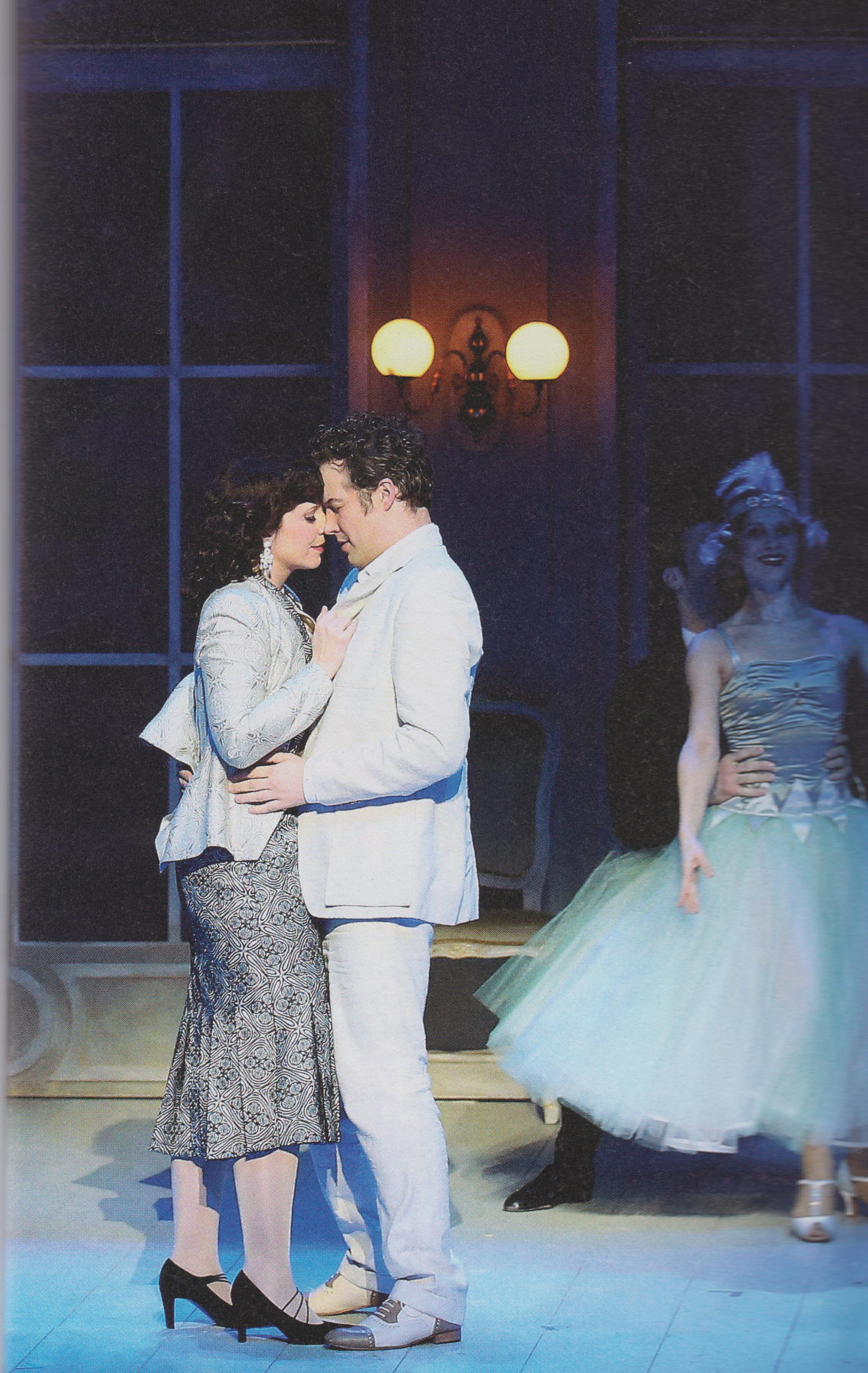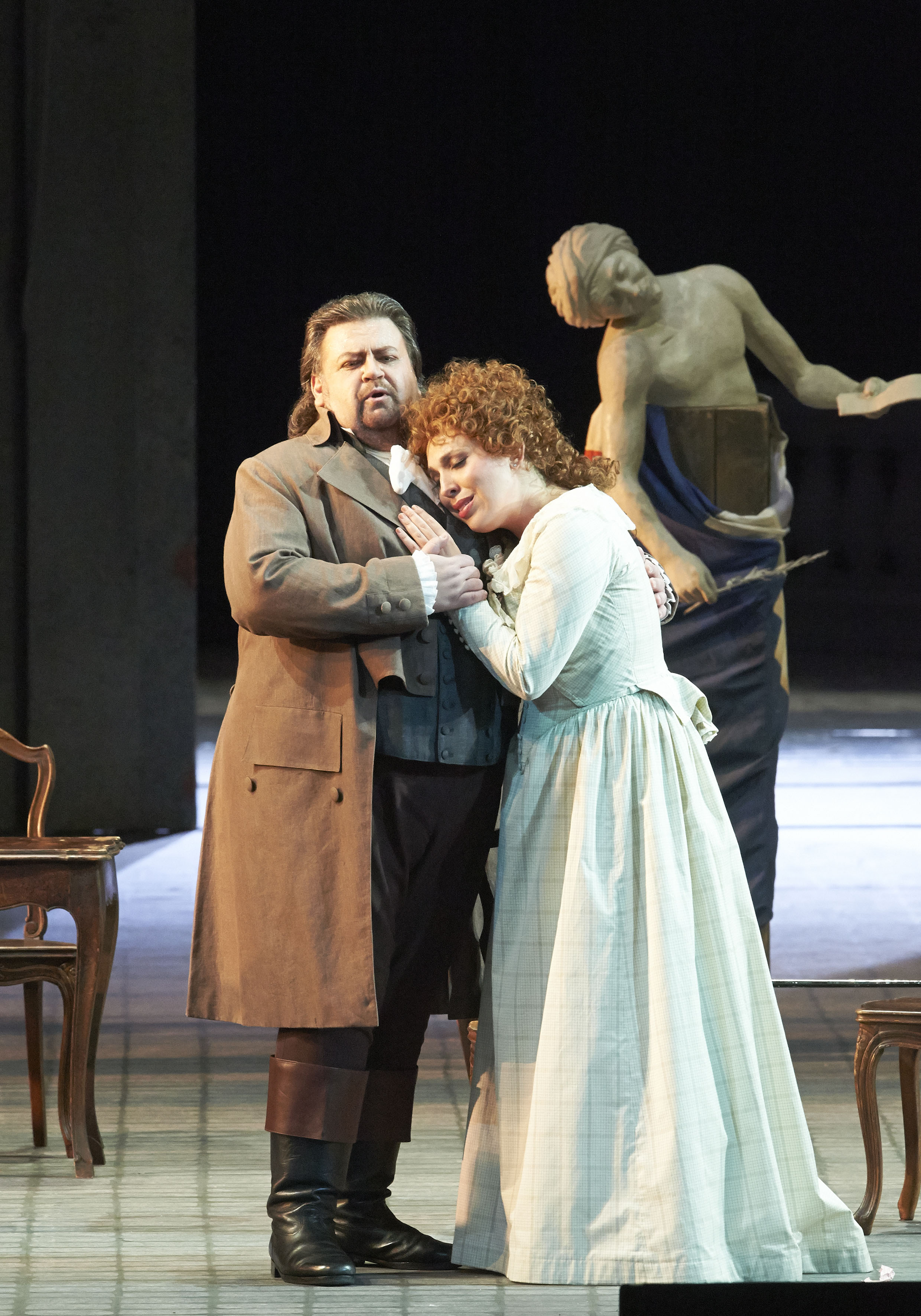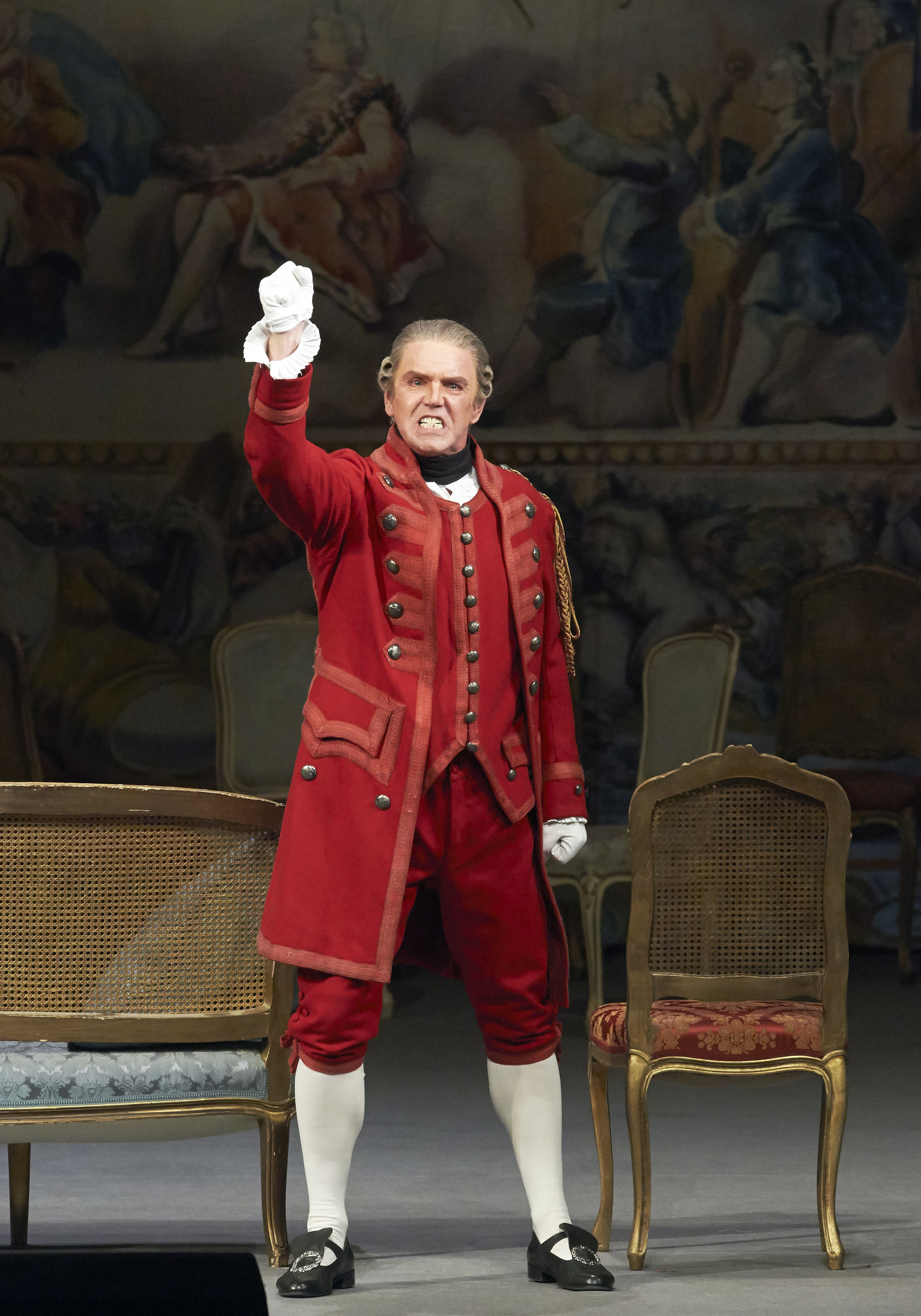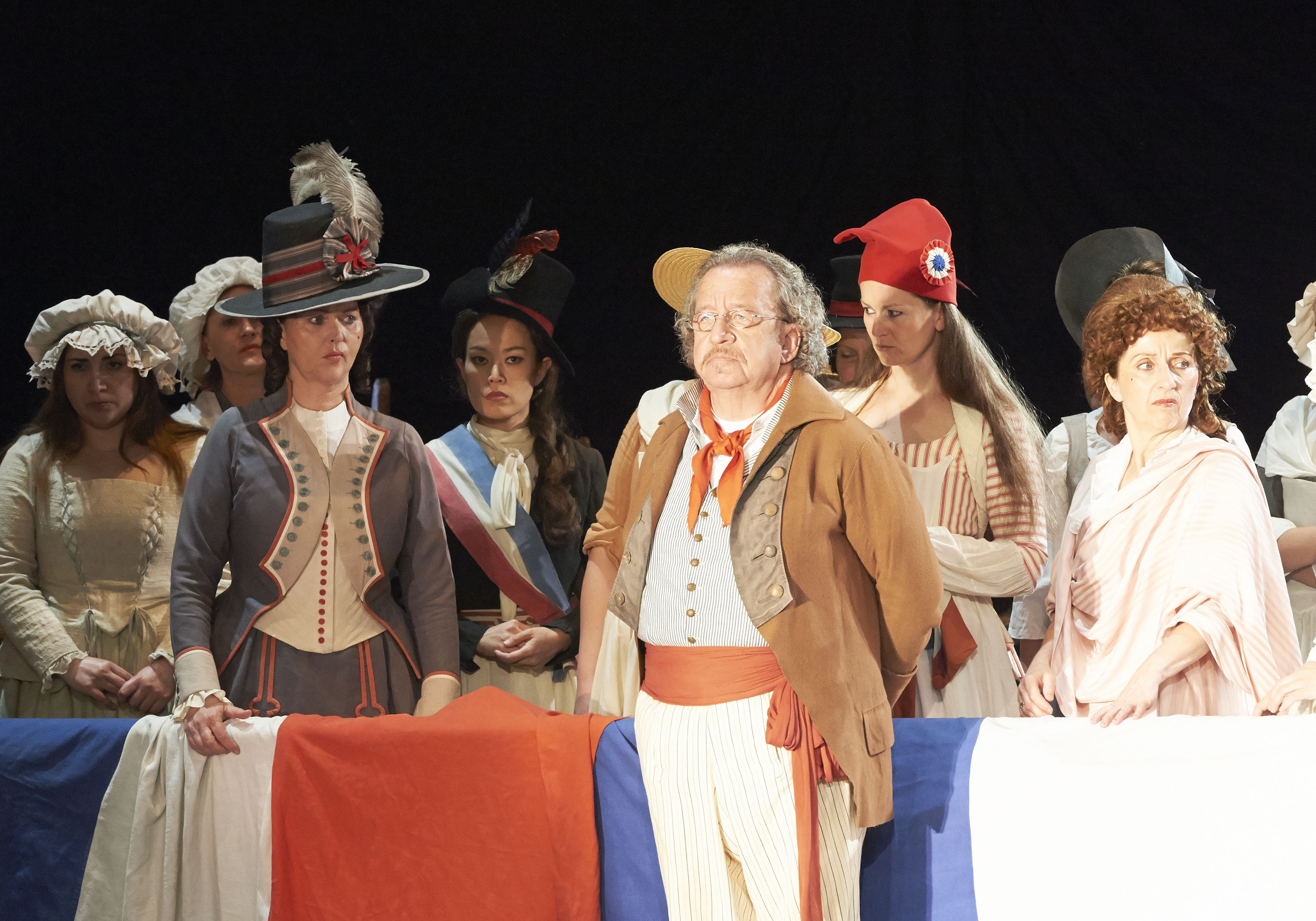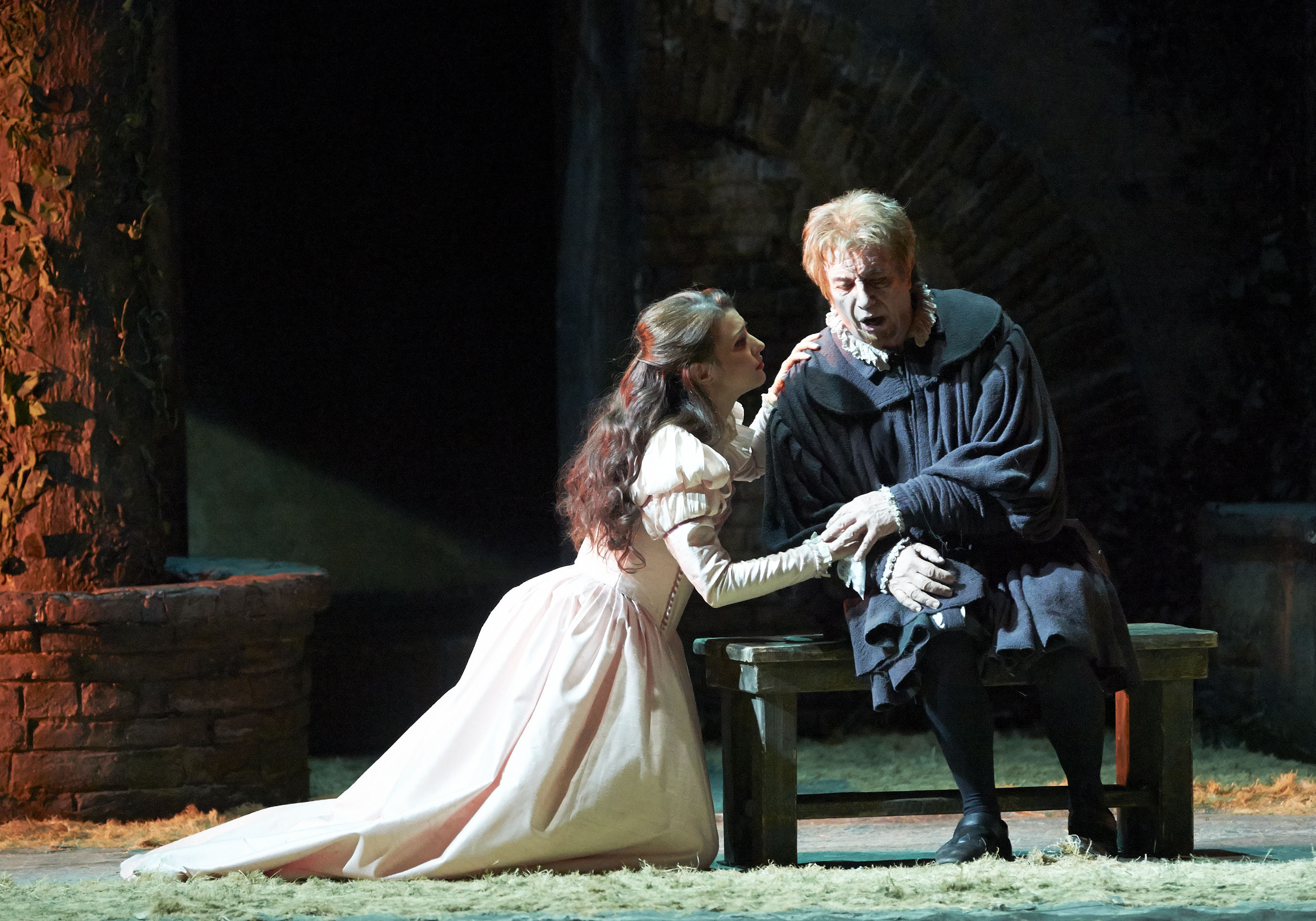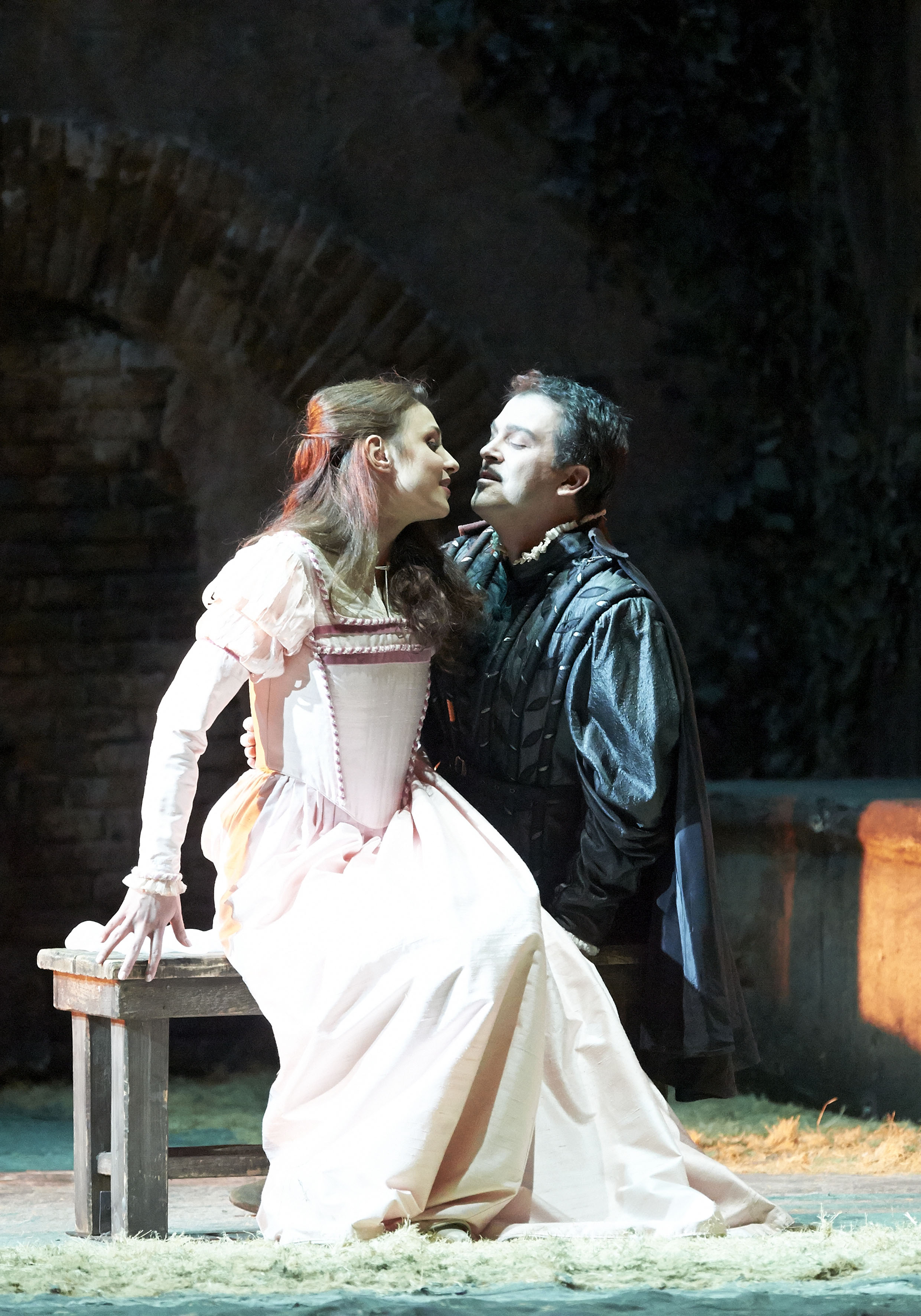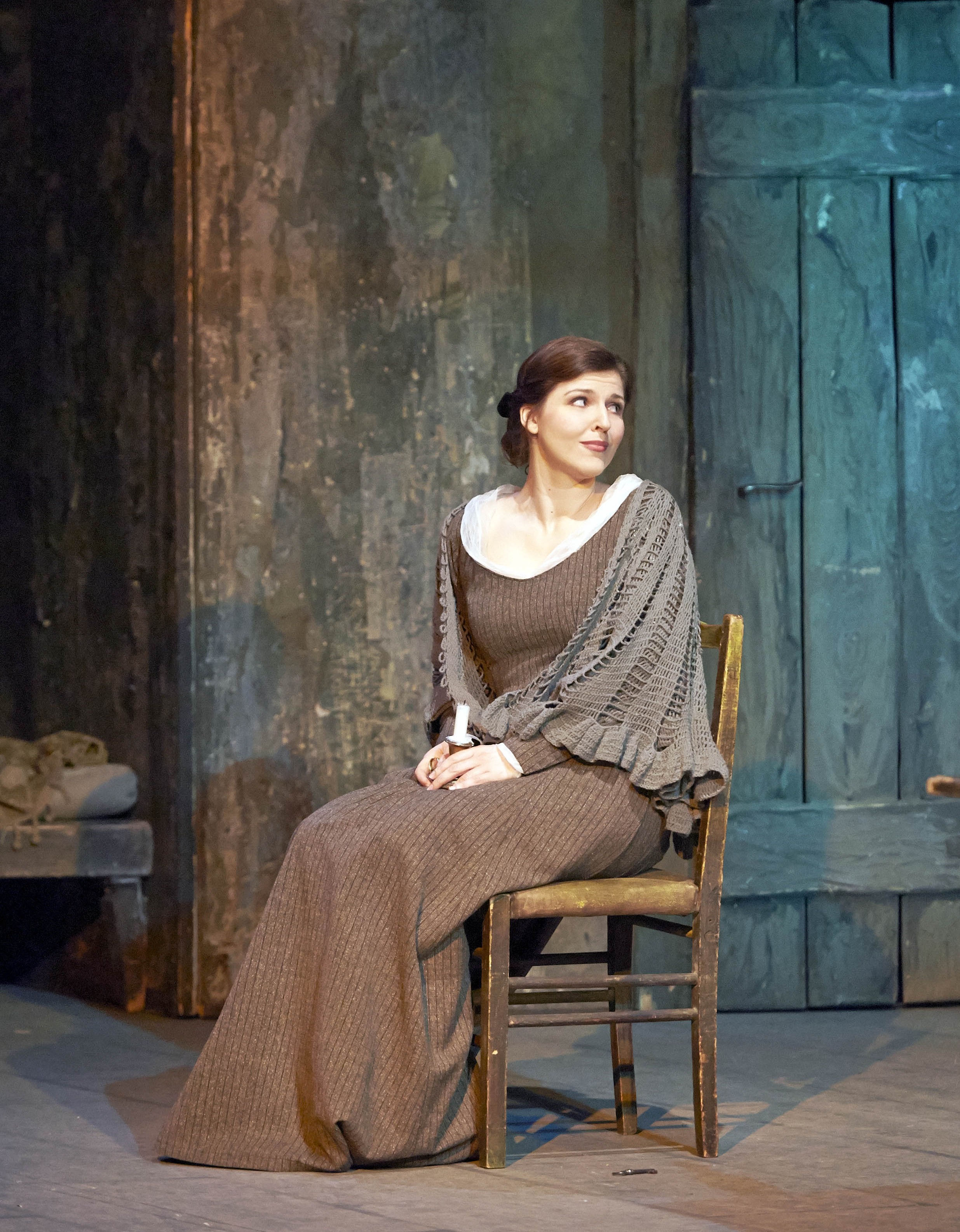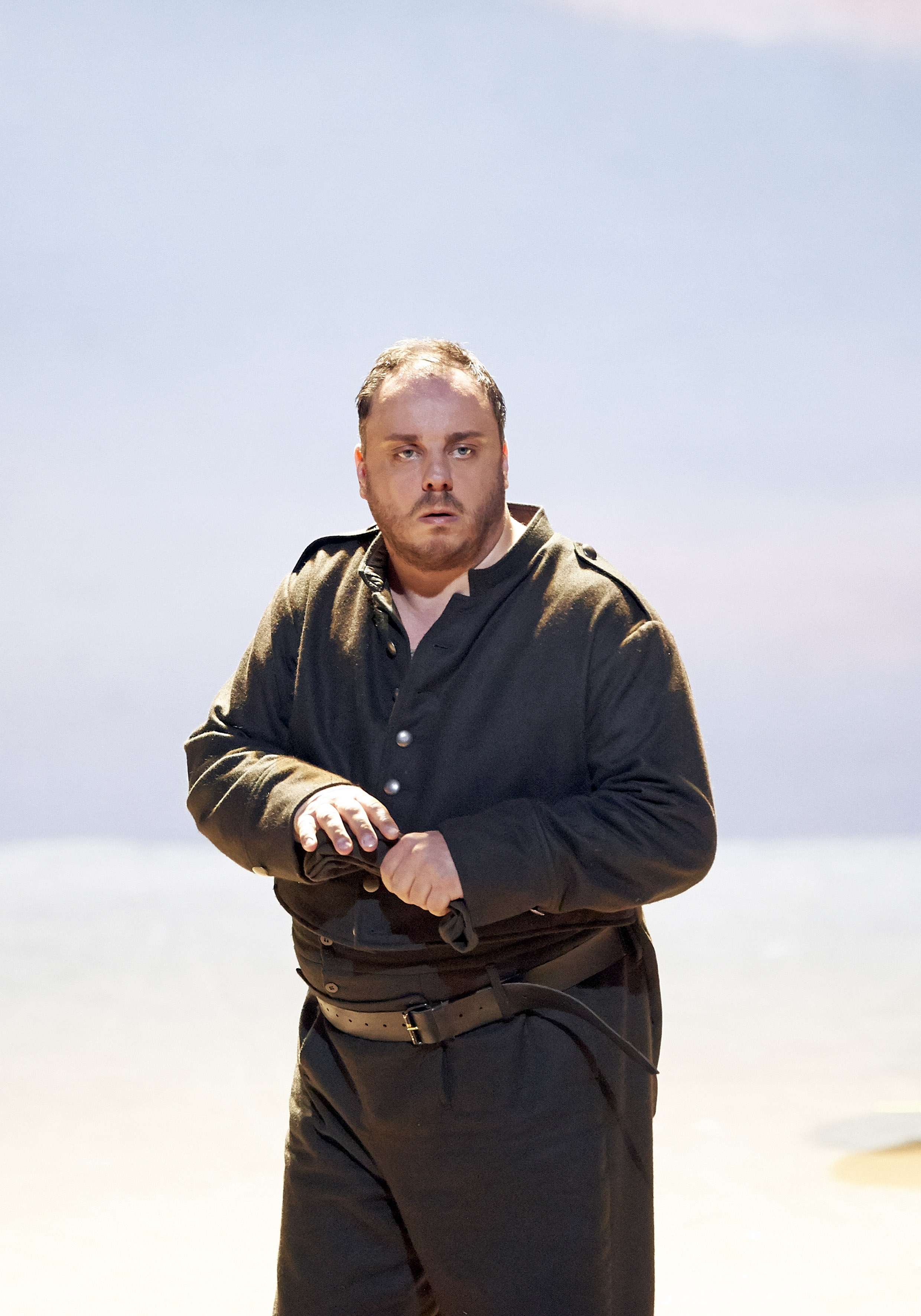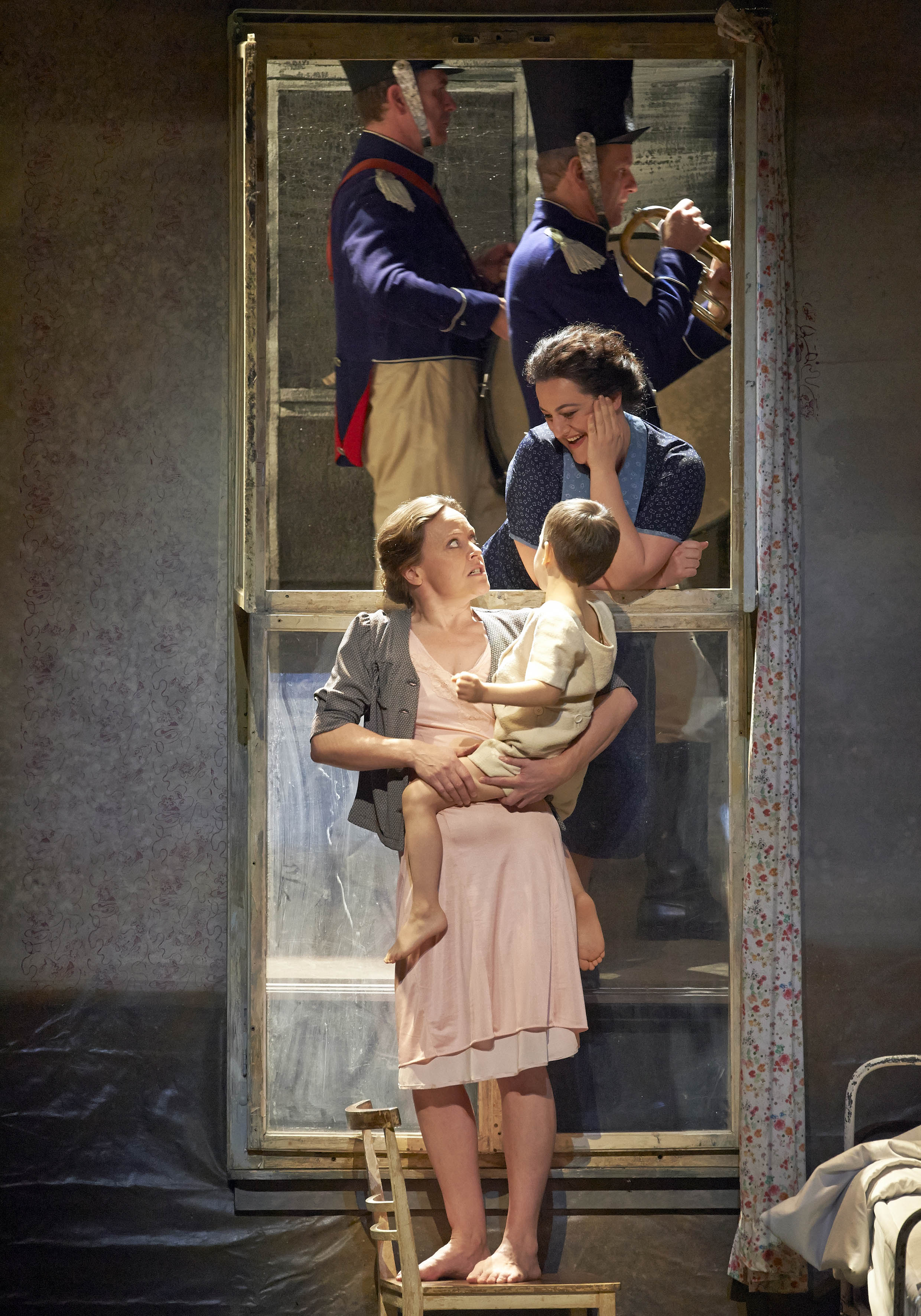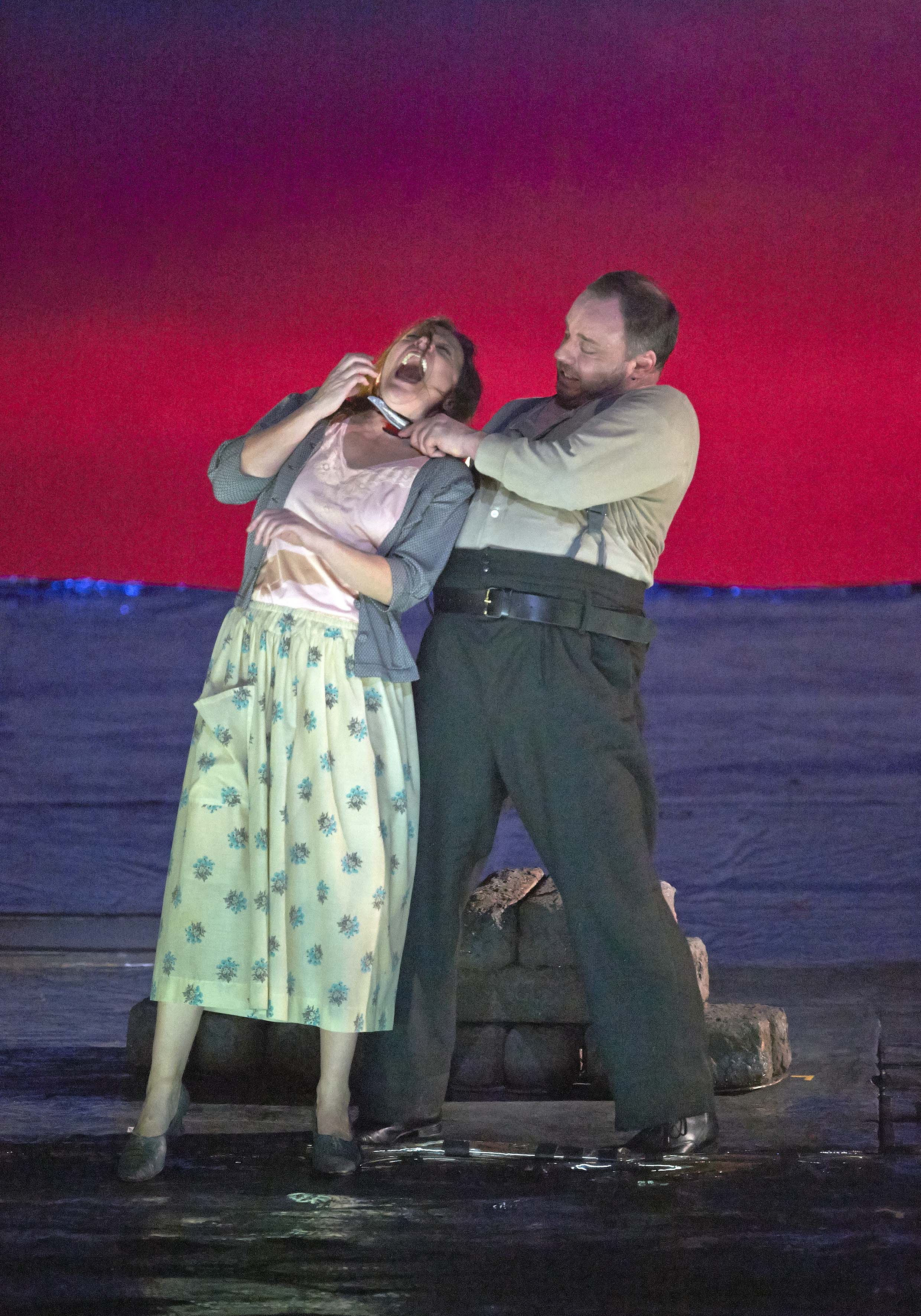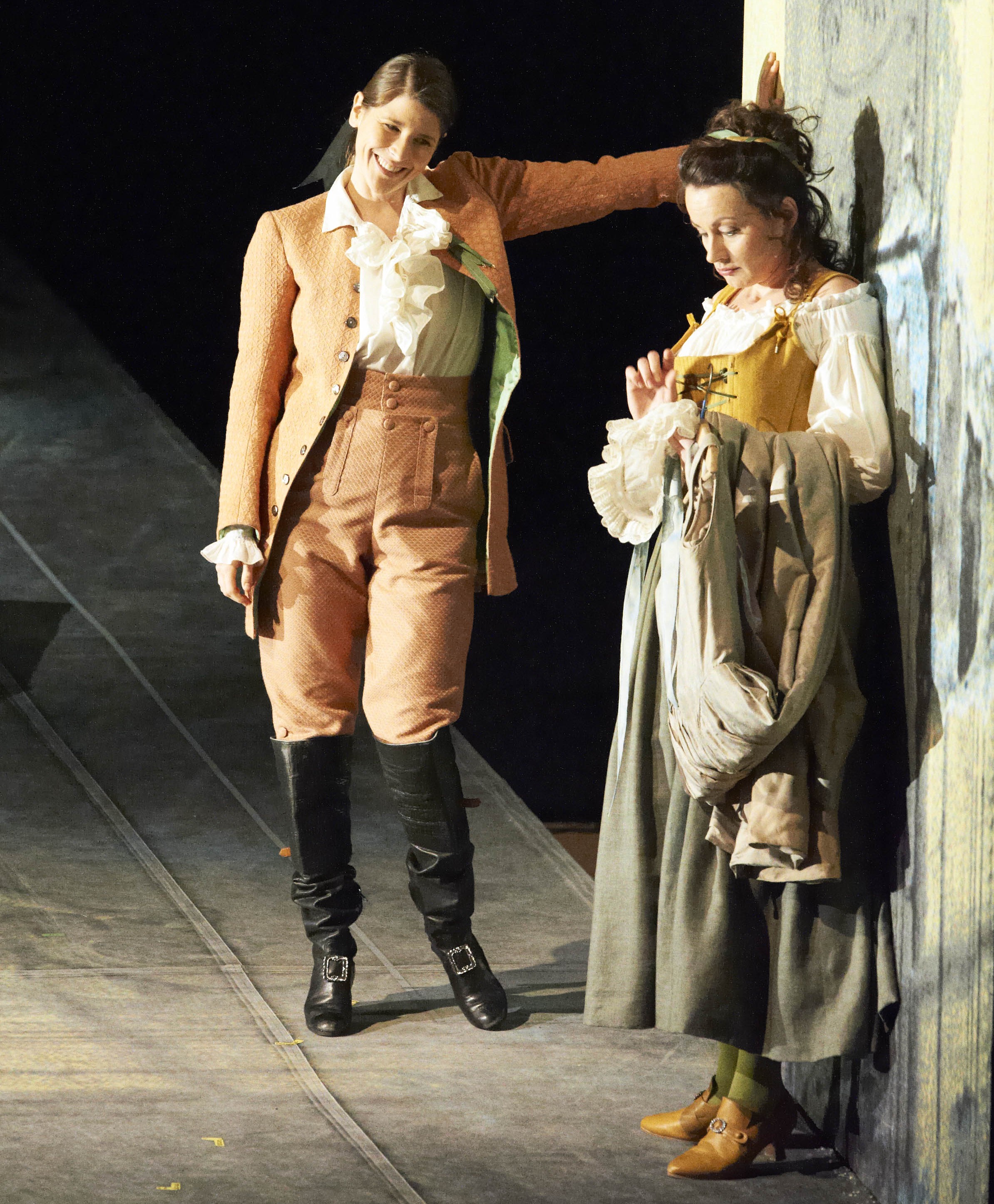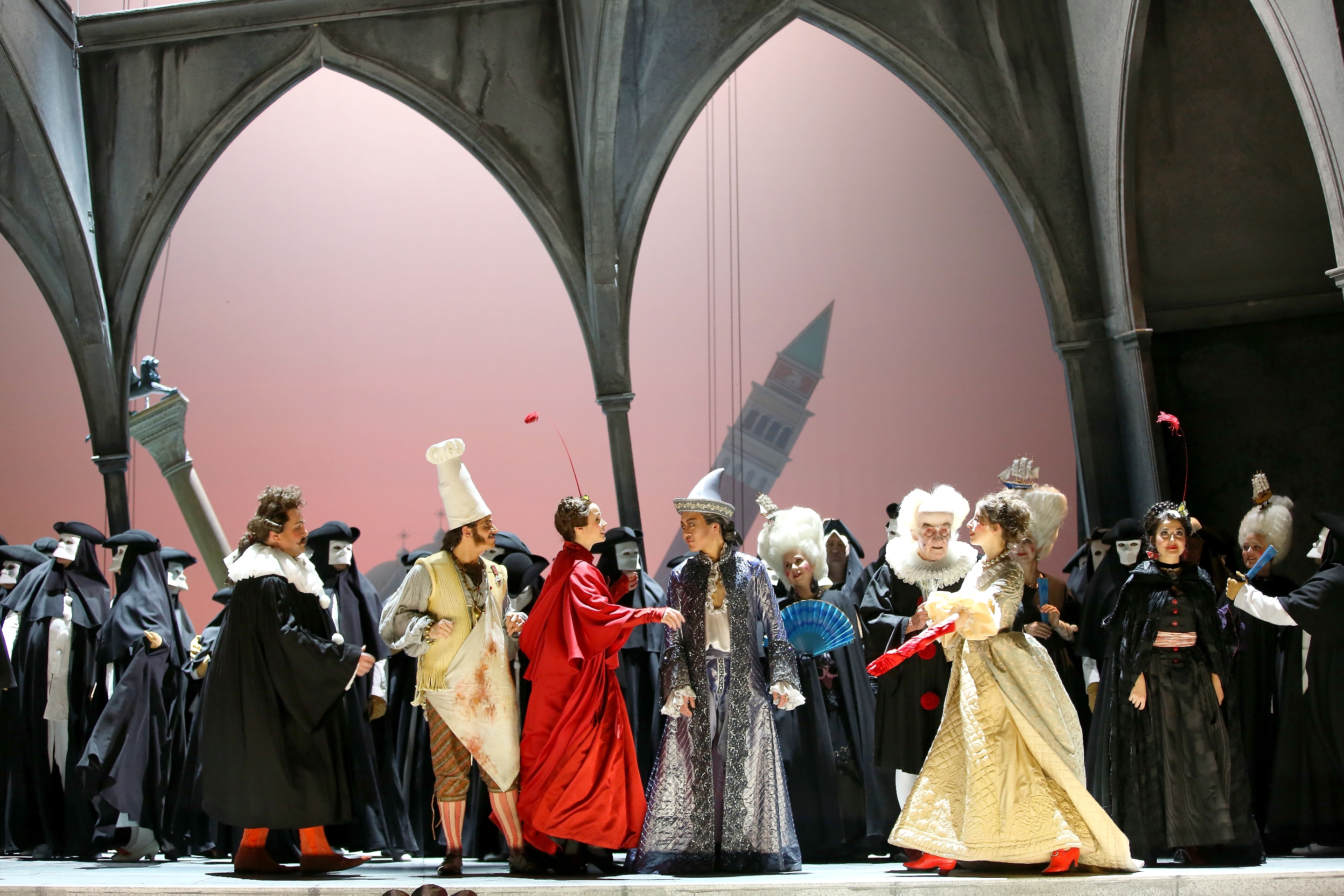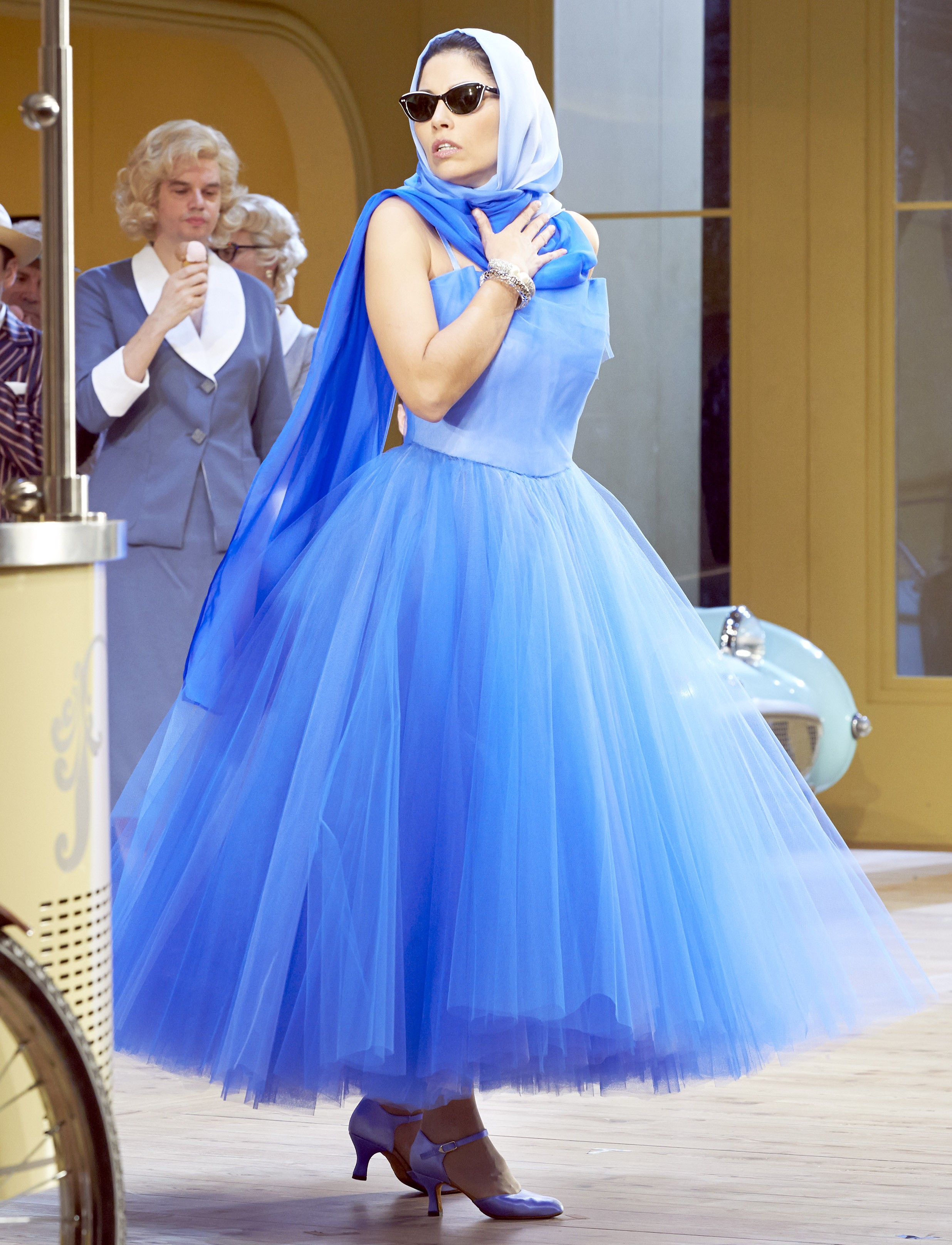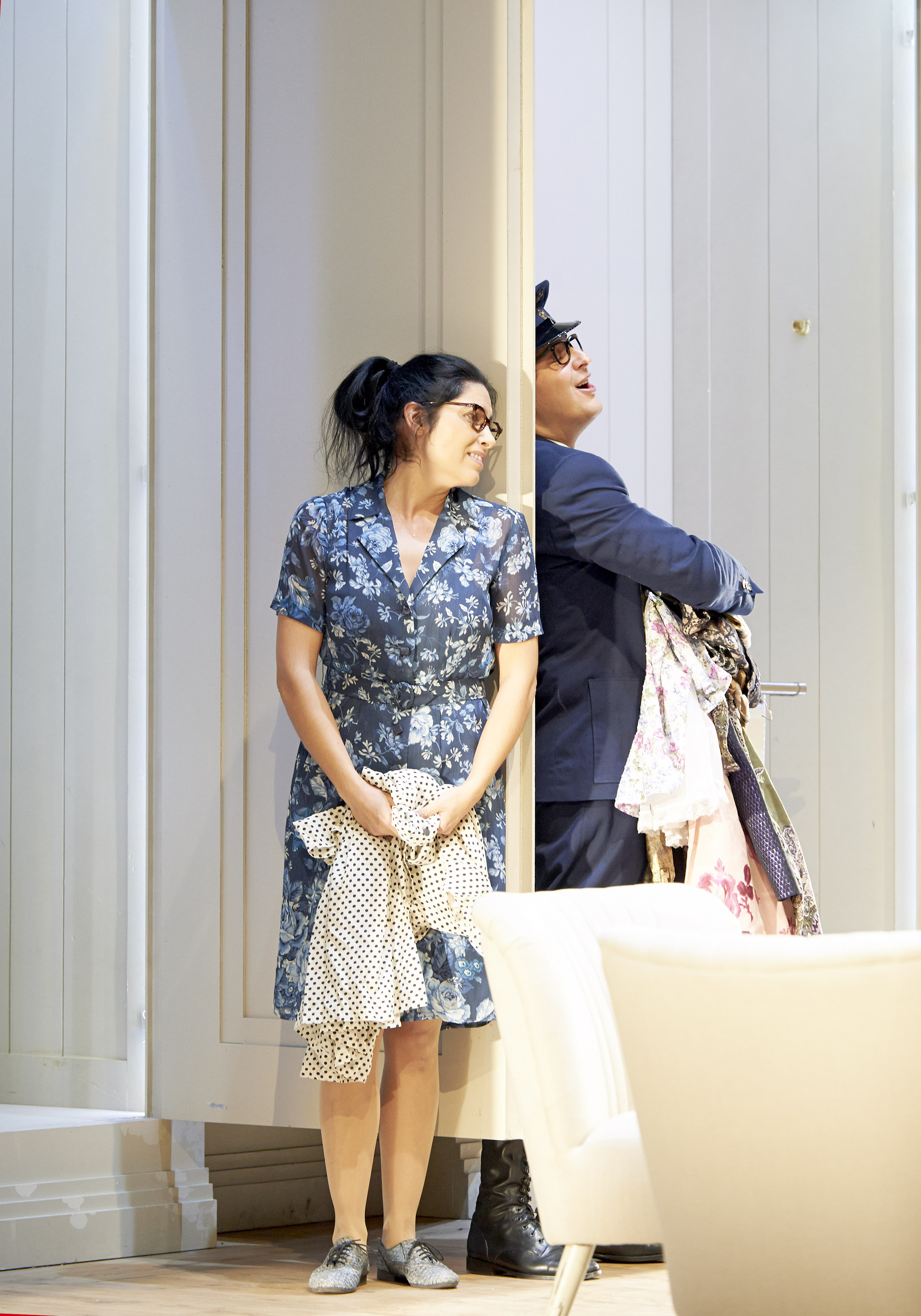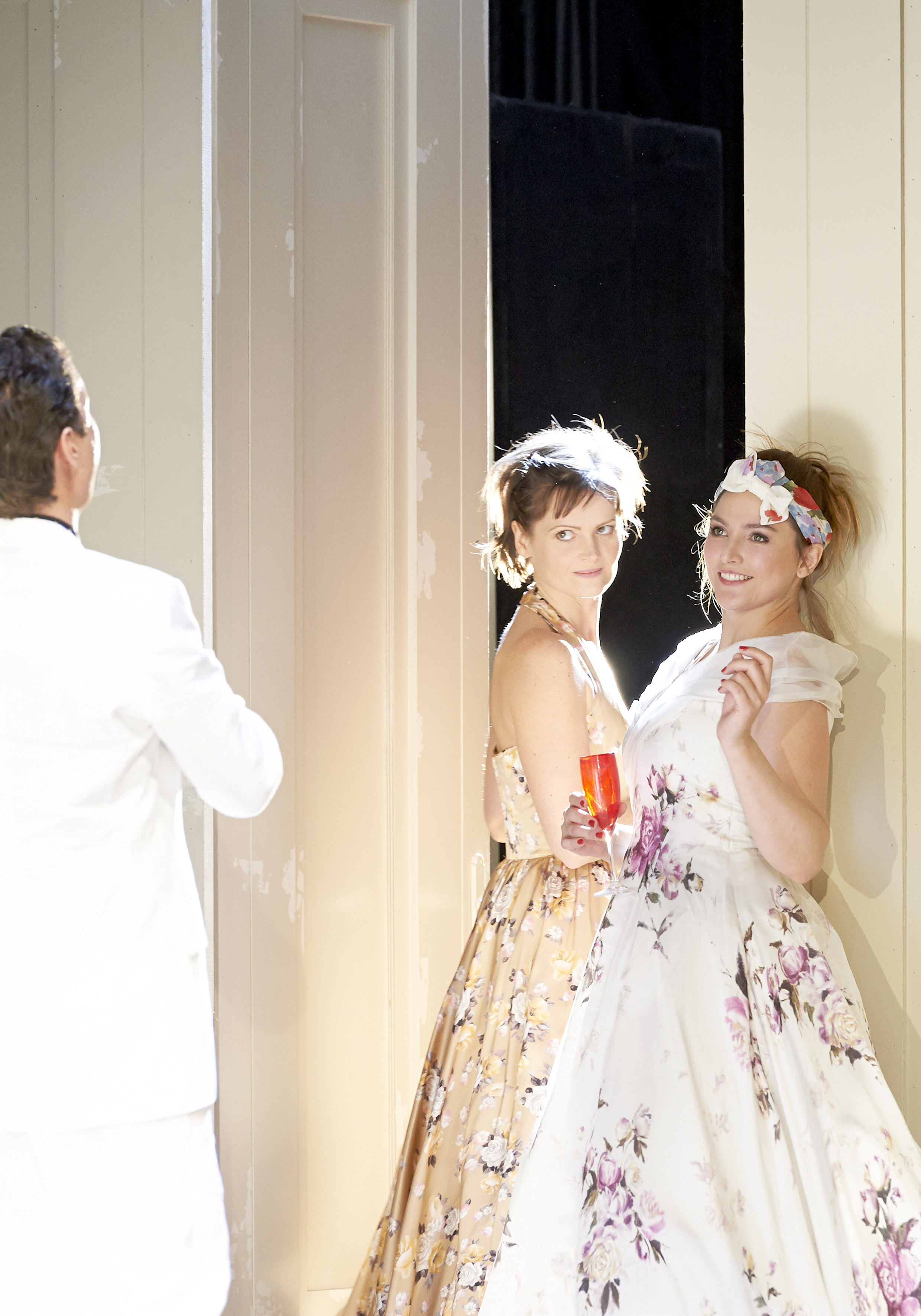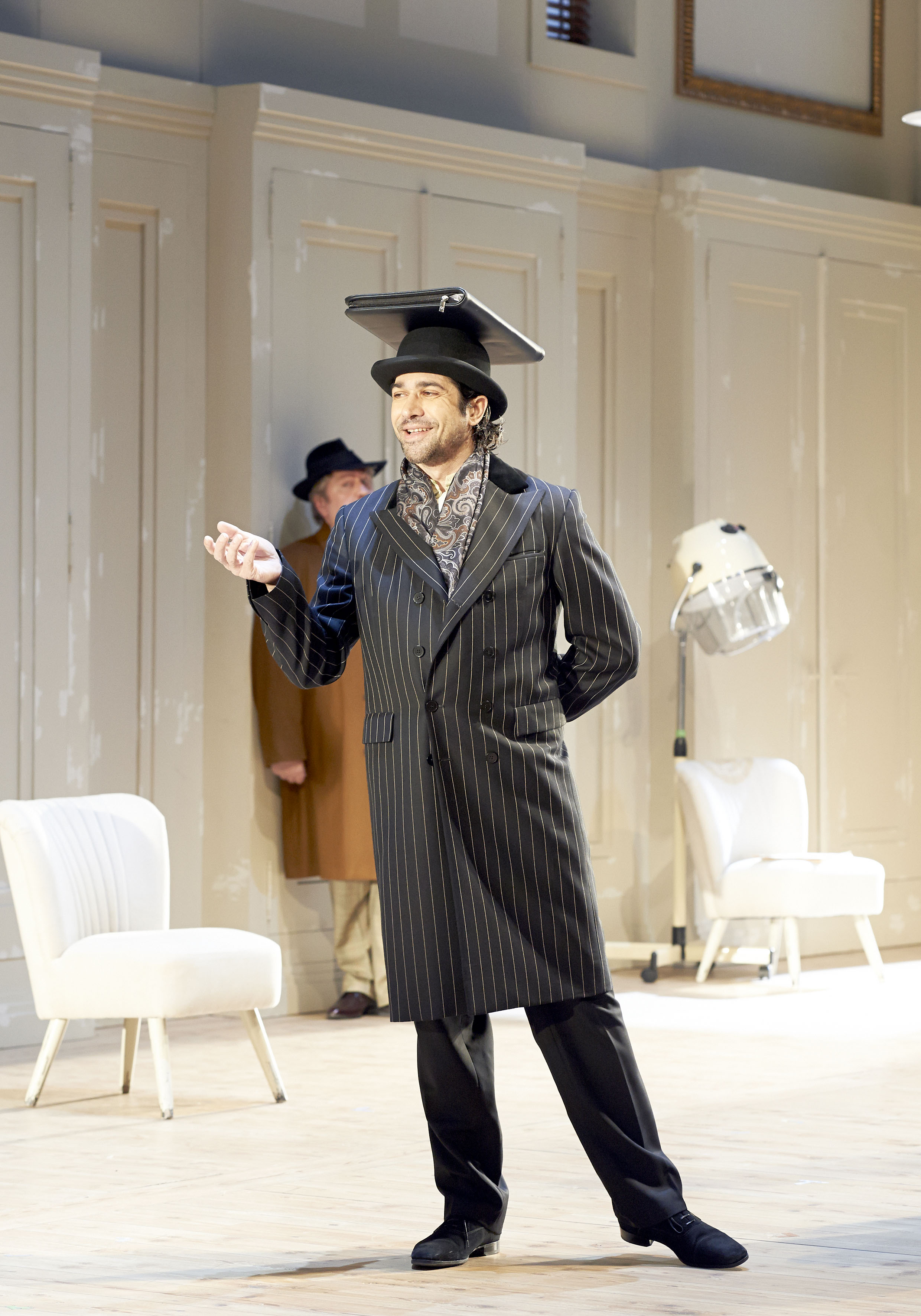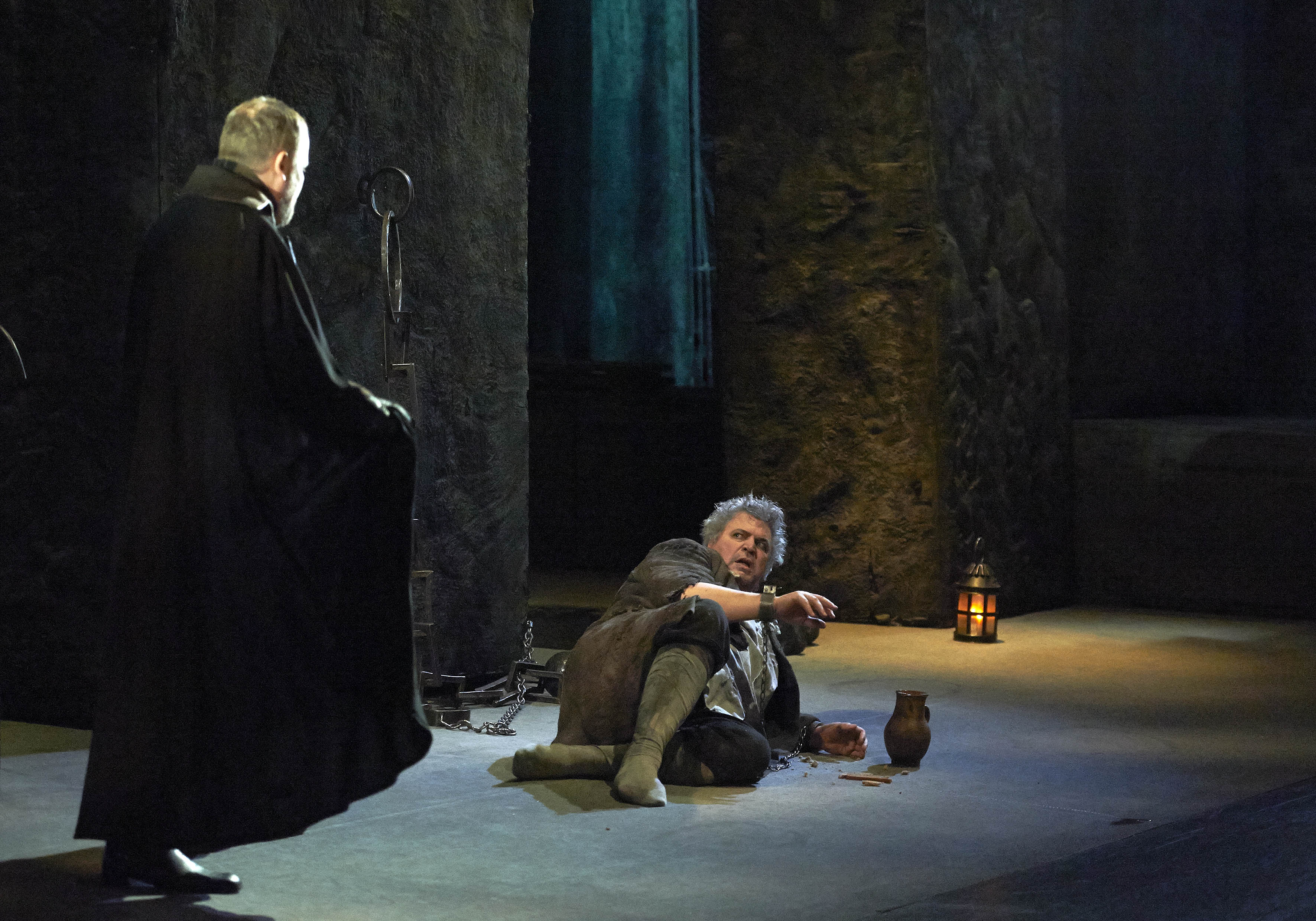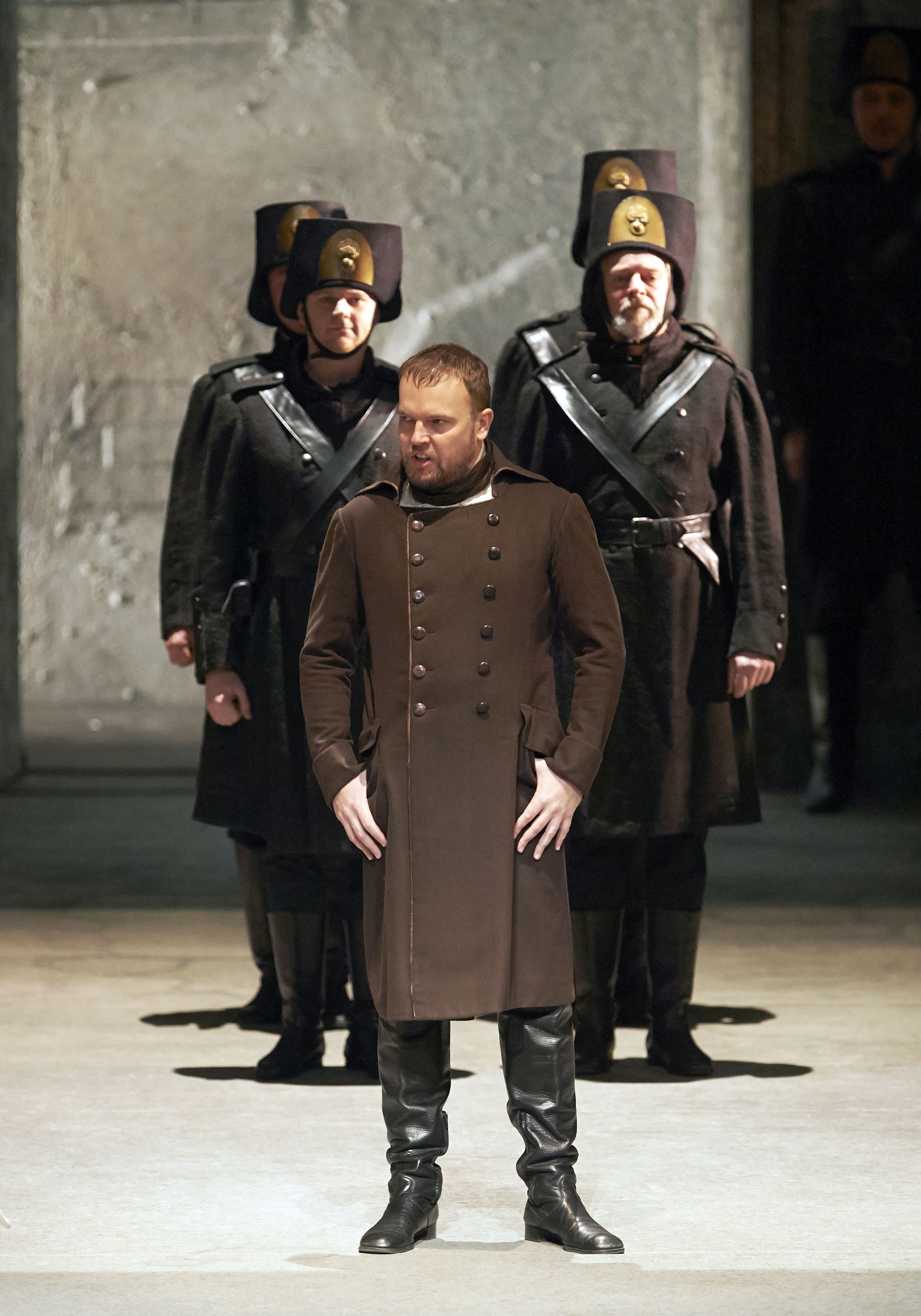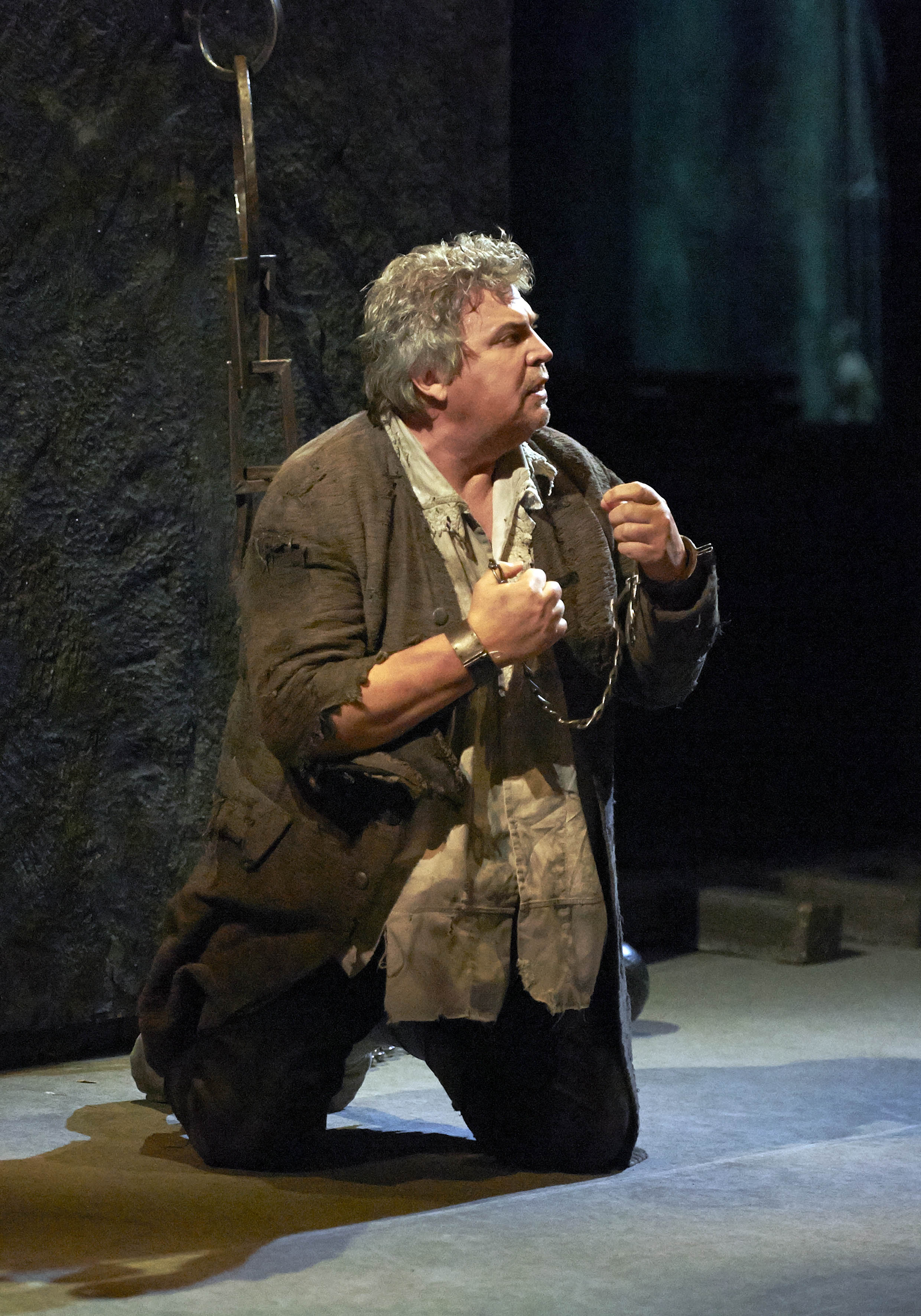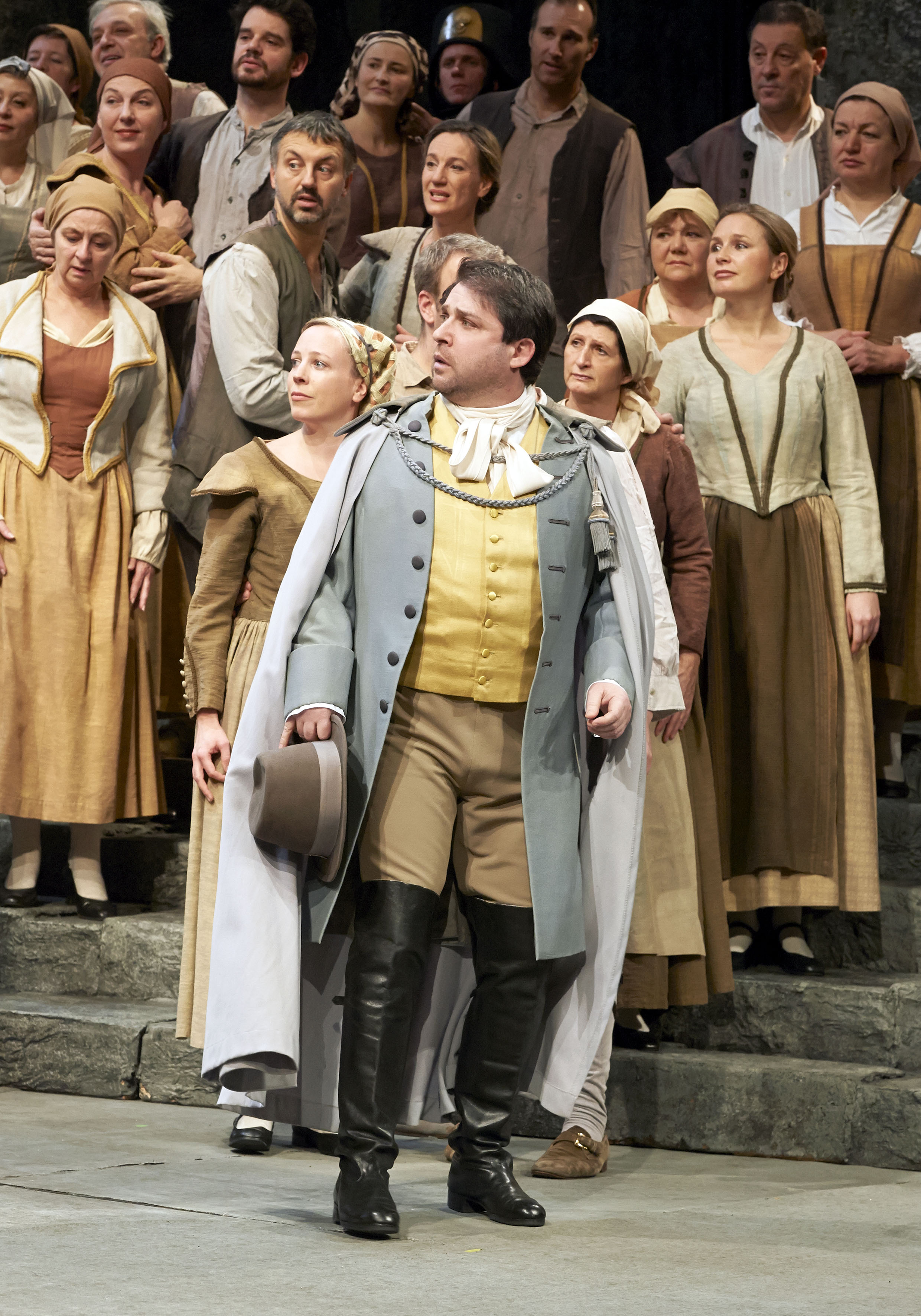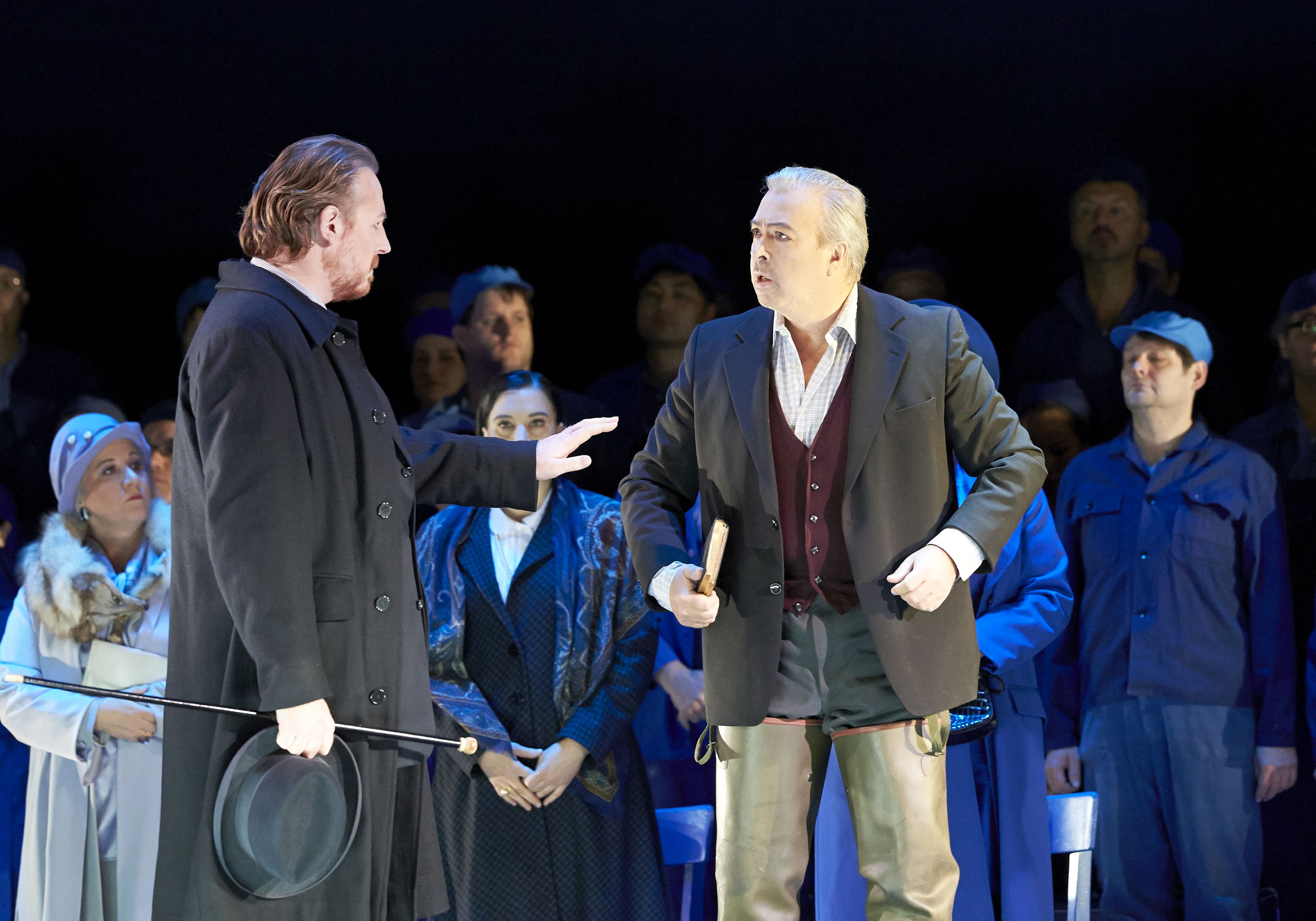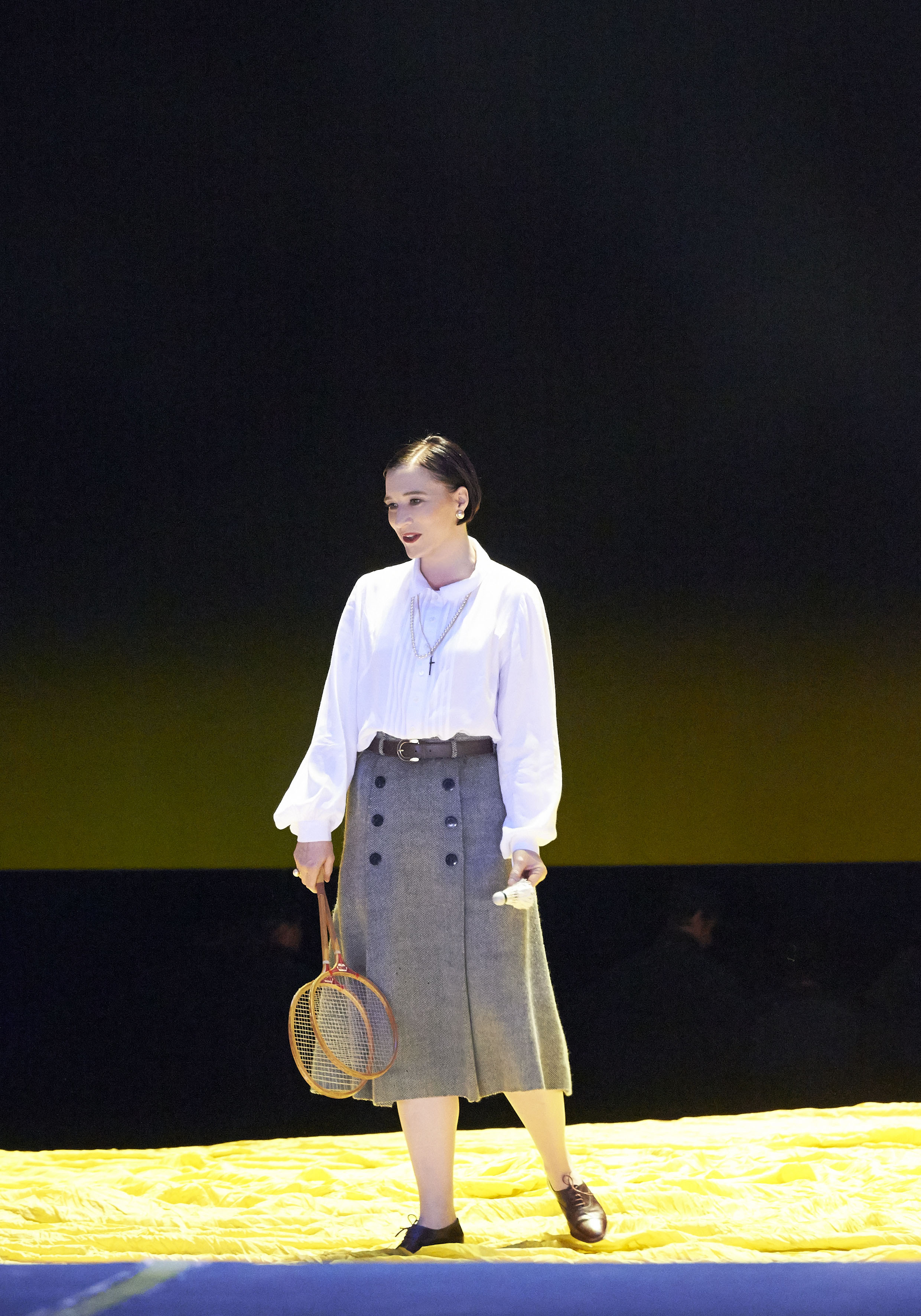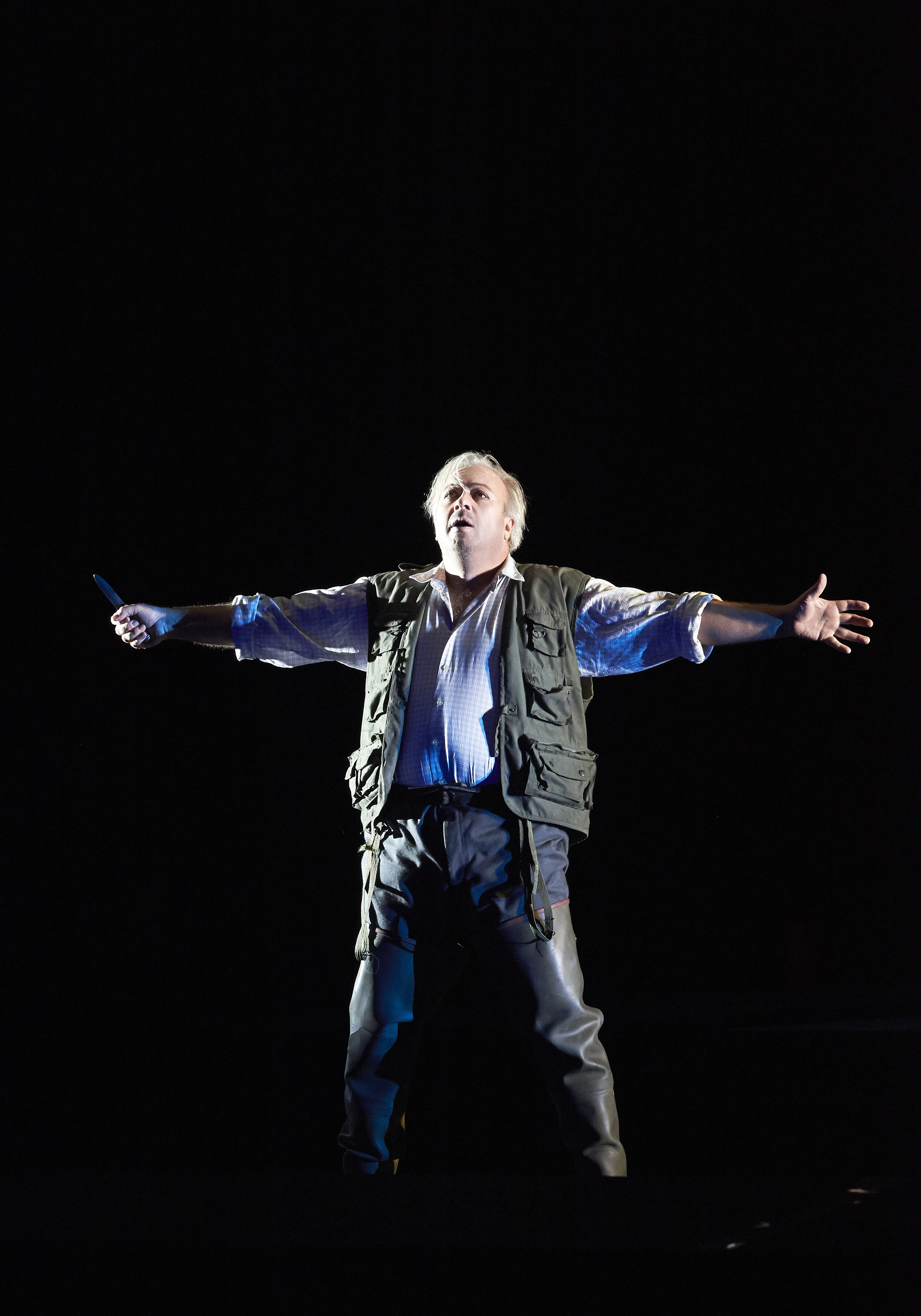
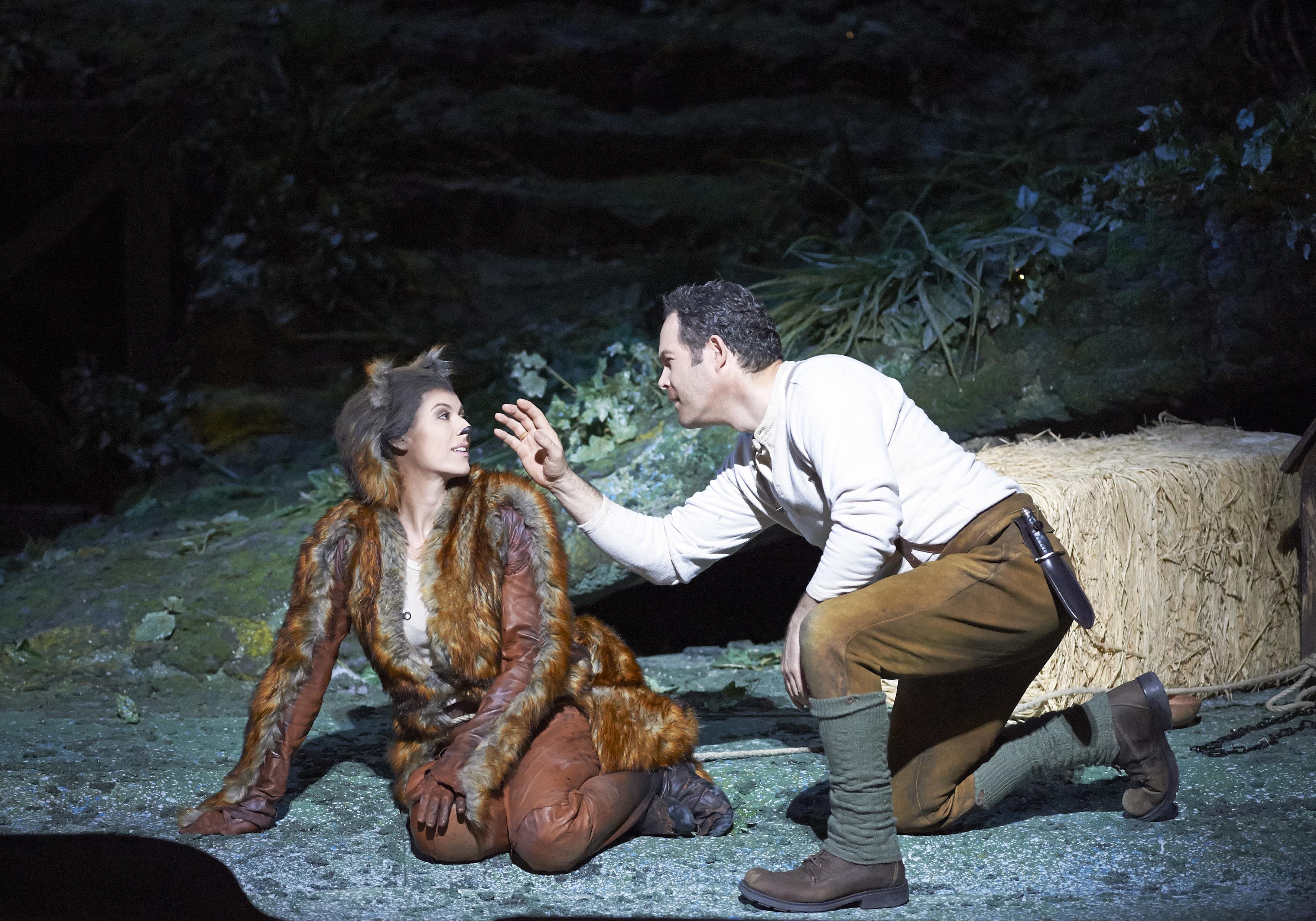
Janacek’s fantastical opera is based on the tale of a vixen, captured and brought up by a gamekeeper, who escapes into the forest. Played out partly in the animal world, partly human, it mixes natural magic with human nostalgia. The Cunning Little Vixen is the focus of stories to do with the passage of time, the cycles of nature.
Otto Schenk’s stage for Vienna State Opera is not meant as a real forest. Animals in human form? ‘Animals cannot be human!’ insists Schenk. The animals are depicted in remarkably authenticated costumes. The costumes (Amra Buchbinder) signify animals. And what is unusual is the size relationship between the animals, insects and humans : they’re out of proportion. 
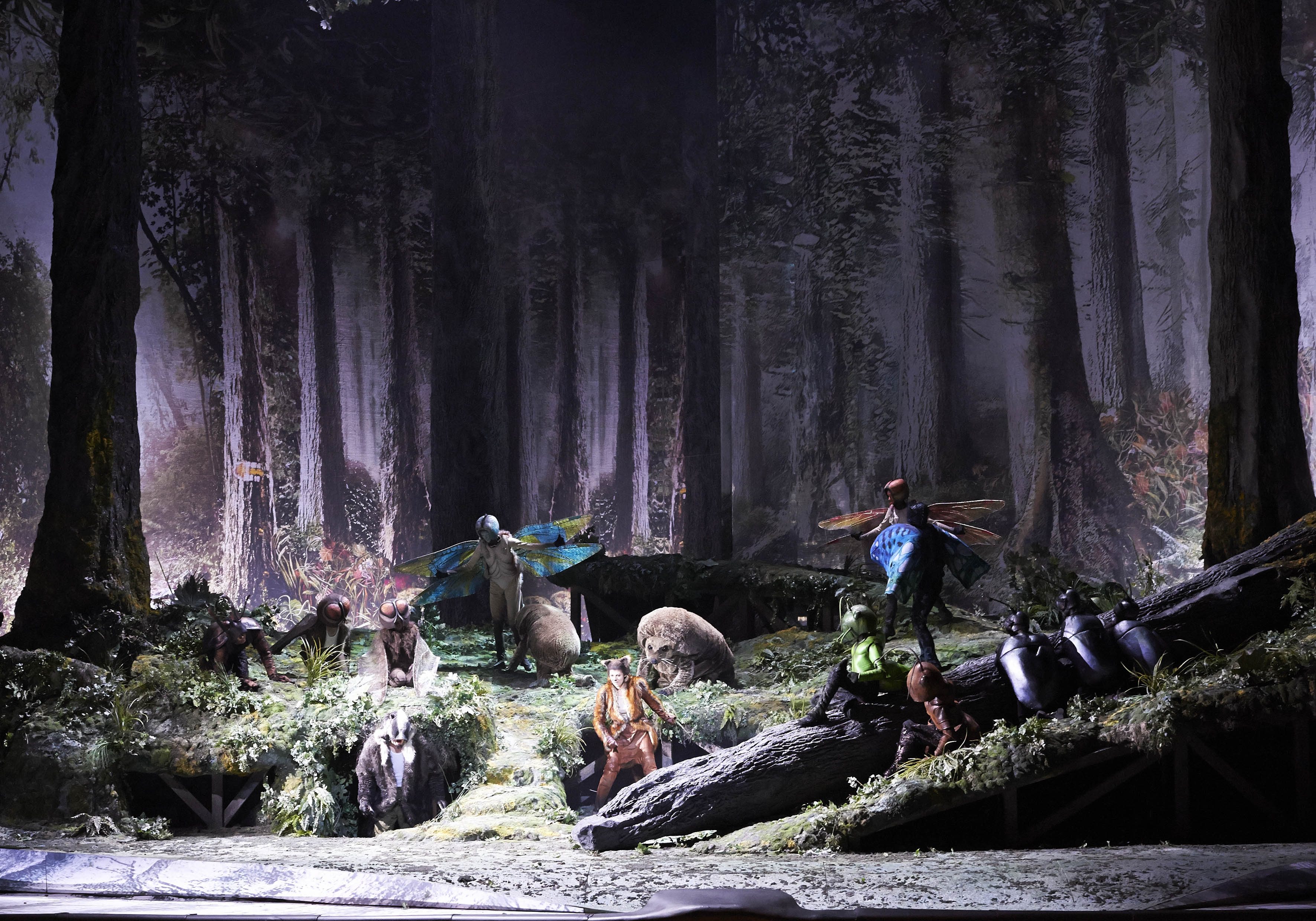
The Prologue, the first 15 minutes largely orchestral, could be a ballet score with the animals and insects synchronising to the music. The foxes are depicted in realistic-looking skins. They’re on all fours -a remarkable achievement- but at first it’s awkward. Especially when the vixen-cub is caught and bound by the gamekeeper, who takes her home. The vixen (soprano Chen Reiss) awakens roped. She’s approached by the gamekeeper (Gerald Finley), lovingly. Janacek’s score is voluptuous, sensual, early 20th Century (1924), but rather like a Hollywood film soundtrack circa 1930s,40s.
How hellishly difficult for trained opera singers to be choreographed to these extreme demands! Reiss’s vixen chews off her ropes, and escapes -fearing the gamekeeper after killing the cock and hens. Insects (including a grasshopper) are blown up to huge proportions ; a badger is the same size as the vixen. Nevertheless, in site of this larger-then-life animal world, Reiss somehow exudes a very human femininity . She tiptoes around as if on high heels. Very sexily.
In the first ‘human’ scene, at the inn, the gamekeeper, the schoolmaster and the rector are at a table playing cards, drinking mugs of beer. They’ve heard he’s taken in a vixen?’ Gerald Finley, a glorious baritone, muses, in his aria, about the passage of time. He jokes about the schoolmaster’s (James Kryshak) failure with women, but is himself taunted about the vixen’s escape. (‘He’s nothing to tell. She ran away.’)
In Janacek’s (modernist) scheme, a series of incidental scenes are connected by long orchestral interludes. We see the schoolmaster, who staggers along drunk: is the world swaying, or is the path curved. Without his stick, he wouldn’t make it. Then a sunflower protrudes, as if held up by the vixen. He’s now singing to the flower, reminiscing, ‘it was long ago’: she (Terynka) had eyes like spring; deceived by the butcher; everything ruined. The rector (Janusz Monarcha), also homeward bound, thinks back to his youth, sings of when he was wrongly accused of seducing a girl. Both men reminiscing are startled by the gamekeeper’s shooting at the vixen; she emerges and escapes.
The key scene is the courting between fox and vixen. God is he beautiful! ‘Allow me to greet you!’, (the fox sung by soprano Hyuna Ko). In her aria, Reiss sings how she was brought up by the gamekeeper and escaped ; she grew up in the forest, knows how to protect herself: but she’s been independent too long. The amazing Reiss waves her tail provocatively like a bunny girl enticing her client. Are you really interested, or after my food? She’s not used to begging, but she’s shaking: tyrant you’ve got what you want! In their foreplay, he asks, Do you come to the hill often? Do you smoke? (Not yet!) Eat duck?
Erotically, Reiss lies on her back, she sings to herself , probing her sexuality. Is she really so beautiful? What’s special about her? She’s only world-wise. But if only he knew how much she adores him.
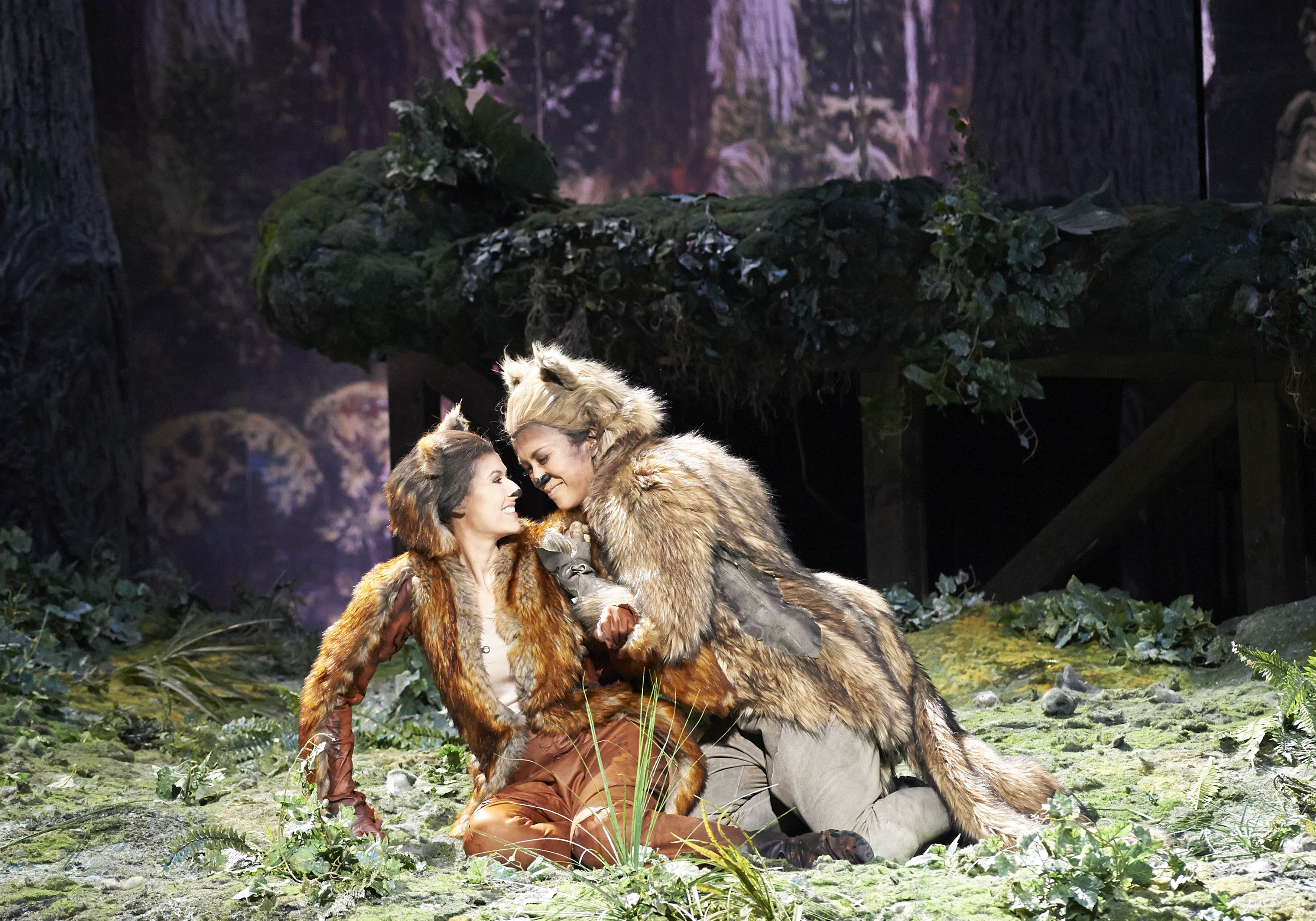
Reiss, in brown fur, brown leather pants, struts around. Her fox, (Goldmane) gold-grey tones, tries to mount her. She repels him. The fox confesses he’s fallen in love with her; she’s all he ever wanted.- But why me?- Think of novels and stories.- Come here, don’t cry, I want you. He shakes the overhead foliage: she coyly winks.
Now as they emerge from their lair, an owl, frog, rabbit and all manner of insects greet them. The whole world breaks out in a euphoric, bacchanalian dance of congratulations. He rubs her: they’re off to the preacher! Cue a marriage ceremony.
Another orchestral interlude . (Wonderfully expressive playing from Vienna State Opera orchestra under Tomasz Netopil.) Harasta, poultry dealer (Wolfgang Banckl) sings his ditty: as he wandered, he played his music: come and look, please come and buy. A green skirt he’ll buy her, Terynka… The gamekeeper accosts him, how’s he doing without a wife. Havastra sings, if he wins Terynka he won’t go poaching any more! (He wanted to take her a hare.) Then, ‘the vixen never gives up!’, gives him no peace. They’re seen laying a trap for her.
Orchestral transition, nature’s life cycles. The foxes now have cubs. Curious, men have been here, she warns. In spite of Schenk’s insistence (animals cannot be human) Janacek humanises them like a married couple. How many children have they; how many do you want, he (the fox) sings.- ‘You’re still very handsome.’ She’ll tell him in May, Reiss sings ravishingly.
Then we see Harasta eyeing the vixen: that’s a muff for Terynka. But he trips, and the foxes ransack his basket, devouring his chickens. (What will he tell his mistress?)
The vixen is shot; and rolls down towards him. It’s a shocking moment. The music stops. There’s absolute silence.
Cut to the humdrum human world, the inn. How is the rector, the innkeeper asks. (Gamekeeper and schoolmaster regret his absence.) The schoolmaster, leans, as if he’s got a cold, despondent hearing of Terynka’s marriage. It’s ‘thunder weather’; it’s completely dry.- Where to?- The wood, and then home. His foot is hurting him.
The forester, Finley handsomely dressed in a hunting-jacket- in the forest, now near the lair- pulls away a mushroom. ‘Is it a fairy-tale, or not,’ he sings. In Finley’s poetic aria, he sings ‘he’s happiest when the sun goes down’, and muses on couples in love. He reminisces on his wedding day: the mushrooms they shared, how many kisses they exchanged. It’s a long time since they were together. He’s lying on the bank. The staging is miraculous, suggesting his oneness with nature, his khaki-green jacket merging into the landscape. He seems to fall asleep.
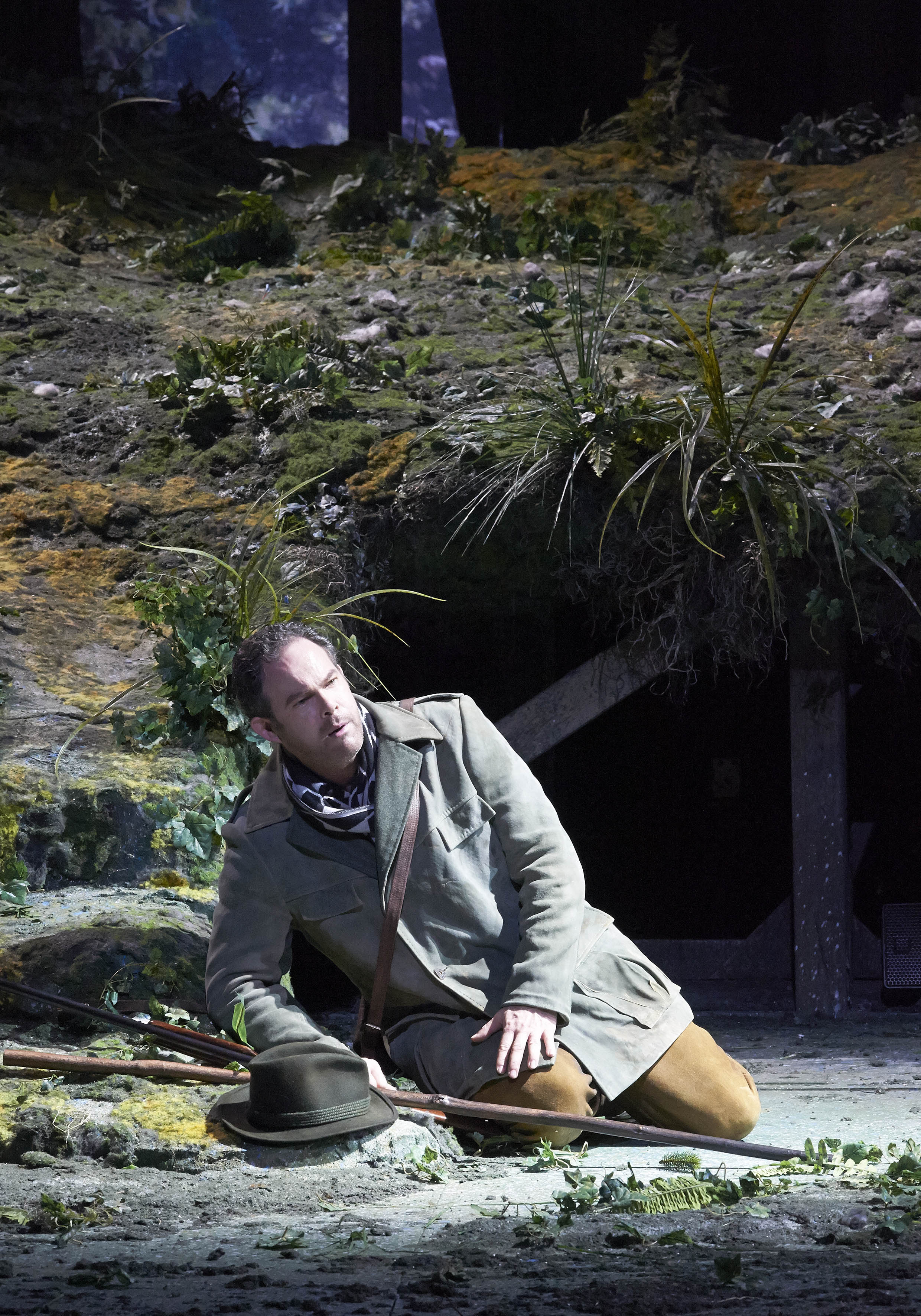
He wakes-surrounded by all the forest creatures. He turns to a human-size frog, who greets him with an android-thin voice. (Cloying, but the audience loved it.) He spots a vixen, a reincarnation of her beautiful mother. ‘Oh, there’s hope!’ Now the stage opens up: there’s a widening shaft of light. It seems as if he and the vixen embrace. Magical realism, an epiphany: or an affirmation of man’s identification with nature. Janacek sees godliness in the natural world. The orchestra surges to a passionate climax.
Janacek’s music bristles- using Czech libretto, not the German translation- reverting to Janacek’s raw, urgent , and (long misunderstood) original scores. The cast, especially Chen Reiss and Finley, justified this triumphant revival. Otto Schenk’s staging has to be seen, a new classic, warranting a DVD. P.R. 12.11.2014
Photos: Chen Reiss (the vixen) and Gerald Finley (the gamekeeper); Chen Reiss (vixen) and Hyuna Ko (fox); Gerald Finley (gamekeeper/ forester)
(c) Wiener Staatsoper/ Michael Poehn
Yearly Archives: 2014
Mussorgsky’s Khovanschina
Khovanschina is set in the turbulent period of change from ‘old’ to new Russia following the accession of Peter the Great. The complex plot conflates history. Ivan Khovansky and his son Andrei are determined to preserve the old feudal Russia; Prince Galitsin represents the new westernised ideas being introduced by Peter; and the monk Dosifei and Marfa the reactionary ‘Old Believers’.
The overture ‘Dawn on the Moscow River’ (ravishingly played by Vienna State Opera orchestra under Semyon Bychkov) is everything you ever adored in late 19th century Russian nationalists from Borodin to Balakirev. But Mussorgsky’s own music is not quite what we hear. Mussorgsky’s unfinished opera was orchestrated by Rimsky-Korsakov, whose performing version prevailed until Shostakovich (1958) restored substantial cuts. (The increasingly modern Act 5 was scored by Stravinsky.)
The stage in Lev Dodin’s production is a horribly modernist structure, a steel grid on three levels, lit by a red square behind hinting at Malevich’s geometric paintings. At first the ‘scaffolding’ is closed off by red/white emergency tape, cleared away by black-clad workers wearing beanies.
‘Sodom and Gomorra-but he still makes a profit’- ‘Hey you, scribe!’- Norbert Ernst’s head is visible on a pulpit out of the stage-‘Read this!’ Prince Ivan and Andrei are planning a coup d’état; peasants will be set up against the authorities. We see the Chorus suspended on a platform below stage. The Chorus of soldiers sing ‘What is happening in Moscow; they’re handing out newspapers to everyone. (They are soldiers, but could they also be the modern proletariat planning revolution?)
But, in Peter the Great’s time, ‘ if you’re poor you will need a scribe’: the scribe is ‘part of the ruling classes’. They grab him, and throw him up and down: don’t make fun of us, they taunt him.
Now, from the top of the steel tower, Khovansky (Ferruccio Furlanetto) addresses ‘My dear children in Moscow and in all Russia.’ Furlanetto, in black cassock, grey collarless overcoat, could be a (Communist) party leader. He calls on his soldiers: are your weapons ready. They will march on Moscow. Beneath this tower, a tumult of people, with children waving small red flags side of the stage. Unmistakeably political.
We hear the voice of a woman (Emma). She identifies her attacker, Khovansky’s son Andrei who chases her,’How sweet you are, tell me you love me.’ Tenor Christopher Ventris, in a singlet- all in black down to his boots- looks like a body-builder. She’s saved by Marfa’s intervention- she’s his former lover- chiding him for his faithlessness. Is his powerful pride greater than a suffering maiden? (Andrei threatens, must he kill her too.)
Elena Maximova’s Marfa, a hauntingly poignant mezzo, is dressed in a black lace-patterned dress, and black shawl, her beautiful blonde hair in a bun. Maximova stands out in a star line up.
Khovansky thunders- ‘What is going on here!’; Furlanetto, platform lowered, orders his soldiers to take the girl (whom he fancies) away. ‘As if he has no control over his son!’
In Khovansky’s key aria, ‘The hour of darkness and spiritual decline has arrived. We are on the brink of an abyss,’ he sings. Everywhere people are breaking away from the true doctrine: a great struggle lies before us. Tremendous, Furlanetto’s sonorously expressive bass. He appeals to the Almighty. Russian bells clink. Chorus murmur, Almighty, dispel corrupt power, God give us strength.
Conductor Bychkov was cheered re-entering before the 2nd Act! Still that grim edifice…Yes, it could, with its different levels, represent power factions and classes. But there’s no sense of historical context, given Mussorgsky’s intention to dramatise a watershed (1692) in Russian history. It’s as if Lev Dodin is purposely de-historicising Mussorgsky’s opera.
Prince Galitsin, the reformer, a central figure in the drama- Herbert Lippert, white-haired- sings ‘Why is he always filled with doubt. No! he won’t succumb to the vain dreams of the past. The aria is like a soliloquy. Take care, pride! He reads a letter (from his mother?), who bids him preserve the purity of his soul. Lippert’s lyric tenor has wonderful purity and powerful reserves. Dark things torment him; how futile is power: how dimunitive is our understanding.
The fortune teller he summons is Marfa. The future lies veiled in a mist. Water does not lie, speak! She (Maximova) is perched, hovers transfixed :she summons the souls who will reveal the prince’s destiny. ‘You are surrounded by malevolent people’: the Prince is threatened with disgrace and exile to a distant land, stripped of wealth and power.
So that’s why he was so troubled! ‘I face shame and ruin!’ Yet he had planned (only a short while ago) to renew his beloved fatherland.
In a key dramatic ensemble, Galitsin’s is the meeting place of all the political factions. Khovansky arrives unannounced- nowhere to sit- he taunts ‘the Tartar’ Galitsin, settling old scores. Dosifei (bass Ain Anger) arrives and interjects. Calm your anger: your petty quarrels won’t save Russia. He reminds them of his past: he renounced his princely rights. That a Russian Prince should renounce his power and adopt the Monk’s habit! The reason for Russia’s disgrace, they know: our strength lies in our faith in God. Simple folk are leaving home, fleeing from the reforms. Dosifei invokes a religious community of faith, while Khovansky bemoans, if only he could have his soldiers! Preserve the old traditions, he sings. Galitsin, Khovansky, and Dosifei- reformer, soldier, and preacher-are on different levels, talking up and down to each other. Alexander Borovsky’s stage, at least here, effective; but some audience found it confusing.
We hear the Chorus: ‘Who are these people?’ -hooded figures in black- ‘they are true believers.’ Marfa arrives; she managed to break away from Andrei; she brings shocking news. While they’re jostling for power, a new force – Peter the Great and his guard- is emerging. Shaklovity (Andre Dobber) enters. The Khovanskys -denounced- are ‘planning a coup d’état.’ He, Peter, called their crime of treason, Khovanschina, the Khovansky plot. And orders the Khovansky eliminated. There’s a tremendous, brass fanfare: ominous.
This is surely the high point of the opera: the later Acts seem disparate, disconnected episodes: the fragments later composers tried to cohere.
So opening Act 3 , Chorus sing ,’we have slayed, conquered heresy and routed out evil.’ A woman is walking through the meadows.
Marfa, Maximova in a mini dress , is erotically running her fingers through her hair: she sings, love-sick for the unfaithful Andrei. Susanna (Lydia Rathkolb) a fanatical disciple of Dosifei, has been spying on Marfa. Susanna denounces her -‘You have lead me into temptation’-and will testify against her! Marfa is seen on Dosifei’s lap, comforting him :’We shall be like God’s candles.’
The scribe announces that Peter’s guard has attacked. Khovansky’s soldiers want him to lead them into battle. Khovansky sings how they were once triumphant, knee-high in Moscow’s blood. Now things are different; Peter’s terror reigns. Go home and accept your fate. Forever!
Furlanetto’s Khovansky , his life in danger, is bolted up in his house, distracted by his ‘harem’. Furlanetto sings, life in Russia is gloomy enough; he must endure the dirge of wailing women! But they offer whatever he desires. Danger! He’s threatened in his own house. (In a highly erotic scene, we see a naked leg, veiled bodies in the ‘Dance of the Persian slaves’.) Shaklovity appears, like an executioner . The Tsar wants him to attend; the Council cannot function without him. Flattered, Khovansky orders his finest robes and staff of office-(left to our imagination!) But Khovansky dies by Shaklovity’s assassins. Furlanetto’s is a towering performance: his demise is also that of the opera: loose and baggy structure (end Acts 4 and 5) lacking the dramatic cohesion of the first Acts.
We hear Marfa’s prophesy fulfilled, Galitsin sent into exile. We see Ain Anger’s Dosifei in a ‘cell’, with Marfa laid out before him, arguing. Marfa asks what fate the Council has decided for them. The order is to surround them. Time for eternal glory at the stake! Dosifei asks Marfa to take Andrei with her : love him as you always loved him. Anger’s bass and Maximova’s magnificent mezzo excel.
Act 5 , a giant immolation- Dosifei’s religious order threatened , its fanatics called to sacrifice – is really turgid; and here, ill-judged, in dubious taste. First the women in black cassocks strip to their underwear, white slips. The Chorus is well sung, but it’s vapid. Except for Maximova, in Marfa’s plea, praying for salvation in the fire uniting her with Andrei. Maximova justifies this Act.
Top platform, Anger, down to his singlet and trunks, with Ventura’s Andrei , and Maximova all in their underwear. The hour has come: trumpets herald Peter’s soldiers: Fate has prophesied their end. Amen.
This cast was uniformly outstanding, Bychkov inspirational, Vienna’s forces (State Opera Chorus supplemented) at their best. Musically so good to make one try to ignore the gloomy stage set. P.R. (15.11.2014)
Photos : Ferruccio Furlanetto (Ivan Khovansky); Elena Maximova (Marfa); Herbert Lippert (Prince Galitsin); Ain Anger (Dosifei) and Elena Maximova (Marfa)
(c) Wiener Staatsoper/ Michael Poehn
Puccini’s The Girl from the Golden West
Puccini’s Girl from the Golden West is a sensation: a real ‘western’ in operatic form, decades before the genre was coined on the big screen. Minnie (Nina Stemme) runs a bar in an American mining camp, where she’s the only woman in a very wild bunch. And she’s some woman-she even gives bible classes. Sheriff Jack Rance boasts she’ll be his wife, but Minnie has fallen for a ‘Mister Johnson’, in fact a bandit in disguise. But good and evil are problematic. Ramirrez is the sympathetic lawbreaker, against Rance’s corrupt Sheriff; and Minnie, in the inevitable showdown, protects Ramirrez. Even the ending is unexpected, defying later Hollywood conventions.
La Fanciulla del West premiered at the New York Met in 1910, could be a blueprint for a century of American music theatre, (anticipating, in its social and psychological realism, Bernstein and Sondheim in the 1950s.) Puccini’s stage prefigures Hollywood filmsets. Marco Arturo Marelli’s stage sets for Vienna State Opera are positively cinematic. In Act 1 there are miners’ corrugated metal shacks crammed on three levels, with a glimpse of mountain crags. Men are noisily playing cards ; opposite, left-stage, Minnie’s bar, like a mobile food stall. A voice off-stage singing ‘I wonder what my family are doing at home’ ignites a chorus of men’s reactions, some poignant: their mothers will ‘weave their grief.’ It’s gritty, but not sentimental. Not so fast! One of the gamblers caught cheating will be dead if he returns. There’s talk of brutal Mexicans. Sheriff Rance (Tomasz Konieczny) boasts, very soon she’ll be his. You’re the only one who thinks that, sing the men. Konieczny in a navy rodeo shirt, black leather pants looks mean.
Minnie enters and dominates the stage. Unbelievable: Nina Stemme is a redhead – in blue denim dungarees, a red-blue plaid check shirt, her hair wild and unkempt. ‘What are you staring at Bello?’ The men are all over her, jostling for favour. Konieczny looks on scowling.
Tables are pulled out. She’s actually giving them bible lessons from Ezekiel.(Spruce me with hyssop and I shall be clean. What’s hyssop?) What this means is that every sinner can be saved. All you need is to have a little love in your heart.’ She stands head raised to the skies in wonderment. A golden moment.
Their first scene alone, Jack sings ‘I love you Minnie’ (dalla mia causa). Konieczny has a superlatively rich bass-baritone. ‘Don’t be silly’, she fobs him off, just leave me in peace. -‘Now you’re mad at me because I told you what I think.’ Jack stands moodily against a hut; then moves, seated on the ‘prayer table’ as if to confess his story: he was attracted there by the gold . But, Konieczny hitting a fabulous high note, a kiss from her is worth more than all that gold.
Stemme is a phenomenon. She has the technique -a great Wagnerian soprano, her Isolde world-renowned- but also warmth and humour for Puccini. And she is a great actress, her Minnie charismatic and also very vulnerable. She sings Jack her story: she lived with her parents in a smoky room over the kitchen. Her father supervised the card games. She saw how her parents’ feet touched under the table: they loved each other so much. Stemme’s voice soars in ecstasy. She’ll find true love, (laggiu nel soledad.)
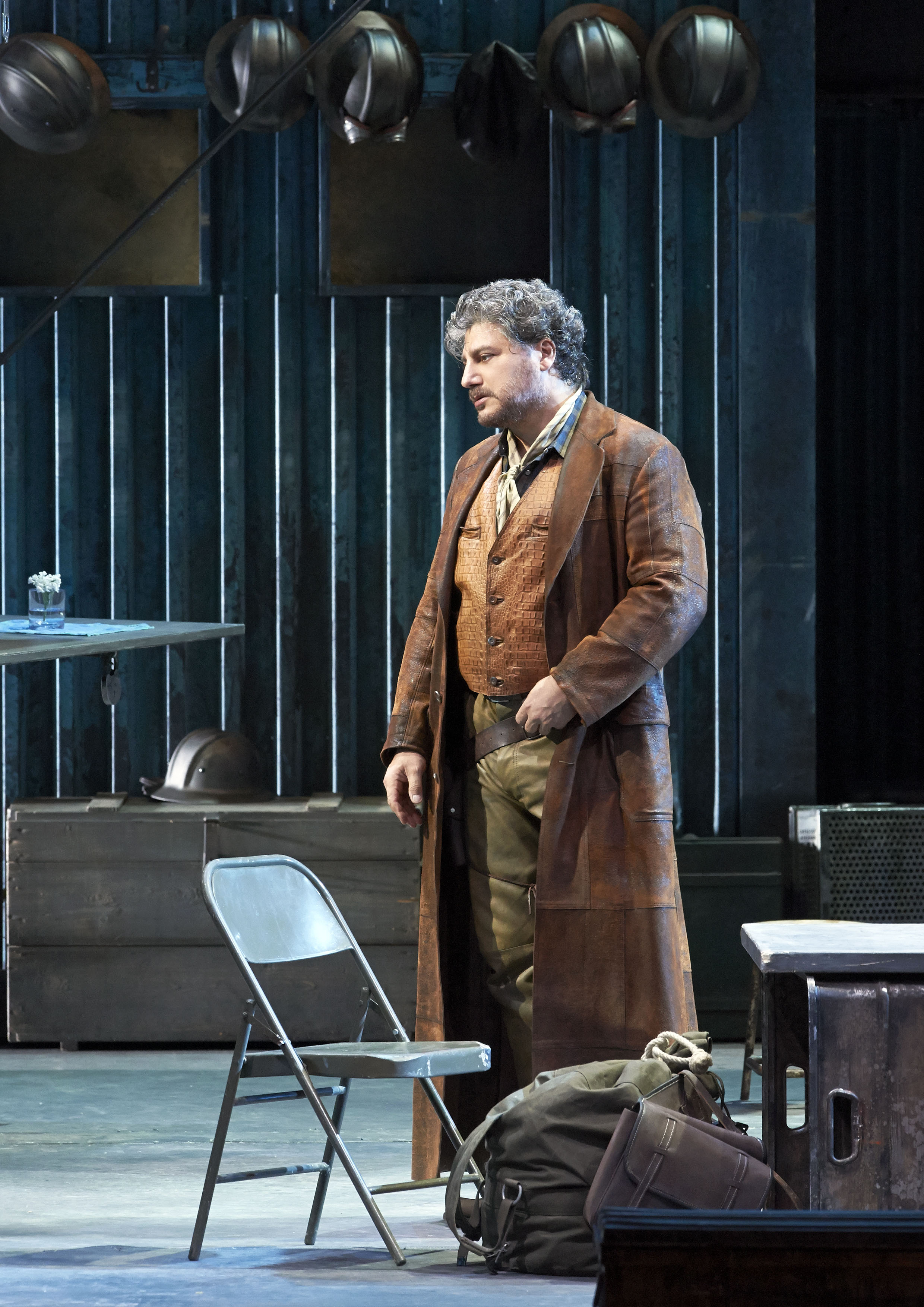
Someone arrives. Do you remember me? Jose Cura’s Dick Johnson (Ramerrez), long hair greying, craggy-faced, is in a worn leather trench coat. For so long she hoped to see him again, but it never happened. Koniezcny’s Sheriff, in black cap, confronts Johnson: she knows him and can vouch for him. ‘Care for a whiskey, Mr Johnson?’ The men stand in a circle, opening a choreographed dance, as Johnson waltzes with Minnie.
In a dramatic shift, a bandit is dragged in like a dog, (Company Manager and Jack) trying to get him to reveal the bandits’ hideaway. (Johnson/Ramirrez secretly signals to him.) Yet Minnie asks Johnson, will you help me around the camp. He’s amazed, she’s there at the mercy of drunks and thieves! She sings, in her aria, several men have already tried, but she’s not even had her first kiss! She lives there alone and is not afraid. Somehow she can trust him. In a searingly moving duet, she bewails what she might have been with a little more education.
(He sings) Don’t cry Minnie, you have a good heart and -putting his hand on her shoulder-the face of an angel. She repeats the phrase ‘face of an angel’, and Stemme seems to glow, reaching up to the heavens ecstatically.
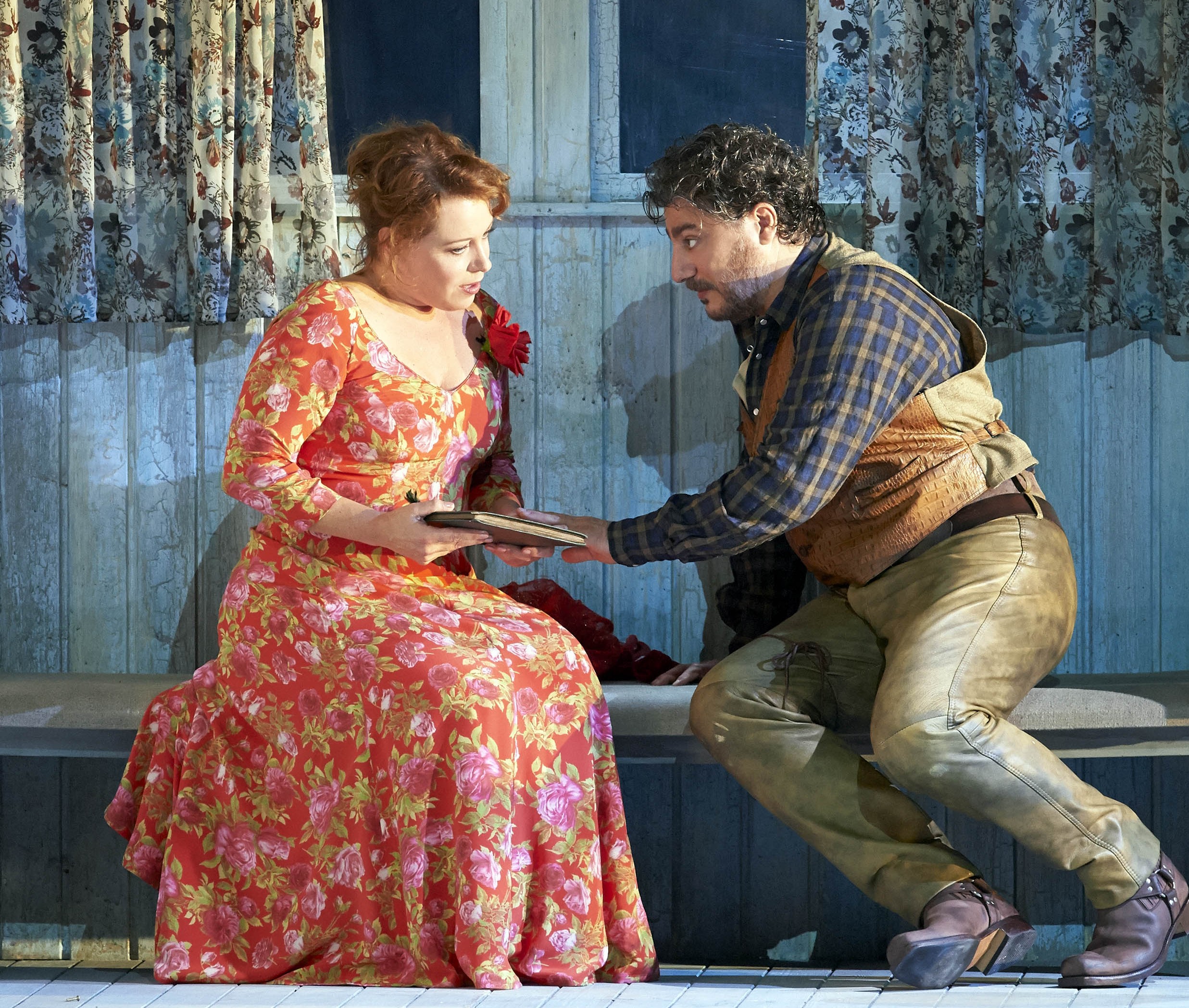
For Act 2, at Minnie’s place, the stage is dominated by a trailer-home shabbily furnished. Minnie changes behind a curtain, into a long red floral gown. Stemme’s hair is now coiffed, swept back; and putting on a rose-design shawl, reassures herself, ‘I am not all that ugly.’ Cura enters through the back door. (Minnie’s Indian girl lays a table with modest green-check cloth.) She sings to him how wonderful it is up there : Oh, se sapeste. Everything smells of vanilla. (Minutely-observed detail, characteristic of Puccini’s libretto) It’s like knocking on heaven’s door. Now Stemme’s voice soars, scaling her high register. For her, love is something infinite.
Hugging her, she complains, you’re crushing my roses- above them we see snowflakes falling. Her lips say no, but…Just one kiss! I beg you! They rush into each other’s arms, to a tempestuous orchestral climax. Their duet is a highpoint of the opera. He sings he’s loved her since he first saw her. They embrace: will live and die together. Snow outside, but he offers to go. She’s in her red robe on the couch: he, other end, on the bed she’s vacated. But he sleeps with his gun (we see, but she doesn’t.)
Jack arrives with a posse. Your friend from Sacramento is apparently a bandit- Konieczny now sports a full-length leather coat- ‘that Johnson is really Ramerrez.’ They leave, sniffing around. Cura comes out of hiding, brandishing a gun. ‘A bandit, sure hit lucky this time!’, she challenges him. He admits he’s a scoundrel, but never would have stolen from her. His father died: the gang of bandits was his inheritance. He’d prayed she’d never find out.
In a highly-charged scene, Johnson is shot by Jack outside as he leaves. She takes him in, and hides him. Jack returns with a search party; the men go; he tries to rape her on her own bed. She fights him off, but, leaving, Jack notices a drop of blood. The wounded man, apprehended, climbs down a ladder, and eventually lies lifeless on her bed, Sheriff’s gun pointed.
In Minnie’s deadly proposal, she offers ‘that man and herself’ in a game of poker. But If he wins… Konieczny, now with soaring notes. Konieczny (usually glowering) actually smiles for the first time at the prospect of winning Minnie.
Stemme, a mature woman, looked very alluring. Maybe that timeless Swedish Garbo quality. While Konieczny mixes a drink, she pulls out a winning card from her stocking. A Tosca moment! She stands holding up the cards exultantly, Stemme’s incredible soprano heaven-bound.
Act 3, against a panoramic cloudy sky, Konieczny stands side of stage brooding. That cursed dog, he’d thought he’d wounded him. Curtain raised, the stage opens up to a railroad ; a container wagon right of stage; railworkers with rifles overlooking the town. Breathtaking realism to the last detail.
He’s been caught, the cursed Spaniard. It’s all over. ‘Let him hang! ‘Sheriff Rance hands Johnson/Ramirrez over to the crowd for sentencing: that is, lynched. The way Cura is manhandled: Graphic! Pretty rough stuff. Cura pleads, spare me your mockery. I’m not afraid of death. Opposite stage, barbed wire, men with rifles aimed (on a raised platform). He appeals, for her sake, never let her know how he died. (Che’ella mi creda libero.) Minnie, he sings, she was the only flower in his life. The noose is lowered. ‘You villain!’ Konieczny kicks him brutally. But whom?
We hear a woman’s agitated cry. Minnie cuts him down. They all stand back, although taunted by Jack. ‘Let justice come into its own, she appeals: did any of them say enough when she grafted, gave them her youth. ‘The bandit that he was died under my roof.’ So it’s all about redemption. Forgive him, all the rest of you, too! She’s the girl who taught them how every sinner can find salvation.
A balloon descends, a rainbow-effect opens out as they ascend. Gorgeous, irresistible: but surreal? A dream sequence, pure Hollywood, neutralises the shock of Puccini’s subversive ending. A quibble. This production could hardly have been bettered. Graeme Jenkins conducted Vienna State Opera Orchestra and chorus, and an exemplary cast, thrillingly choreographed. P.R.14.09.2014
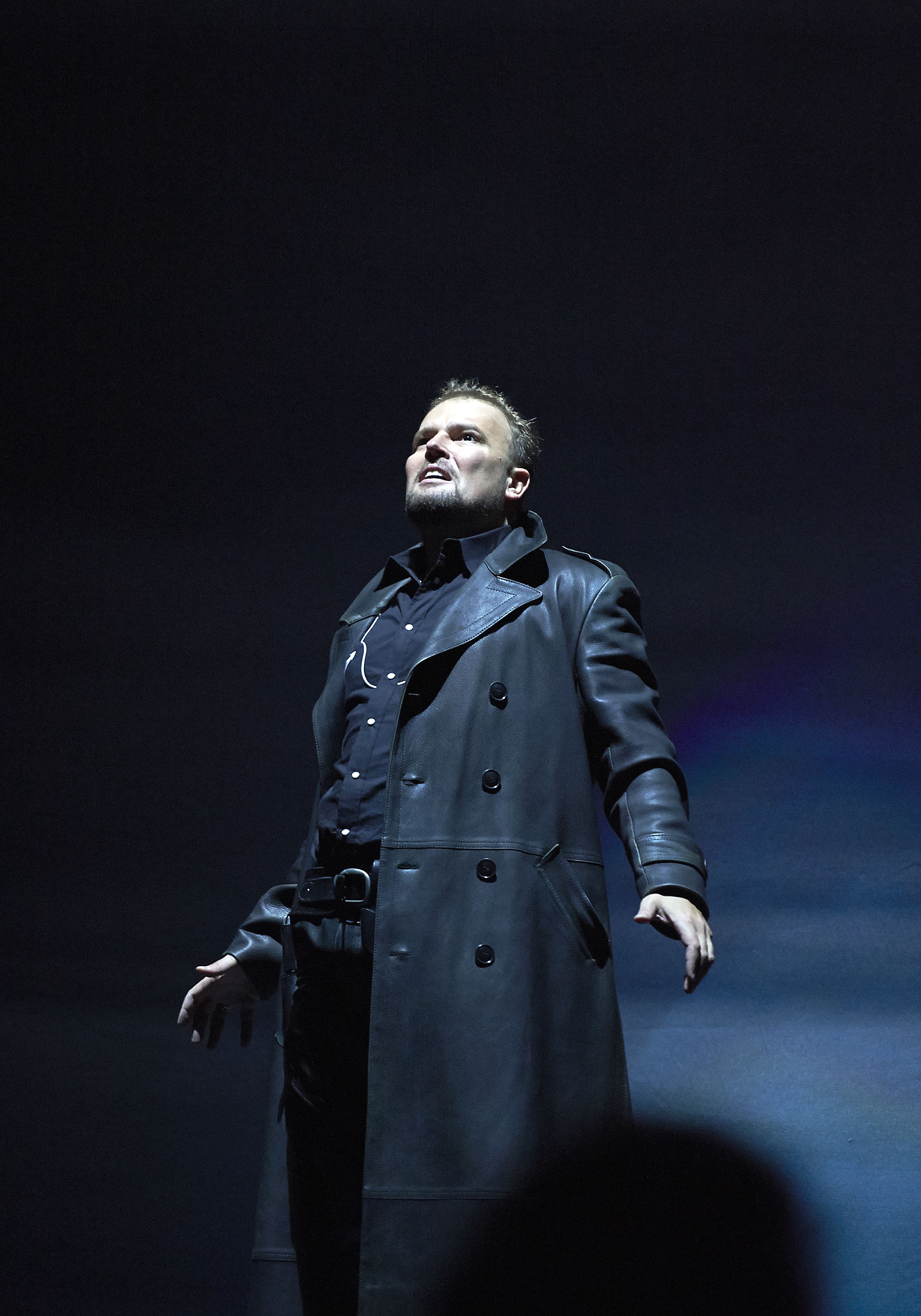
Photos: Nina Stemme (Minnie) and Jose Cura (Dick Johnson); Tomasz Konieczny (Jack Rance); Jose Cura (Dick Johnson); Theme image Nina Stemme and Tomasz Konieczny
(c) Wiener Staatsoper/ Michael Pöhn
Dvorak’s Rusalka
Dvorák’s Rusalka is based on Bohemian folk-lore: the water nymph Rusalka, in love with a prince visiting her lake, wants to become human. But she will lose her ‘voice’; and the prince, cursed, will lose his life. The story could be a parable for the loss of innocence: indigenous peoples corrupted by modern invaders subsuming their cultural identity. The prince has found ‘a dumb woman in the forest’, they gossip . Rusalka, with the prince, remains unknown to him: fearful, and showing no passion. So the prince turns away -with the arrival of a ‘foreign princess’- to his own kind. Rusalka is stranded between alien cultures, neither a woman nor a nymph. Their love is doomed by the ‘curse’ of their incompatibility.
But operagoers visit Rusalka for Dvorák’s ravishing music; and would be reassured by Vienna State Opera’s traditional, late 19th century, modern-tweaked, production, directed by Sven-Eric Bechtholf. Rusalka (Olga Bezsmertna) begins staring out over a balcony, beneath, her father the wood goblin is being teased by water nymphs. Rolf Glittenberg’s set, on two levels with withered trees, cleverly depicts an underground, underwater world. In her aria , Rusalka’s feeling sad; she’d like to leave these watery depths: be human beneath the rays of the sun. ‘You want to be human?‘, her father (Günther Groissböck) interjects.- They have something called an immortal soul. ‘Don’t crave for a sinful soul’, he warns. But she craves love: sings of the man she sees bathing-without his clothes- in her presence. She knows that if she were a woman , she would embrace him and he would return her kisses. Erotic, voyeuristic? But it’s sung by Bezsmertna with unaffected innocence. Her wood nymphs would weep for her every night, warns her father. (Would they, the Prince is the very good-looking Piotr Beczala.) She will be lost forever, he forbodes. Groissböck- young Austrian, in demand- has a superlative baritone.
Now the opera’s hit number, that went viral for Dvorák (in the 1890s). In her aria Rusalka invokes the moon. You travel the world, looking down on the homes of mankind. ‘Oh moon, tell me where my beloved is, whisper to him that he may embrace me in his dreams, oh silver glittering moon…’ Bezsmertna sings movingly, without affectation, so plaintively. It’s meltingly sad.
‘Poor pale Rusalka’ visits sorceress Jezibaba (Janina Baechle). She pleads for a magic potion to release her. Baechle, huddled in dark furs, creeps around the stage picking up dead birds. She has elemental forces. ‘Is that all you’ve come for?’ Baechle’s is a formidable mezzo-soprano (a Wagnerian who sang Erda here recently.) If she fails to find human happiness, she and her lover will be cursed. Would she be voiceless for the price of her love?- Rusalka, defiantly, she’ll gladly be mute. (She thinks her human soul will overcome such obstacles.)
A voice is heard off-stage: Don’t shoot! We see a huntsman (baritone Mihail Dogitari.) The Prince knows she’s nothing but a spirit: will fade away. ‘Stay with me my faint spirit’; his hunt is over. Beczala is outstanding; his tenor has great power, but purity. Beczala leads in with Rusalka’s motif : Divine sweet dream! Bezsmertna’s Rusalka is in a white satin shift; he, Beczala, in a silver grey suit with traditional loden collar. The sisters sing one of their number is missing.
Act 2’s brilliantly lit stage is backed by a frosted window. The gamekeeper and cook sing about the strange creature the prince came across in the forest. The woman cannot speak, is quite pale. May they be protected from such ‘ill-fated love’.
Beczala sings ‘for days you’ve been laying at my side in a daze’. He stares into her eyes, but she’s enveloped in a dream. She, Bezsmertna, is laid out on a black velvet-covered platform. Why is he filled with anguish? Nevertheless, even if cold as ice, he must make her his. She, singing to the audience, feels no love for him, but cannot bear another to take her place.
The ‘foreign princess’ arrives, and intervenes reminding him of his duties: even a bridegroom is a servant. ‘And your beloved remains silent! Does she speak to you only with her eyes?’ Mezzo-soprano Monika Bohinec, brunette in a claret velvet gown, sequined midriff, and wearing a tiara. He’ll quickly make up for his neglect, he promises. (Rusalka looks on powerless, quivering.) Though his heart may belong to you, the honour is mine, boasts Bohinec’s princess.
Bezsmertna waltzes around the stage in a white wedding dress. Amazingly, and significantly, Rusalka doesn’t sing in this scene. The loss of her voice signifies the sacrifice of her individual self: the suppression of her cultural identity.
In this staging, a choreographed dream-like sequence, she stands overlooking a burlesque scene in which a rather plump prince (Beczala) in long-johns, jumps on the Princess (Bohinec) laid out in white on the ‘marriage bed’. Rusalka haunts them, in a prolonged motion, as if invisible: she’s a sprite after all.
The Goblin upbraids her. ‘You have fallen for the dazzling beauty of the world, alas!‘ For all her human form, a nymph’s blood flows in her veins. Groissböck’s goblin- in dark coat, with long platinum-white hair – forewarns her ‘Alas, poor Rusalka, human nature will become a curse to you. (Meanwhile, the human world is portrayed in a chic tableau. The Prince’s household in black outfits, bride and groom splayed out.)
‘Woe is me for betraying you,’ returning to her father, she’s found her voice again. Bezsmertna sings, hitting tremendous high notes. He has fallen for another, a wild , human beauty, and abandoned his poor Rusalka. Groissbock tears apart the wedding dress in a rage. Bezsmertna, powerful, impassioned, yet admits, ‘I was born of the cold water and have never known fire! I am cast out by you and lost to him.’ She’s neither woman or nymph: can neither live or die!
Meanwhile, the bitchy Princess sings asking ‘Where has she flown to, the one without a voice and a name. Bohinec back in her claret gown, taunts, will he embrace that sleepwalking beauty of his. Beczala sings enigmatically, how ‘he would break his vows to love only you’, singing of Rusalka’s cold, white beauty. Rusalka stands back of stage, as if reaching out to him. ‘Follow your chosen one to the depths of hell!’ thunders Bohinec.
Act 3 and again the double-levelled stage, upper storey balcony window looking out at the human world. Rusalka now sings from the underworld, bewailing her happy youth, condemned by her transgression to pine away in the cold waters. Didn’t you enjoy the kisses and find company in the human world, Jezibaba cajoles. Only human blood -his -can purge her and remove her curse. Excellent: chillingly sung by Baechle. But Rusalka rejects her: would rather suffer eternal torment. But he must know happiness!
She’s the outsider. A chorus of women sprites sing of how they will shun her; she will never be able to return to their world. The Goblin sings, it was the Prince who betrayed her: he’ll be avenged. There’s an enchanting, but problematic, scene in which the sprites hover over a body, their hands bathed in blood.
The Prince calls out to his ‘little white deer’; sings, night after night, he searches for her deep in the forest. Beczala, incongruously dressed – black frock -coat, silver trousers- like an old-fashioned crooner: Speak to me voiceless forest.
She sings, my dearest one, do you still recognise me?- He, if you are dead, kill me. If alive, save me!’ Suspended between worlds, she sings, she was once his beloved, now can only bring him death. A will-of-the wisp, her womanhood is defiled. If she were to kiss him now, he’d be lost forever. But he will pay for his deceit. Beczala, sings pleadingly, ‘Kiss me!’ He dies, petrified, as if metamorphosing into the trees.
His death was in vain, deems the Goblin. But Rusalka appeals to God to have mercy on his soul. Bezsmertna, who stepped in at short notice, was magnificent; and warmly applauded.
Tomas Netopil inspired idiomatic playing from Vienna State Opera orchestra and Chorus in a performance sung in Czech, authenticating Dvorák’s score. Vienna Staatsballet dancers added to a very special occasion. P.R. 10.09.2014
Photos: Olga Bezsmertna (Rusalka); Piotr Beczala (the Prince); Olga Bezsmertna and Günther Groissböck (Water goblin); theme image Olga Bezsmertna and Piotr Beczala
(c) Wiener Staatsoper /Michael Pöhn
Verdi’s Il Trovatore
Verdi’s Il Trovatore is one of a trio of operas -after Rigoletto, before La Traviata -that (beginning 1850s) launched Verdi’s worldwide fame. But Trovatore has fallen out of favour, reviled for a supposedly weak and implausible libretto, its scandalous ‘Church baiting’. Verdi’s contemporary critic Edward Hanslick scorned the sensationalised horror in which a gypsy brings up the son she rescues from a fire. In Verdi’s plot Manrico thinks he’s the son of gypsy Azecuna, who’s obsessed with avenging her own murdered child. The key theme is the deadly rivalry between unknowingly estranged blood brothers. The outsider (troubadour) Manrico and Count Luna (military commander) are on opposed sides politically, but also in love with the same woman, Leonora. Verdi’s love story is also a ‘parable of the repression of minorities.’
Vienna Volksoper’s Il Trovatore , a co-production with Bonn Opera directed by Dietrich Hilsdorf, has polarised opinion. So I’d expected a radically modern take. Not so. It was criticised as a tasteless spectacle, but well crafted. Arguably, the shock scenarios, derive from the material. The bloodthirsty scenes are justified in depicting the ‘Inquisition’.
In the event it is thrilling theatre, restoring the stage to Verdi’s mid-19th century context : gothic blood and gore, a mystery thriller of its time.
So I can’t understand why Vienna Volksoper wasn’t packed. No really big names, but the sets are splendid, the measure of the more famous Staatsoper, which invariably has full houses, and Volksoper Orchestra and chorus, under veteran Alfred Eschwé, are of the best.
The opening scene is pure spectacle, soldiers in colour co-ordinated burgundy and lilac; background authentically grey plastered walls. But it’s shocking- Ferrando, their CO stirs up the soldiers’ fear of witches and hatred of gypsies: setting the scene, underlying suspicions and racism. He sings of how a gypsy abducted and burned the Duke’s son; the witch- albeit life-size puppet- is baited and viciously bayoneted.
But the Chorus is splendid, Verdi a composer ‘at the height of this melodic vitality’. Indeed the Chorus- as in Rigoletto– have some of the most memorable tunes, (Trovatore’s characters perhaps less memorable.)
Verdi’s opera is unusually divided into ‘Scenes’. Purists might complain of ‘Director’s cuts’: the opera expurgated. But the episodes with introductory titles give a modern ‘cinematic’ quality.
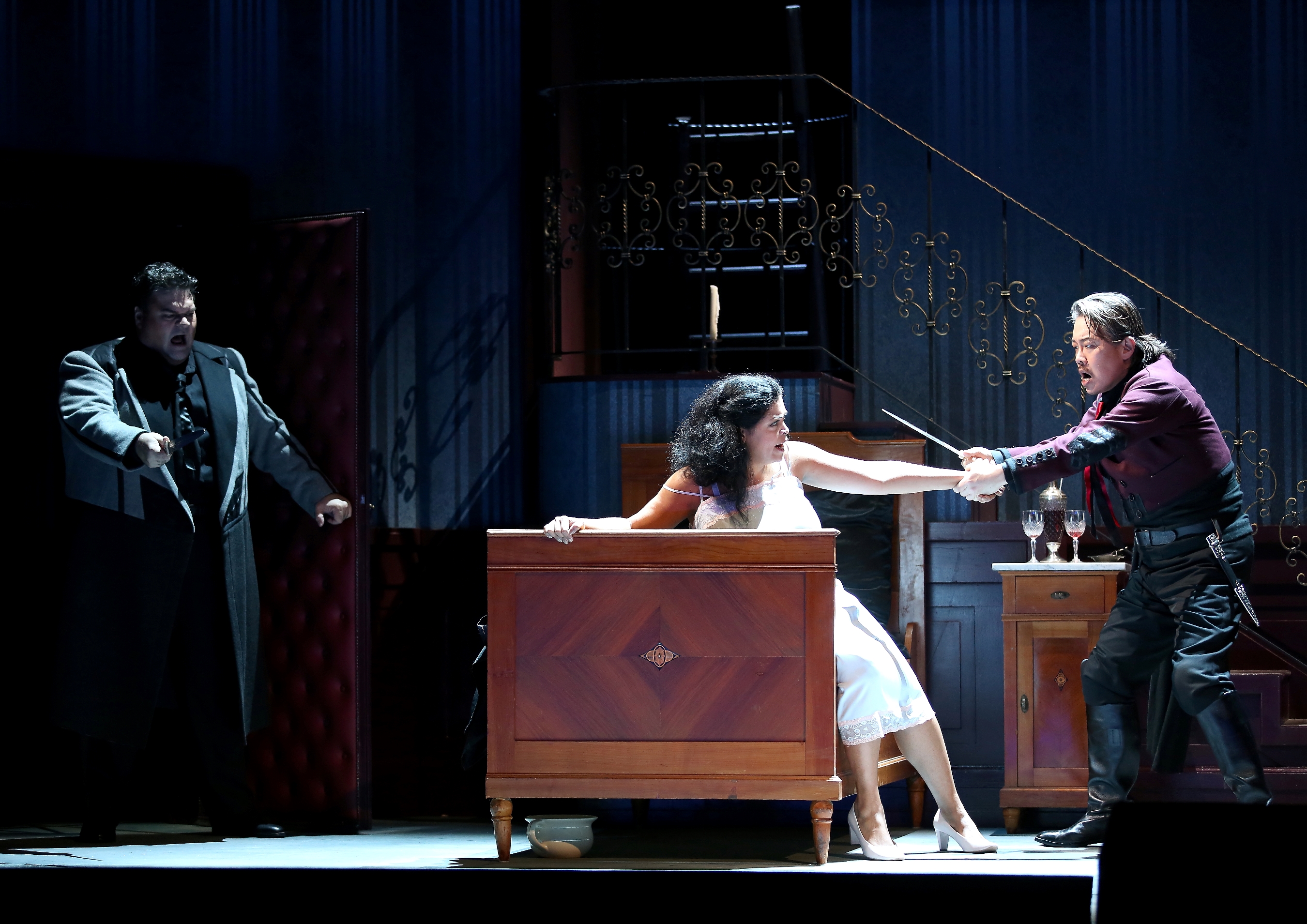
So scene 2 (The Duel) Leonora is the focus, waiting for her troubadour. She’s warned by her friend of the consequences of the social mismatch. (Again a stylish set: four-poster bed centre, rear a wrought-iron stair well, refined regency silk-papered walls.) Leonora (Irina Oknina) is elegantly sung in her aria about the dream : not the most powerful of sopranos, but bewitching. And surprisingly, moving to the front of stage, she scales the heights: love is too great to put into words, her fate is defined in proximity to him. She casts off white satin layers: then in a ravishing aria -now with a wine glass in her hand- wearing only a white slip.
Manrico at Leonora’s window, observes her- in the arms of Count Luna. Mathew Hausmann, tall, black-hatted, croons every fibre in him burns of love: he must see her. He trembles, a heart gives hope. A voice off-stage, Manrico. Faithless! – She’s thrust between the two rivals. Manrico is Vincent Schirrmacher, effectively groomed as Italian. The two protagonists brandish their glimmering swords- the bed in between- Leonora at first separating them.
The Gypsy scene: Vedi! Le fosche notturne spoglie, the gypsies’ Anvil Chorus. A stage of black-clad figures, with a make-do statue of the Madonna on an oil barrel; left- stage a barred window. Azucena the formidable mezzo Chariklia Mavropoulou, sings of a woman burnt at the stake: the flames blaze to the heavens! As the female Chorus reiterate the men’s refrain- she emerges. Manrico, badly wounded, is on crutches, nursed to health by Azecuna. She sings of how she exchanged her own son- sacrificed to the fire -to rescue him. How her mother cried for revenge, her words engraved in her soul: how her own son cried so badly it was heart-rending. Mavropoulou, a fulsome lady, magnificently enacts her role. She sings, appeals to the heavens – kneeling- still consumed with grief. (God is this operatic!) -Manrico, then is he not her son? – She convinces him: has she not always given him a mother’s love. She was confused- reacting to her story- so overcome by emotion. The ‘accursed moonshine’ shone on him.
Manrico sings of how he wanted to administer the fatal blow to the Count; an unforeseen power stopped him. Now she offers him her dagger. He swears -without mercy- to avenge her and kill Luna.
In a grey-walled cloister, Count Luna hearing Leonora -presuming Manrico dead- intends to enter a nunnery, laments in his aria: everything is lost, but he ‘won’t let her become another Jesus’. She’s his! He sings of her beauty, her radiant smile. The Count is on his knees pleading- Housman finely articulated, but not the thrilling high notes. But what staging! He uncovers a marble life-size statue of Christ; unbolted, hides in its place. Red uniformed soldiers swarm in to abduct Leonora. Off-stage nuns are heard; they approach with candles. The Count jumps out from beneath a black cloak; and there’s Manrico holding his sword unsheathed. (Meanwhile nuns cluster behind the Christ statue for protection.) The Count clutches at Leonora. Soldiers raise their rifles as Leonora escapes with Manrico.
The witch hunters scene, in which Azecuna is interrogated, is shocking , but not gratuitous. (It anticipates Verdi’s Don Carlo where Flemish Protestants are incinerated.) Two black- hooded figures bearing placards are beaten in procession by soldiers- ironically accompanied by Verdi’s jolly Squilli echeggi la tromba guerriera. But front of stage, there’s a cage with a stooped figure being poked by inquisitors, a Priest attending. Azecuna is interrogated, put to the test. Gypsies have no roots, she responds defiantly. She’s handcuffed, plied by Luna with wine. She’s revealed as the child abductress- daughter of the witch they had burned. Azecuna cries out for Manrico. The soldiers, linked in a line, begin a ‘witches dance’. Azecuna is led to a fire. Macropoulu is heart-rending, chillingly powerful, but no way exaggerated.
Meanwhile (The Gypsy’s Son) Manrico and Leonora together at last, prepare to wed. He’ll think of her to his last breath (Ah si, ben mio. ) Schirrmacher sings eloquently, with beautiful diction. (Heavenly Chorus; Madonna foreground; we glimpse green lawns, people in flight, indicating war.)
In the Revenge of the Rivals, Manrico is led away blind-folded. Leonora positioned (centre stage) front of the bed, is seated blindfolded in a black coat, before her interrogator. In her aria, she reminds Luna of their previous love. Beautifully enunciated, Oknina’s Leonora, a lighter soprano, but no hint of strain. Her coloratura was beguiling. She’s shunted across the stage, observed silently by the Count. His only God is revenge, he sings. She begs mercy for Manrico. Her appeal enrages him. She swears to offer herself to him (while she takes poison unnoticed.) For him it’s a dream come true.
For The Execution, the set is a grey-plastered building. Manrico is sitting on a long bench with Azecuna now blind. Mavropoulou, hair -cropped, wearing large dark glasses, sings movingly she’s tormented by visions: the picture of the burning woman, her mother. Weariness bears down on her (Si la stanchezza m’opprime.) They find solace in Manrico’s troubadour song, D’amor sull’alli rosee.
Leonora has come to recue Manrico: but at what price? She has sold their love- he reproaches her- to his rival. She begs him to escape, or all is lost. Oknina is on her knees, the poison working too quickly. She collapses between the two rivals, confessing to Manrico, she chose death rather than life with another man. Manrico is carried away .
The closure is vintage Verdi. In his death throes, Manrico calls for his mother. Azecuna sings triumphantly to Luna, ‘He was your brother!’…’Mother, you are avenged!’ Her vow fulfilled, yet, dying, she calls for Manrico, her son.
This Volksoper co-production is a triumph of stagecraft and not to be missed. The cast was adequate, Mavropoulou unforgettable. This revival justifies Verdi’s Il Trovatore, ‘a phenomenon in Italian opera.’ P.R. 3.09.2014
Photos: Stuart Neill (Manrico), Melba Ramos (Leonora) and Tito You (Luna) ;Melba Ramos (Leonora); Janina Baechle (Azecuna) .Photos of the September 2014 cast were not available
(c) Barbara Pálffy / Volksoper Wien
Wagner’s The Ring : Die Walküre (The Valkyrie)
It began to go wrong with the announcement that Peter Seiffert (Siegmund) had laryngitis but would, nevertheless sing. (Warm applause from the audience). Jeffrey Tate, engaged to conduct the entire Wagner Ring cycle had already cancelled due to illness: replaced tonight by Cornelius Meister. The solid cast still included Nina Stemme (Brünhilde ) and Tomasz Konieczny’s Wotan. At least the foundations of Vienna State Opera’s production for Die Walküre were dependable: Rolf Glittenberg’s stage design, both minimalist and monumental, the costumes unobtrusive, classic, modern, with a gothic twist.
In the dramatic opening, urgent strings, blazing horns, flashes of lightning reveal a sparsely furnished stage. The white silhouette of a wolf (the Wälsung emblem) is projected side of the stage enclosing the Hunding’s humble living room, the refuge for the desperate Siegmund. (Hunding’s wife Sieglinde takes him in-unaware of his identity, Siegmund being her brother.) Gun-Brit Barkman’s soprano is clear, with a classical purity. She’s a slightly-built figure-dark-haired, tenderly eyeing him as she brings him food. She revives him: Die Sonne lacht mir neu, proclaims Siegmund. But he sings (Seiffert movingly) of how misfortune follows him: Mitsunde folgt mir. Woeful (Wehmut) he calls himself. They approach each other in a corner: the sound of a hunting horn disturbs them.
You are reviving him! Ain Anger an immensely deep bass, an experienced Hunding, has sung the role since 2007. They’re bound by the laws of hospitality. How he resembles my wife, comments Hunding. (Not exactly, Seiffert an immense figure in animal skins.) My father was a Wälsung, sings Siegmund, he lost both brother and sister. Ever an outcast, he’s plagued by bad luck; ruins everything. He’s wund and waffenlos (addressing Sieglinde). Seiffert, a tragic figure, has pathos and dignity. Hunding realises who’s the man before him: his call is revenge. But he’ll shelter him for the night, bear arms in the morning. 
The wolf is again projected moving across the back of the stage. Siegmund knows about the sword: Walse! Where is your sword. Seiffert, struggling, does his best. In a sublime aria, sings of the sun’s holy light that has inspired in him a new energy. Sieglinde, who’s given Hunding a sleeping potion, sings of the Held , the hero before her: of her tears and consolation. Barkmin has fine articulation, but does she have the power for this monumental role? Seiffert’s magnificent tenor is straining , but even his limited range rises above her. He sings of the Mondlicht (moon light). Du bist der Lenz ; Sieglinde’s top notes lack that rocket fuel. He saw her in a dream. She saw herself with a brother. Was Walse your father, she sings. ‘Siegmund so nenne ich dich’ – ‘Siegmund heisse ich und bin ich!’ He uses his name only in extremity. Noting, so he names the sword she unsheaths. They realise their relationship is adulterous, yet they will make eternal the Walsing dynasty.
Act 2 Die Walküre and we’re back to the ice floats of Valhalla. The stage is a subtle mix of sci-fi and gothic; there are pillars of craggy stalactites, the stage is bathed in a white moonlight. Curiously, the gods play with the heads of the protagonists, miniaturized like voodoo objects.
The daring husband is sick, (Der Kühn der Gatten verkrankt). Tomasz Konieczny’s baritone is sensational- deeper and more complex than in Das Rheingold– like a vintage wine. He’s a generation older since the bucaneering Wotan- the eye-patched figure in Rheingold. The transition is tremendous. Fricka (Elisabeth Kulman) : So it’s Schluss with the eternal gods? Untreu, fruchtlose. This Fricka is so slim, yet she has terrific vocal resources. She too seems more impressive than in Rheingold.
Her intervention must be powerfully convincing to persuade Wotan not to side with his son Siegmund. (Sieglinde is his daughter.) Surely the lord of all pledges cannot tolerate such unlawful adultery and incest? The Wälsung loses her honour: stick to your oath.
So Wotan, against his wishes -his hope was that a hero will win back the Ring- has to order Brünnhilde to kill Siegmund. I am the saddest of them all, sings Wotan. He recalls to Brünnhilde the tale of woe: Alberich’s curse. ‘Was ich liebe müss ich verlassen’, the curse of the gods. ‘Go to him’. The law must be implemented.
In Brünnhilde’s aria, Stemme sings Heavy weighs the weapon of rage: must he betray the faithful: (Leid müss dich treulos die treu veraten.) She is commissioned to kill Siegmund, but cannot: sides with both sinners; and demonstrating human weakness, loses her god-like status. Stemme is both goddess -superhuman vocal resources, immensely powerful range – and human, with warmth and poignancy.
In the Siegmund and Brünnhilde scene, Herbert Lippert has taken over from the heroic, but ill, Peter Seiffert. Lippert is not a helden tenor, but he sings lyrically.Brünnhilde forewarns him of his impending death, but promises a glorious entry into Valhalla . Siegmund rejects the offer when he learns Sieglinde cannot follow him there. (Brünnhilde protects Sieglinde pregnant with Siegfried.)
Act 3, and the set is astounding. We see life-size models of horses on stage, the body of Siegmund laid out. The warriors’ strife disturbs even the horses! the Rhinemaidens sing. The Ride of the Valkyries blazes from the orchestral pit. Brünnhilde sings that for the first time she’s being pursued- a thunderstorm from the north, representing her father’s rage.
In her confrontation with Wotan, Valkyrie, Walsa maid is she no longer. Is he casting her out? He pronounces, she’s no longer his emmissary. She’s condemned, exiled from the land of the immortals ‘aus der ewige Stamme.’ Wotan’s utters his curse: he who overpowers her will rule her maidenhood. Here the Rhinemaidens scream- Save her this disgrace – emitting a shrill, siren-like, wailing. She’ll never ride on horseback with the Valkyries again! Centre- stage Konieczny’s Wotan stands fiercely, swinging his spear in a circle like an Olympic javelin player.
Stemme’s appeal to Wotan is inevitably a highlight. ‘War es so schmach, war es so niedrig…‘: was her act so vile to suffer from a humiliation so dishonourable. Oh, look me in he eyes! Calm your rage. And she sings referring cryptically to ‘the hidden guilt that makes you abandon your favourite child.’ Did he not order her to fight for the Wälsung. But he became his own enemy when he acted on Fricka’s demand. She knows he loved the Walsing. And she had to help Siegmund; realised the hero’s distress. Machtige Trost : it was victory or death for Siegmund.
She pleads- Stemme affecting, with human warmth- protect her as she sleeps: so only a hero will wake her. In this long scene, Wotan finally relents, changing his order to ‘the bravest man she encounters’; and surrounds her with a wall of fire impenetrable but to the bravest.
So the god departs, kissing the divinity from Brünnhilde. Somehow he lacked the cosmic dimmension. Konieczny is a lyrical, romantic bass-baritone (at his best, perhaps, in those Strauss roles (Mandrycka in Arabella.) Konieczny’s bass-baritone is, for me, not best suited for Wotan. Technically fine, but not superhuman. In other words, less interesting over (Wagner’s) long passages (unlike the Finn Juha Uusitalo in the 2009 performances of this Sven -Eric Bechtolf production.)
But super stage effects closing Act 3! Flames are projected around the stage – the horses still in place- to depict Brünnhilde’s fate. Terrifically effective. The flames even change direction, blowing, laterally, like Saturn’s rings.
Tonight’s conductor Cornelius Meister was competent, but lacked that spiritual quality the best Wagner conductors can summon- (Welser-Möst (2009), Christian Thielemann (2011) had it.) Over a five hour saga there has to be a structure, a game plan- not just enervating, shorter passages. Earlier, rather sadly, Peter Seiffert braved the first Act: valiant, but painful for him, risking that golden tenor. In-house tenor Herbert Lippert stepped in very plausibly: a lyric rather than Heldentenor, he looked right, and saved the evening. P.R. 22.06.2014
Photos: Thomasz Konieczny (Wotan) and Elisabeth Kulman (Fricka); Peter Seiffert (Siegmund) and Gun-Brit Barkmin (Sieglinde); Nina Stemme as Brünnhilde (photo from Siegfried) ; Featured image Peter Seiffert and Grun-Brit Barkmin
(c) Wiener Staatsoper/ Michael Pöhn
Wagner’s Ring: Das Rheingold
For Wagner’s operas, it isn’t enough to assemble the finest soloists, the best orchestras and chorus. Wagner intended his Ring cycle as a Gesamtkunstwerk, total music drama. So the staging is crucial to the mix. Epic, surely, befitting the interplay of the gods; but the mythology, timeless defies any specific époque, archaic, or modern. And, please, no silly designer concept to detract from onstage drama!
Sven Bechtholf’s production, first staged Vienna State opera 2007, nearly succeeds. In the opening, Das Rheingold, Rolf Glittenberg’s sets are monumental, but minimalist, but the costumes are sometimes distracting.
The orchestral Prelude (Vienna State opera orchestra under Adam Fischer ) built to an unbearable tension. Anticipating the appearance of the Rhinemaidens -white-clad figures on rocks bathed in a grey moonlight, beneath them an effective tarpaulin covering like waves. Their arms sway in semaphore as if they are controlling the waves. Alberich (Jochen Schmeckenbecher)- squat, toad-like, repugnant- they cajole him, teasingly. A sulphurous dwarf, he may be, but they’re fishes after all, he counters. Alberich is bare torsoed, with long, greasy hair, wearing baggy pants. A Rhinemaiden pushes him over: the dwarf lies beneath them, the Rhinemaidens towering imperiously over him. They entangle him in swathes of their long scarf-like material- seaweed. It’s like a sado-masochistic ritual. These are the ultimate in superdames, their gowns now under green light.
There’s a wooden structure- in fact, housing slabs of gold- in which Alberich is messing. Alberich’s curse is that only he who renounces love can avail himself of the gold. Nur wer der Minne Macht entsagt, sings Woglinde to Wagner’s famous tubas. (And, Wellgunde, whoever can fashion a ring from the gold will inherit the world.) So they taunt him, come Alberich, come smile at us! Now the three maidens retreat into what look like giant mushrooms, or toadstools. So verfluche ich die Liebe: he curses love and goes for gold.
A long orchestral interlude. A brilliantly white stage, Wotan seated on what looks like an iceberg. Oh, mein Gott! Tomasz Konieczny, in a black shirt, grey mohair trousers, a white duster coat, appears to be wearing shades: in fact a black eye patch. His wife Fricka (Elisabeth Kulman) is in a shimmering silver creation, black inset, silver grey cloak with snow-flake motif. (They’re all, the rest of the Valkirie gods, in brilliant white.) She’d warned him. He’s (Wotan) contracted the giants Fafner and Fasolt to the building of their palace. Now they demand their prize, her sister Freia. The other gods defend Freia, but Wotan -the god of treaties- must keep his word. ‘Gier’. It’s all about greed.
Freia (Caroline Wenbourne) is all in white. The two builder giants are like blown-up Giacometti sculptures (or, if you like , Michelin men): they’re wearing latex in a carbon coal-like effect. Silver, yet shaven-headed, the giants are dignified, sympathetic. Fasolt (bass Sorin Coliban) and Fafner (Ain Anger) are distinguished singers.
The moral: the richest -even the gods- can breach their word when it comes to (not) paying workmen and servants.
Donner, god of thunder, (Boaz Daniel) picks up an oversized ice pick and challenges Fasolt and Fafner. Loge, the cunning god of fire, Norbert Ernst in a shiny black DB suit, and with orange shoulder-length hair, looks like a rock star. In the plot, Alberich, now Mr Big, has stolen the Rhinegold. The giants agree to release Freia, who they drag away, for Alberich’s gold. So Wotan and Loge set of to trick Alberich…
Third scene change. Centre stage glass cabinets showing human parts- limbs and legs. With a diamond effect stage backdrop, it’s all very high -tech, the smoked glass panels bathed in a red light. Alberich’s Nibelungs are melting a hoard of gold, his minions like coalminers, but with orange helmet LED lamps. They lie in a heap at his feet; then they’re off suddenly scampering like vermin.
Alberich’s brother Mime, (Herwig Pecoraro), who created the magical Tarnhelm, writhes in agony at Alberich’s invisible whiplashes. Alberich, in boasting to Wotan of his magic powers, turns himself from a dragon into a toad. But the crawling Kröte is crushed and seized by Wotan, to whom he must surrender gold, Tarn-helmet and Ring.
It’s an unfair contest, the god Wotan resorting to trickery for greed. Schmeckenbecher, a lyrical tenor, actually engages our sympathies -against Konieczny’s perfect- if overbearing- Gott figure Wotan, an arrogant mobster with his eye patch! (Alberich screams and curses the Ring: Verflucht sei dieser Ring (besides power, it will bring death and misfortune.)
Back to the white wasteland of Valhalla, the floating icebergs. The court of the gods, all wide lapels, wide (flared) bottom trousers, all in white, could be out of a 1970s Abba video. But they’re not a nice lot. Rather a Lars Von Trier family saga of greed, lust and incest.
Wotan is admiring that expensive ring on his finger. Looming, threatening back-stage, the idyll is threatened by the giants come for their payment, Freia as contracted. Donner (Boz Daniel) lamely threatens with that icepick; but Wotan reluctantly gives the gold to the giants. Those nasty workers -those gross giants soiling their perfectly styled designer den- have to be paid off.
We see Wotan still admiring the Ring, its allure bound up with transgression, the arcane, symbolising the corruption of power. Only when the goddess Erda intercedes will Wotan give it up.
Erda’s aria is a highlight. Erda ( mezzo-soprano Janina Baechle), the voice of wisdom, represents spiritual values against their materialistic greed and power lust. She foresees everything: how it was, will be; warns of the end of the gods. Baechle is hooded, in blue, as if she’s emerged out of an earth crevice. She sings movingly, yet with a quality of stillness. ‘Ein düster Tag dämmert den Göttern. Dir rat ich meide den Ring! (Behind her Wotan stands brandishing the ring.) She warns him: she already knows everything. ‘Keep your word!’ So Freia is freed : the giants take their gold. But backstage, they fight in a dispute over the gold ; Fafner kills his brother Fasolt. The curse of the Ring is already working.
While Loge swishes away with the Ring, Wotan and the Valhalla ‘family’ of gods pose, as if frozen, for a photo-shoot. Donner is seen swinging his hammer(conjuring a storm), rotating his arm on the ice float. Slightly absurdly, he’s in a calf-length white coat, black patent shoes- as if he’s exited an A-list night club. Absurd, but it’s superbly sung.
Centre stage is Wotan kneeling. Follow me, wife: in Valhalla live with me! Now I’m concerned that Konieczny hasn’t quite the ballast for this role-that uncanny, superhuman, godlike power.
Loge schemes of more fun, more evil. Loge remarks, the gods crossing triumphantly into Valhalla, are hastening to their doom. The Rhinemaidens sing, give us back our gold. Treasure is only what lies deep -not the false gleam of the surface. There’s allegory for you!
The elderly Viennese operalover summed it up. Konieczny was no Wotan. Not deep enough. As I’d thought , Konieczny was too human, his bass-baritone lacking rather that inhuman, unworldly quality. Konieczny, with that eye patch resembles a pirate, swashbuckling, cheeky, mischievous. And inappropriate. For the Viennese, Elisabeth Kulman’s Fricka was the highlight. For me, Janina Baechle’s Erda had it, that intangible , other worldly quality. Her short scenes -bewitching, enthralling- held time still. PR. 19.06.2014
Photos: Tomasz Konieczny (Wotan) and Norbert Ernst (Loge); Tomasz Konieczny and Jochen Schmeckenbecher (Alberich); Group photo used as featured image
(c) Wiener Staatsoper/ Michael Pöhn
Bellini’s Norma
Another dream come true in Vienna, the city of dreams? This one’s at Vienna State Opera: Edita Gruberova, legendary in the title role of Bellini’s Norma, had to cancel due to a broken leg. It’s the fairy tale of the diva giving a younger artist a break. Sounds familiar -remember The Boy Friend, Ken Russell’s 1960s film, where Glenda Jackson has to sit in the audience and watch her understudy (Twiggy) steal her part? As Norma, Maria Pia Piscitelli opened with warm, if lukewarm reviews, and gradually made the role her own.
Don’t let the plot put you off Bellini’s masterpiece! As Pollione, Massimo Giordano- world-famous, who was billed – a supple tenor with rich timbre- sings to Flavio, Norma serves the bloodthirsty Druid’s god as priestess. Her anger was revealed to him in a dream. (Freudian guilty conscience, he’s swopping her for her younger initiate Adalgisa.) Giordano sings, he was standing at the altar of Venus- orchestra almost jaunty, with syncopated rhythms- intoxicated with love and desire. Then ‘a shadow came between us’, he’s enveloped by a Druid’s cloak. (Cymbals and chorus build up to anticipate the arrival of Norma.) But Pollione boasts to Flavio, he’s protected by a power greater than hers. Giordano’s tenor is like a full-blooded red wine, glorious, affirmative.
There a lot of orchestral intermissions in Bellini. Introducing Norma, Oroveso (distinguished bass Dan Paul Dumitresco) announces Norma carries her hair wreathed in verbena, the snake held in her hand gleams… Not in this concert (Konzertant) performance. Maria Pia Piscitelli, in a long green dress is standing facing the audience. Has the Roman eagle not defeated their land (Dumitresco’s bass powerful, authorative). But for her the time for revenge has not arrived. ‘What has the god revealed to you,’ now demand the Chorus.
Norma, (in her seminal aria Casta Diva ) sings ‘Keep the Peace’ repeatedly to gorgeous, soaring notes. Now, her aria introduced by a flute, Chaste goddess, temper their zealous hearts and this fervent passion. Spread on earth the same cloak of peace that prevails in heaven… This sublime aria should be obligatory listening for soldiers before going into battle!
Now the holy rites over, the orchestra has a military swagger: when the gods demand the Romans’ blood, let the first blow fall. But Norma sings she’ll be unable to punish him. Norma’s inner conflict is between her duty and her private passion. Piscitelli sings tenderly, Ah! bello a me ritorna Oh, beloved, bring back the beauty of our first love; I will be your defence against the whole world. Piscitelli’s Norma is not quite the measure of this complex, impassioned Elizabeth- ‘Virgin Queen’ figure. (Anyway, Norma has consummated her passion, and has children by him.) But Piscitelli, constantly improving, gets even better.
As Adalgisa, Nadia Krasteva, a latin beauty, holds her hair alluringly, looks around. She’s smouldering, in her aria, How that Roman made her transgress her vows. A little hope! An irresistible force drives her back for more! Then she pleads, ‘Oh, God protect me: I am lost, take pity on me.’
Giordano’s Pollione appears. She should pray to the god of love, not the altar. And what of our love?- She’s renounced it, sings Krasteva defiantly. Giordano, engagingly powerful, Go, heartless woman! Offer your cruel god my blood as sacrifice. Then, as if retracting, even if every drop of blood spills, he cannot leave. ‘Only you were promised : God gave your heart to me.’ She sings of the grief he’s caused her: her distress standing before the divine altar. Now Giordano rising emphatically: Would you really leave me, Algadisa? Krasteva emotionally overwrought, she’ll come with him. Your love gives me confidence: together they’ll be strong.
In the first of the two powerful duets between Piscitelli and Krasteva, Adalgisa unburdens her heart to Norma, unaware that it’s Pollione she loves. Norma filled with compassion, releases her from her vows. Adalgisa brings back memories; the same thing happened to her. But which man is your lover? Learning it’s Pollione, Norma reveals her own secret affair, Adalgisa aghast. Piscatelli, in an impressive display of coloratura, insists ‘She is innocent! Tremble you vile rogue!’
Norma confronts Pollione, she is the victim of a vile deception. He taunts Norma, spare your reproaches- which of us is the guiltier? Giordano, smooth, potent- invites, Come Adalgisa – his tenor gloriously surging. But Adalgisa rejects him, Norma curses him.
In Norma’s aria opening Act 2, she considers killing his two children Dormono entrambi. Yet they must not die, they are her children! Piscitelli’s range seemed lacking; but she has warmth and fully engages. Adalgisa is summoned, Norma, contemplating suicide, begs her to take her boys with her to Rome. 
The second of their duets is a stand-out triumph for Piscitelli and Krasteva. In Norma’s aria -Take them , protect them, allow your heart to be moved – Piscitelli sustains superb high notes. But Adalgisa has another idea: offers to persuade Pollione to return to Norma, (Krasteva, now in black gown, pointing to Norma’s little children.) These two ladies are superlative in duet, playing off each other, bringing out heir best qualities. ‘Relent! I loved him; but now!’-‘I shall be with you until the final hour.’ -‘With you I can defy life!’ The women pledge their solidarity; all girls together. Quite outstanding!
In this second Act, Piscitelli, noticeably thaws, her facial gestures more expressive, against that immobile priestess, opening scene, addressing her people. Now her soprano rises to sublime heights. ‘Roman blood will flow like a river!’ Crashing percussion; the bell is sounded. Chorus demand to know what has happened. What, a bloodbath? but before she called for peace. The Chorus- Vienna State Opera’s magnificent in Italian repertoire- thunder Guerra, guerra : War! Will she complete the rite? Who will the sacrifice be? Pollione is arrested for attempting to abduct Adalgisa.
In Norma’s scene with Pollione, finally, left to question him, he is in her hands. She offers him freedom if he gives up Adalgisa.- Giordano, defiantly, No he’s not that weak; no one can break their bonds; he refuses to renounce Adalgisa. But her wrath is greater than his love.
Piscitelli is quite into the part. The Romans shall be slaughtered in their hundreds; kill me but have pity on her, she insists. Piscitelli seems to have found hidden reserves. Her soprano seems to have matured, strengthened. An astonishing improvement. He’ll be adequately avenged when she dies before him. Can I accuse an innocent woman of her crime? Norma announces to her people, a priestess has betrayed them. ‘Norma!’ sing the Chorus in hushed shock, ‘You are a sinner!’ Then, variously, ‘We do not believe her’, ‘What a disgrace!’ In Norma’s aria- ‘May this terrible hour show you who you’ve betrayed. In vain, he attempted to flee- Piscatelli renders with such passion. Chorus sing, ‘Compose yourself, reassure us’; she, insistently, I am the guilty one. Too late, Pollione now sees hers as a transcendent woman. In his remorse, his love is rekindled.
Something really special has happened in the last performance of Piscitelli’s debut as Norma: a stand-in for Gruberova. It’s what makes live opera magical. She pleads to save her children; don’t make them die for her sins. Piscitelli’s face is contorted with distress and emotion. She will perish on the pyre; he will join her, inspired by her courage.
The long orchestral and the prominence given to the choral parts make this a logical choice for a concert performance (Konzertant) , with Vienna State Opera orchestra actually on stage with rows of Vienna’s chorus behind. The conductor Andriy Yurkevych was competent, but not of the best; but these musicians and singers. P.R. 17.05.2014
Photos: Maria Pia Piscitelli (Norma); Nadia Krasteva (Adalgisa) and Maria Pia Piscitelli
(c) Wiener Staatsoper/ Michael Poehn
Countess Mariza
Vienna Volksoper’s spectacular new production of Emmerich Kálmán’s Countess Mariza (Gräfin Mariza) opens with a gypsy woman singing, ‘Love is a fleeting drama.’ Against a stage covered in white fabric, Annely Peebo in traditional Hungarian dress, a black sequined gown, sings it’s a story full of music we danced. She’s accompanied by a gypsy fiddler. The stage is taken over by young gypsy dancers in black, who perform front of stage. My God ,they are sensational- members of Vienna State Ballet- and very erotic, the five virtuoso couples gorgeous looking.
The white sheets collapse to reveal a palace state room, furniture covered over. Count Tassilo (Daniel Prohaska), whose family are bankrupt, is acting as manager for Countess Mariza’s estates. He’s welcomed by children, dancing for him in traditional Hungarian costumes. While Prohaska’s steward is white- suited , his friend Karl is in a sharp double-breasted geometric pattern suit, and sporting patent shoes. Very roaring Twenties! The background is the 1920s financial crisis, post World War 1. Tassilo’s estate is being auctioned off; and they’re not the only family to go under, after the collapse of the Austro-Hungarian empire.
They reminisce of better times: the cue for the opera’s stand-out number, ‘Grüss mir die süssen, die reizenden Frauen in schönen Wien. Do you remember, when the evening falls, drinking a glass of wine, the sweet charming ladies? It’s a tribute to charming Vienna: the Danube, the waltzes, hidden alleys where couples linger. Mein Wien! Kálmán’s tribute has the measure of Johann Strauss. Tassilo’s romantic vision is sung by Prohaska, a very adequate tenor; but he looks good, and has charm.
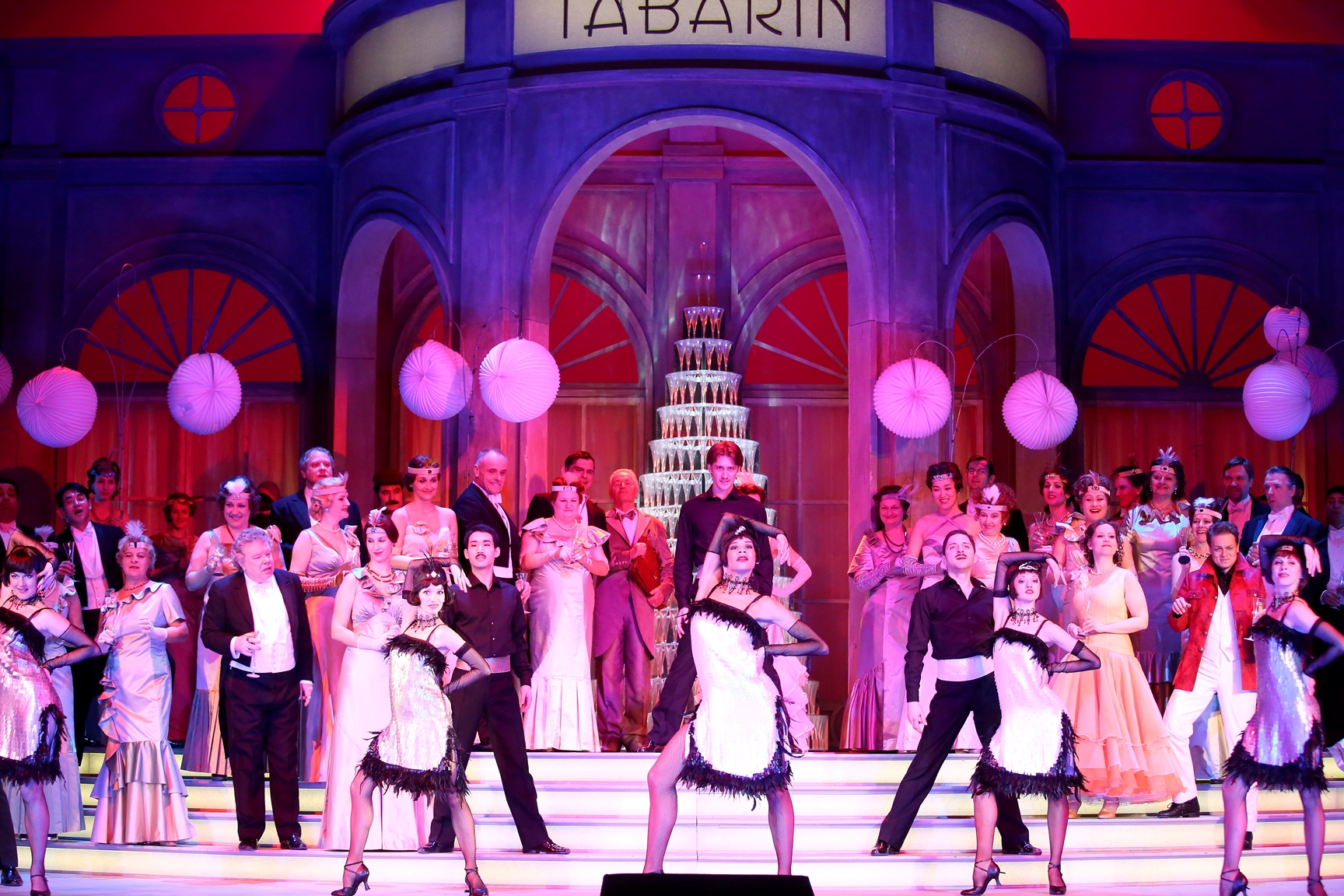
Cut to Mariza’s welcome home party to celebrate her engagement to a ‘Baron Koloman’- he’s absent- invented to ward off gold-digging admirers. Another Gypsy song, one of the glamour highlights, with the men in cream suits wearing boaters, and the girls in 1920s shifts, very short and sexy. The stage rotates to reveal the Countess on the steps of her castle, surrounded by bodyguards in black hats and shirts, wearing dark glasses. Very camp. It’s brilliant staging. Come and set yourself free, play with feeling, party the night away! The gypsies are contrasted against the cream, gold set, two girls side stage, and the fiddler playing, black-hatted, looking very mean and moody.
Kálman’s operetta Gräfin Mariza, premiered in Vienna 1924, defined a new realism, with plausible characters, and gritty dialogue (A.Brammer and J.Grünwald.) Ursula Pfitzner’s Mariza, very modern, pulls on her cigarette. Her fiancée is ‘absent’; introduced to her new ‘steward’, she treats him condescendingly. Tassilo recognises his sister Lisa (Anita Götz) in the Countess’s retinue, but, ‘not a word’, Tassilo’s real identity kept secret. They ‘know each other’. The siblings meeting is a cue for Meine Schwesterlein. The stage opens up to a fantasy children’s playground, brought to life with animated figures.
The man the Countess is engaged to doesn’t exist. But a Baron Koloman Zsupan introduces himself! Thomas Sigwald, outrageous in a bright red brocaded blazer- looking uncannily like Graham Norton- rode straight to Budapest when he read he was to marry the Countess. He sings, he’d always dreamed of marrying a woman like her, only to be found in Hungary. His passion burns hotter than a goulash. His duet with Mariza Komm mit nach Varasdin is a showstopper. Suddenly, a whole row of Koloman look-alikes in red blazers and white pants lead in. They perform an ingenious dance routine, using over-sized garden tools as percussion instruments.
A disconsolate Tassilo, excluded from the ball, sings how he was once the Czarda’s cavalier. Prohaska is swigging on a wine bottle: it may all be different tomorrow. Background, a couple of gypsy lovers very uninhibited, are embracing; and lead into a gypsy fest extravaganza. The stage is filled with the Countess’s guests holding up umbrellas for a ‘When it rains’ ensemble.
The Countess in white is confronted by a gypsy offering her a glimpse into the future. Before the month is out her heart will be given. The man is not far away: a cavalier! Now Mariza moves from the castle steps into her dining room on the revolving stage. Tassilo – ‘her steward, he’s not there for her enjoyment’- now performs for her the Komm, Zigany number he’d refused after all. Their intimate meeting is ‘all very surprising’: he pushes the bottle he’s drinking from over to her, while she’s smoking one cigarette after another.
In the pause between the Acts, a little girl sings to the gardener, (telling her the story in a framing narrative), ‘The story’s over. They love each other?’ The old man replies, ‘if only it were so simple!’ 
The Countess reappears in a slinky grey silk jacquard skirt, low -cut blouse. ‘Yes, supposing you have all those millions, but you’re not happy,’ he sings. Dancing a favourite waltz number, they sweep into a room of waltzing couples – women in swirling chiffon, men in DJs.
Tabarins is the star number of Act 2. ‘Tonight at Ten, we’ll be at Tabarins’ Those sexy gypsy dancers- the guys in black hussar outfits, white commerbunds, against the girls in stunning white Charleston-era sheeny tops and head bands. (Now we know where David Rose’s The Stripper came from!) The dance troupe are a sensation.
Tassilo (Prohaska now in black DJ) warns Mariza, don’t you see all your friends are out for your money. But he is himself exposed by her admirer Prince Populesco: Tassilo is ‘the ideal Cavalier’. ‘To learn all that takes five hundred years at least.’ The Countess, furious, vows to crush him: leave him to me!
The stage revolves to a banqueting hall, the occasion for her revenge. (Simply the best staging I’ve ever seen here!) ‘Hey, Mariza, pull off your masterstroke!’
She knocks chairs over. – We hear the ‘Play on gypsy’ refrain- This gentleman is mad about romancing ,but she knows his game; and she throws money at him. Her only condition is he never speaks of love again. Tassilo sings, he fell in love once. She was a proud, fair lady. Komm, Zigany ‘Play with feeling – his number- show me what you can.’ Mariza sings -ironically- the gypsy’s refrain, ‘Before the month is out…’ (Pfitzner’s high notes are a little shaky.)
Earlier in the Sag mir, mein Lieb (Put on your prettiest dreams, be ready at ten), duet, Prohaska’s top notes were adequate, but not thrilling. She, Pfitzner, is pleasing and a little more. Their voices are fitted to operetta, not powerful, but as required. Kurt Schreibmayer’s Populesco, also ensemble, added ballast.
In the denouement, Sigwald, a terrific comic turn as Baron Koloman, reveals he’s only an actor. He’s actually in love with Lisa, Tassilo’s sister (Mariza’s once-imagined rival), who’ll marry him anyway. Sigwald sings well with Anita Götz’s very competent soprano.
The staging and costumes by Toto (in Thomas Enzinger’s production) are a world -beater- miles better than the rather threadbare affair for Kálmán’s recently performed Czarda’s Princess. Alexander Rumpf conducted Vienna Volksoper forces with panache, orchestra in snazzy black suits and red ties, attuned to Kálmán’s syncopated dance rhythms. Worth a trip to Vienna. P.R. 15.05.2014
Photos: Vienna Volksoper ensemble; Daniel Prohaska (Count Tassilo) and Nicholaus Hagg (Karl Liebenberg); Ursula Pfizner (Countess Mariza) and Daniel Prohaska (Tassilo) and members Vienna State Ballet ; Featured image Ursula Pfizner and Vienna State Ballet
(c) Barbara Pálffy/ Volksoper Wien
Andrea Chénier
Giordano’s Andrea Chénier is the story of the poet of the French Revolution who sacrificed his life for his ideals. Giordano’s fourth and greatest opera, Chénier is described (by Vienna State Opera) as a ‘must for all opera lovers.’ For once this was no hype, the opera -new to me -was a revelation.
Through Chénier we see aspects of the French Revolution, from pre-revolutionary aristocracy to the reign of terror. Chénier’s commitment to freedom and humanity provokes enmity and suspicion. First at a pre- Revolution celebration at the Contessa di Coigny (where he falls in love with her daughter Maddelena); in the Jacobin Terror he’s a suspected counter-revolutionary on the run. Chénier is the artist always at odds with corruption and political repression.
In Otto Schenk’s design , Vienna State Opera’s stage for the Countess’s party has faux painted walls (resembling tiers of an opera house): front stage, the salon has antique furniture.
The valet Gérard (baritone Anthony Michaels- Moore) sings passionately, ‘You have fathered slaves’: how he hates their gilded house, their stylish gallants. ‘Your fate is sealed!’
Maddalena (soprano Norma Fantini) appears rather plump. She suffers in a tight corset; her servant Bersi (Alica Kolosova) thinks it’s absolutely superb. She also complains about her hideous petticoat: even if born a beauty, she now looks terrible. This is an unnatural world- the aristocracy- of artificial courtesies and sycophantic flattery. So her mother, white-haired, haggard, is greeted, ‘how elegant, absolutely charming’, ever youthful. It’s all flattery and teasing.
The poet, Andrea Chénier (Johan Botha) stands out, against the frills and frippery, in a navy jacket and culottes. Botha is unmistakeable to any opera lover, especially for his Wagner roles. He stands observing the show from the side-lines. They’re talking of ‘dark clouds’, impending revolution. But the ladies sing about the tomorrow they await in an innocent pastoral. Botha seems to scowl in contempt as a harp plucks in the background.
Maddalena, this figure of curiosity, asks how a poet is inspired by his muse. Chénier’s aria is a highpoint of the opera, and Botha’s lyrical tenor sublime beyond words. ‘Poetry, he replies, is as capricious as love; the muse is unpredictable, not to be commanded. He gazes up at the eternal blue of the heavens, the world bathed in golden sunlight, a boundless treasure. He extols his beloved fatherland. But the revolutionary poet criticises the Church, the Priest deaf to the pleas of an old man. And the nobleman does nothing against such poverty.
Turning to Maddalena, beautiful woman, do not scorn the words of the poet. ‘You know nothing of life, a divine gift, don’t deride it!’ She’s entranced by Chenier. (‘She’s a strange girl’, comment the other women.) Gérard is also deeply impressed.
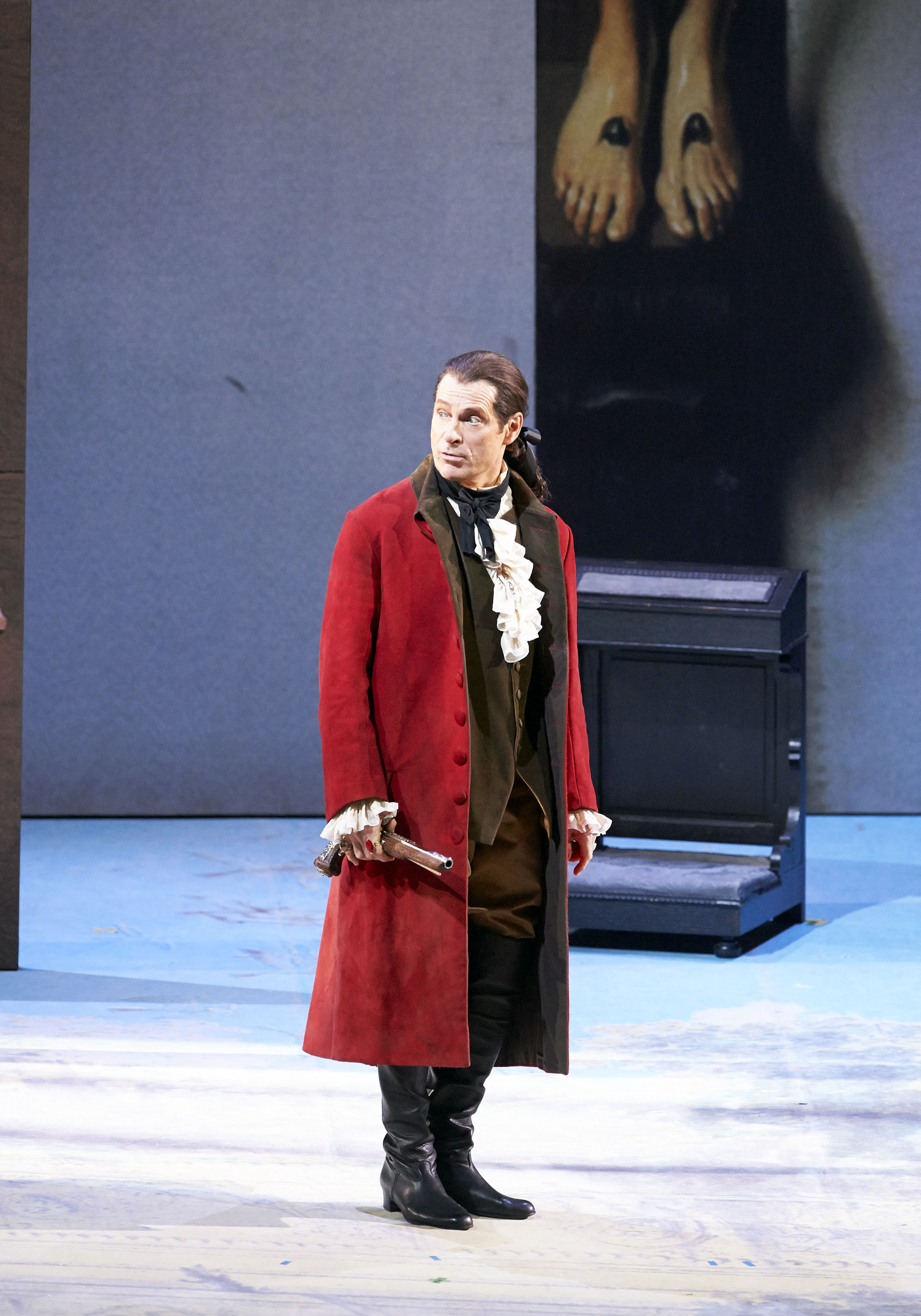
A demonstration outside of starving peasants disturbs the party. Gérard resigns. The Countess’s guests will, nevertheless, return to their gavotte. Botha was enthusiastically applauded. Botha sang Walther in Wagner’s Meistersinger, the outsider to the guilds’ cant and ceremony: here the whole rotten feudal system.
Act 2 opens to a huge square, left stage café tables and chairs; a white statue; and an upturned carriage. A Revolutionary tribunal hearing. Gérard promoted to the Chamber of Deputies. Secret police agents -black-hatted, dandy- tick off a list of suspects: Chénier is included. In Chénier’s aria, Botha sings movingly of a power that says you shall be a poet. So, although advised to leave by his friend Roucher (Boaz Daniel) , his destiny demands that he should stay. And -bewildered by a lady’s anonymous letters-the name of his destiny is love. ‘Believe in love, Chénier.’ Botha’s rendition is ardent, captivating. Botha- his life undone- accepts Roucher’s pass.
Giordano’s music is a revelation- surging late 19th century romanticism, contemporary with Puccini (La Boheme, 1896) : an exhilarating experience, especially with Paulo Carignani conducting Vienna State Opera Orchestra and Chorus.
Through Bersi, her former maid- who shelters Maddalena, now sought by the police- Chenier makes contact with Maddelena. In their duet, Maddelena, in a white shawl recognises Chénier: ‘Do you remember me?’ Now Fantini is more shapely: the artificial padding she wore as a Countess’s daughter discarded. (The aristocrat’s clothing represented unnatural constraints against real feeling.) Their destiny was to meet again. She sent him the letters. She’s alone, in danger, and afraid. Will he, her last hope, protect her? Fantini is rather good. And Botha magnificent singing of their moment of blissful love. To an oboe accompaniment, she washed away his last cowardice: he’s prepared to die. Despite the danger, the Terror, they pledge to stay together; even unto death! ‘Magnificent moment of blissful love’, they proclaim in duet. (This has the measure of Puccini’s best!)
Act 3: a Revolutionary court. The window facades are blacked out, a crowd of observers looking on; but elegant furniture front of stage. There’s talk of France attacked on all sides, by Prussians, Austrians. Women are urged to contribute their jewellery; mothers to give their sons to France, the motherland. ‘Old Madelon’ -Monica Bohinec in an unforgettable cameo- sings how she’s lost both her sons. She offers her grandson- barely a boy- yet he’s instantly conscripted.
A creepy police informer is dressed in black hat, frock coat, breeches and boots- rather foppish with a walking stick. Gérard (Michaels-Moore) is barely recognisable in a dashing black tailored jacket, braided in red. In his aria, Gérard hesitates- disillusioned – to sign Chénier’s death warrant. Once he was driven by hate. But now realises he’s still a servant: all he’s done is change masters. He was a child of the war of liberation. Why does he no longer have faith in the vision? (He wanted to arouse a conscience in the people: turn the world into a paradise.) He has betrayed his calling; he is a libertine, still slave to his passions.
Madame di Coigny introduces herself, now in a simple white dress. He’s captured her lover Chénier. Now Gérard confesses he wanted her, even as a small girl – his life-long passion, he, the servant always eavesdropping. He grasps her, wants to bury his hands in the sea of her blonde hair. If her body is the price of Chenier’s life, then take her.
Maddalena’s aria, La mamma morta, poignantly sung by Fantini, reminds of Verdi (Amelia’s plea in Un Ballo in Maschera ).They murdered her mother in the doorway of her room. She was alone, in poverty, trouble and danger. Bersi prostituted her beauty to save her. In all this wretchedness, love came to her. But she offers to dry his tears and watch over him. Does he (Gérard) see blood all around him? She will help him forget. ‘I am love, love, love! Mine is the body of a dying woman , so take it!’ (Tremendous!)
Out of love for Maddalena and his earlier sympathy for Chénier, Gérard helps him escape; but Chénier is nevertheless arrested. Gérard accuses the Court of violating justice: of murdering poets. Michaels-Moore powerful, impassioned: his life is a ship on course for death, so be it. But he will fly the standard for his country. You will not drag it through the dirt: Chénier is no traitor.
The Marseillaise is heard in the background. Maddalena has offered to take the place of a condemned prisoner so she can be with Chénier. They run into each other’s arms. Chénier sings of his troubled soul, but she is all he ever desired. So they will go to the guillotine together: in the hope of a new life, together in death. Their final duet vicino a te is terrifically sung. The feeling is Wagnerian, reminiscent of Tristan und Isolde’s Liebestod, love in death. ‘Death! Eternal love!’, ‘death arriving with the sun.’ Maddalena (like Isolde) walks to her death. Strains of Wagner-realising something new is, after all, the reworking of the familiar- did not detract from discovering a major operatic work, Giordano’s masterpiece. P.R.9.05.2014
Photos: Johan Botha (Andrea Chénier) and Maria José Siri (Maddalena); Anthony Michaels-Moore (Gérard); Alfred Sramek (Mathieu), also featured image. Photos of Norma Fantini as Maddalena were not available.
(c) Wiener Staatsoper/ Michael Poehn
Verdi’s Rigoletto
Vienna State Opera’s spectacular period production Rigoletto (stage Pantelis Dessylas) opens in the Duke’s palace. The banqueting hall where the Duke is entertaining his Court has rich oak panelling; the costumes, late Renaissance, appear authentic. So Verdi’s plot is dramatically more plausible than those modern stagings using the Court as a Mafia analogy.
The opening scene sets in motion the tragedy. The Duke (Piero Pretti) sings boasting, he finds pleasure today, he may be with another tomorrow. And without scruples, proceeds to woo the beautiful wife of Ceprano, his loyal retainer. Pretti, well named, has an irrestibly mellifluous tenor. We’re in no doubt about his lechery, but he’s charming.
Rigoletto role is that of court jester -a Shakesperean Fool- aiding and abetting his Duke, and mocking his courtiers. But he’s victim of his own intigues. Rigoletto’s tragedy is inherent within the characteristically Verdian relationship between over-possessive father and daughter seeking independence and love.
Leo Nucci’s Rigoleto, short, red-haired, appears slightly stooped, in fact a hunchback. And he’s actually wearing a harlequin outfit. Nucci is an operatic legend, celebrating his 500th stage appearance (4th April 2014) and 35 years performing at Vienna State Opera. His Rigoletto is a special treat for opera lovers. His distinguished baritone has enormous timbre, and he inhabits the role with subtle characterisation. Nucci holds the stage firing his caustically witty ripostes.
But the tragedy is sealed by Count Monterone’s outburst, demanding an explanation of the Duke who’s dishonoured his daughter. Rigoletto scorns the slighted father. Monterone curses both master and servant, but it’s Rigoletto who is haunted by the curse.
Act 2 , returning home, Rigoletto is accosted by Sparafucile, a professional assassin, (in whom Rigoletto sees a reflection of his own life.) Rigoletto’s aria -deeply troubled by the curse- is a highpoint of the opera. It reveals insights into his complex nature, the demon that drives him. To cellos and double basses- unsettled, disturbing- Nucci sings movingly, we are all alone. Rigoletto compares himself to Sparafucile: Sparafucile murders with his dagger, he uses words. He repeatedly sings , mantra-like, the old man put a curse on him . Now echoing Shakespeare’s anti-heros- Richard III , Iago- sings Nature has made him vile. How terrible it is to be crippled. But he may not weep. His young, handsome master orders him ‘Make me laugh’. If he, Rigoletto, is evil, it is because of him.
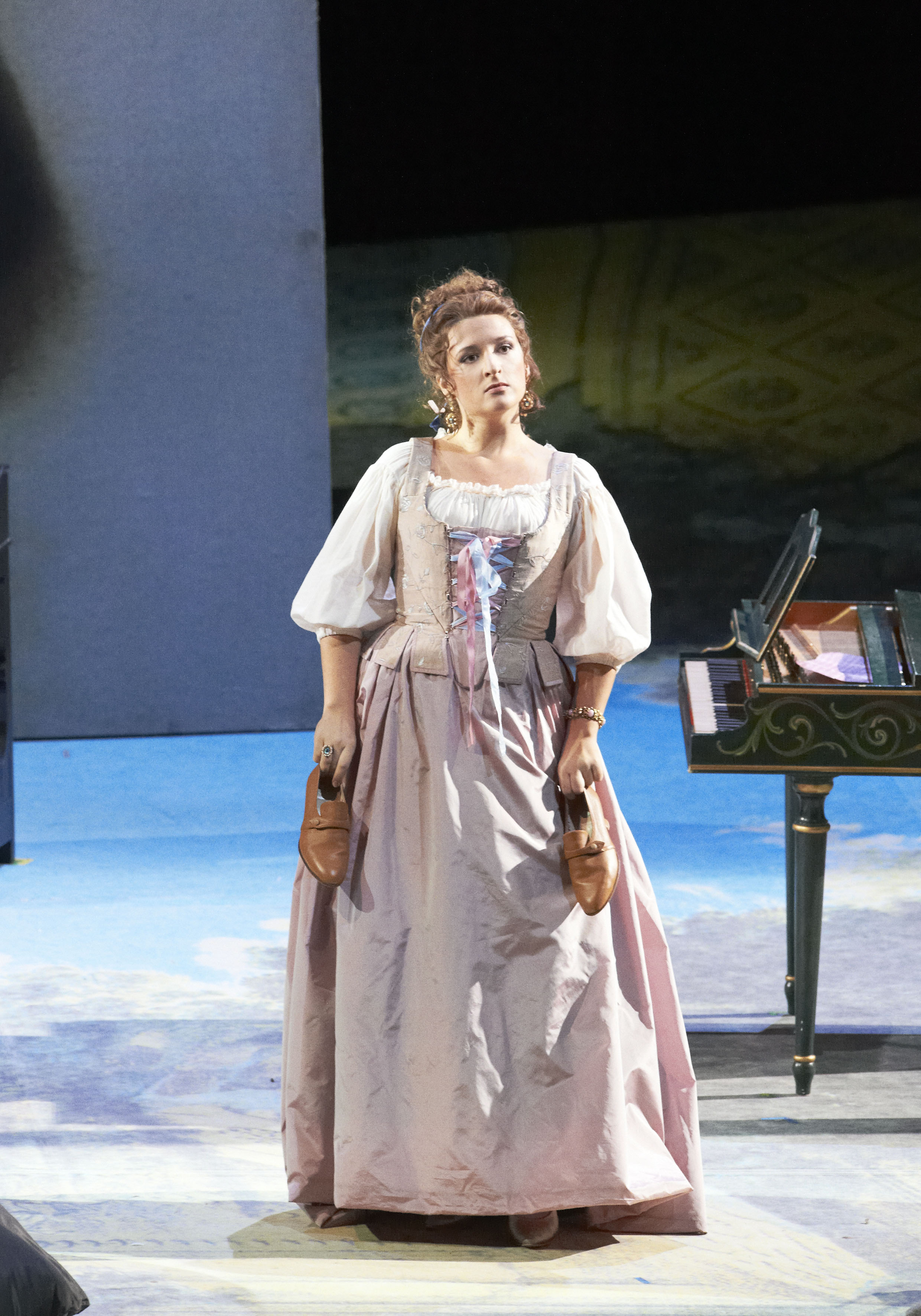
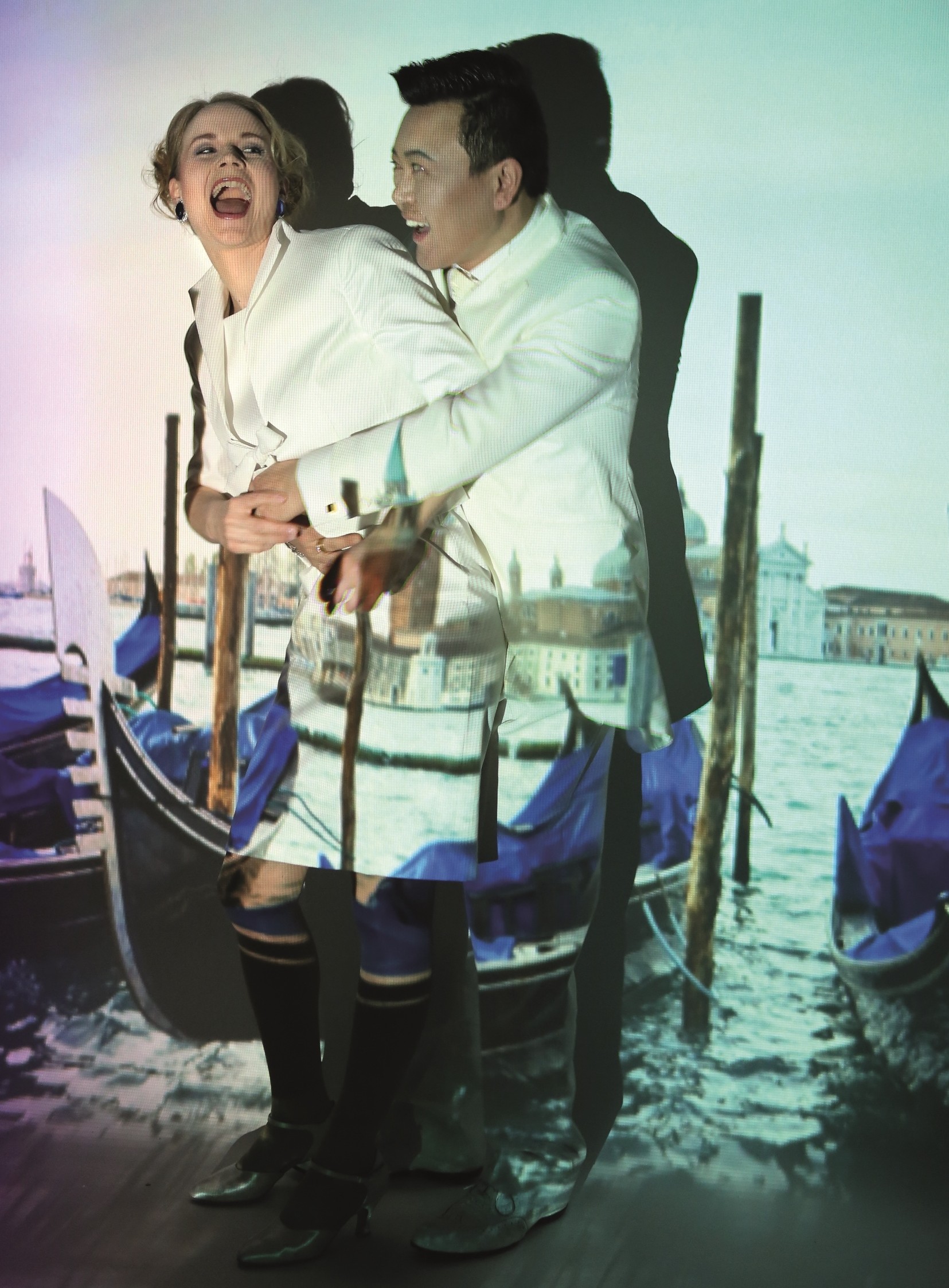
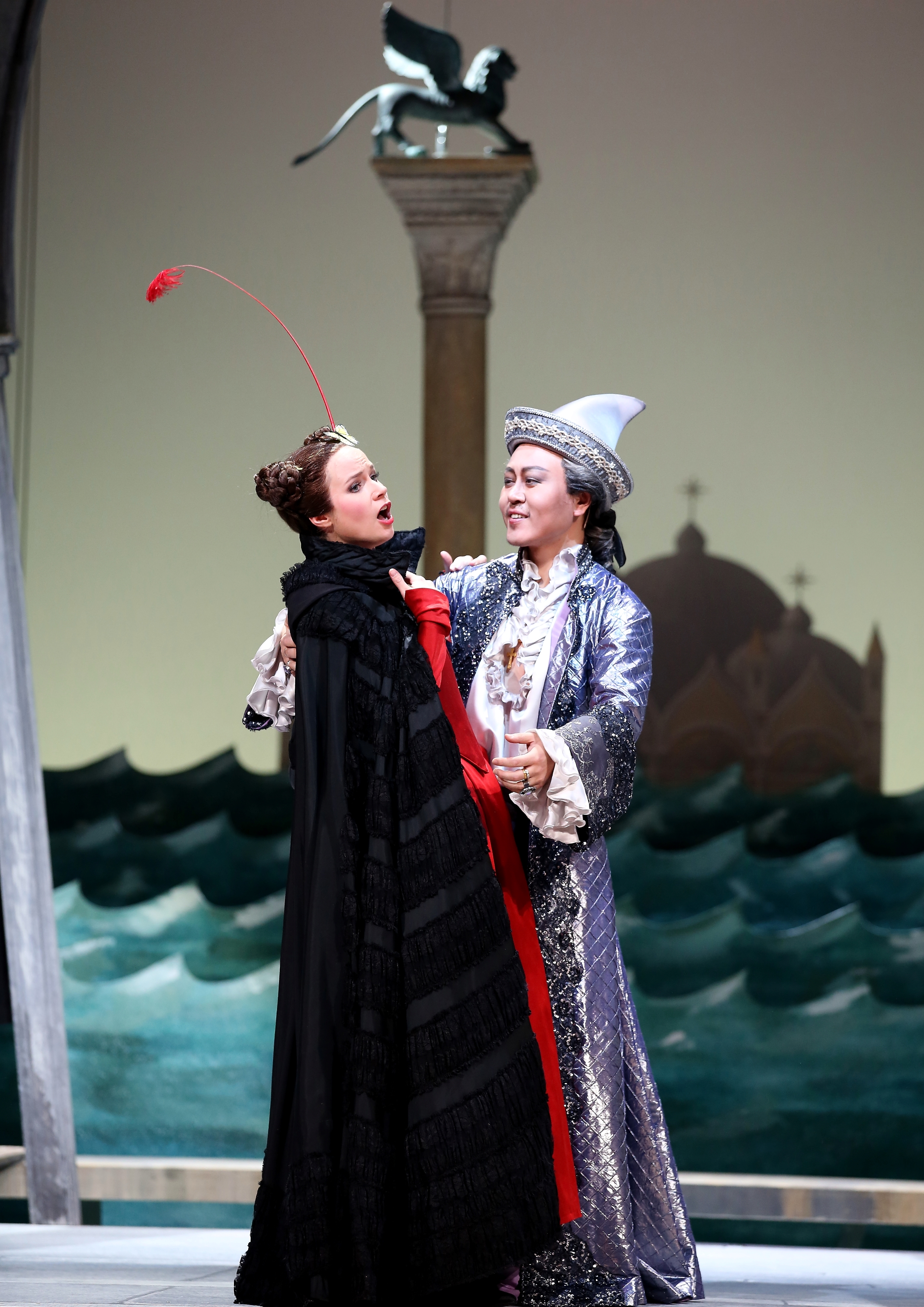
But here-(at home) -he becomes another man. Now upbeat orchestral strings: his daughter Gilda appears. His love for her humanises him. Gilda (Valentina Nafornita, a charming brunette ), complains she ony ever goes to church. – ‘Don’t remind a man of the happiness he’s lost’. His wife died. Only she is left to him, his mercy.-‘But what grief,’rejoins Gilda, ‘Calm yourself father.’-‘Only you are left to me.’ In a powerful interaction between Nucci and Nafornita, Rigoletto, Verdi’s obsessive father, ‘You are my family, country, universe.’ She’s been there three months, hasn’t seen the town. ‘Is the door locked?’ – ‘Always. Your precious flower will never be broken.’ . (Rigoletto instructs the housekeeper, Giovanna, she needs to be vigilant.)
Gilda confides in Giovanna (Juliette Mars), she’s been seeing a young man in church, (‘a student’). He’s generous, and refined. She doesn’t want a nobleman; she’d love him all the same.
‘Say those sweet words again!’ The Duke (disguised) has insinuated his way in. Pretti’s tenor is melting, melodious. ‘She is the sunshine of his soul’. Physically, Pretti is short and slight in relation to Nafornita, who’s seated on the garden bench, he standing over her. Their duet is well delivered. Their voices melt; she coos along. (The Duke is shameless, such is the power of rhetoric!)
In Gilda’s aria , Let his name be engraved on my heart, Nafornita is accompanied by a flute solo: jaunty rhythms introduce the well-known Caro nome, ‘Beloved name, may you always remind me of love…’ Nafornita’s display of coloratura is pleasing , but (standing left of stage by a well) she sounded a little shaky at one point. (She was unwell.) Elsewhere, Nafornita’s gorgeous stage presence and acting compensated.
We see the sumptuous palace interior; tables strewn with chess sets. Pretti sings angelically, he’s overcome by her virtue. And sententiously, she has been stolen from him. (The Duke’s courtiers have abducted the secreted-away Gilda, believing her Rigoletto’s mistress). With saintly indignation, he sees her tears as she calls to ‘her beloved Gualtier’ (his disguise). Terrifically sung by Pretti in a rich red velour house coat: the devil has all the best tunes.
Chorus- Vienna State Opera’s excel in Verdi- sing, ‘He has discovered a rare beauty’. In one of the great Verdian choruses- ‘They carried her out…blind-folded the girl.’ They actually sound quite charming. Verdi gives them a jaunty swagger, mocking their false bravado. The Duke sings of the poor girl: love summons him (Possente amor) . Chorus repeat (ironically), why is he so agitated.
Nucci’s scene, searching for Gilda (end Act 2) is harrowingly well played. They mock him, ‘Poor Rigoletto! What’s new, jester?’ They taunt him- Where can she be?-Verdi’s strings sardonic, almost laughing, jeering. Nucci, hunch-backed, is pitiful in his jester’s costume. In his aria -The girl you abducted last night is my daughter- their contempt changes to embarrassed silence. Rigoletto begs for pity; he can only weep. He pleads, have a heart. Then, a long sustained note, ‘You are fathers…’, accompanied by a superbly played cello solo. It was powerfully rendered. The applause for Nucci went on and on.
Gilda is brought in. Distraught, shamed. She’s been deceived, but confesses her love. Rigoletto sings, have no fear my angel. We are alone, speak. Gilda admits she saw the young man every sunday in church. She said nothing, but their eyes spoke. He came to her secretly yesterday, then left. But she ‘was filled with hope.’
Nucci sings poignantly, he hoped she would rise up as high as he, Rigoletto, has fallen. Weep my child to my heart! He swears to avenge the honour of fathers. Terrible vengeance is his one desire. The jester will strike him down. (The Duke sings, side of stage, he suspects me.) The scene ends tremendously, Verdi’s conflicting voices in ensemble.
Opening Act 3, an imposing rocky stone building (the Tavern). Maddalena (Nadia Krasteva) salaciously tempts the Duke. ‘All moral sense vanishes in the act of love.’ There is no doubt of his deception of Gilda. The Duke is incorrigible: ‘Come here and hear his heart beating.’ She is leading him on- dangling her legs- all thighs. Krasteva’s mezzo is excellent!
Now the Duke’s iconic aria La donna e mobile… ‘Woman is as wayward as a feather in the wind. Her pretty face is deceitful, whether weeping or sleeping.’ It’s insolent, bragadaccio, misogynistic; and accented by a soaring clarinet solo. Outside they’re overheard by Rigoletto and a despairing Gilda. He’s given Gilda time to get over him. Would she still love him if he were deceiving her? Besotted, she continues to love him. (Later Rigoletto negotiates with Sparafucile: Kill him and he’ll double the reward.) Again we hear the Duke’s swansong. Cruel misogyny! Pretti, in a grey swashbuckling outfit: Lamentable the man who puts his trust in a woman! But it is superbly sung, reaching thrilling high notes. Well applauded.
For Rigoletto the moment of vengeance is here at last. (A storm brewing, a sack is delivered.) ‘Take a look at me, the jester. Now he is at my feet!’ Then he hears the Duke’s refrain, as if mocking him, from the balcony, (La Donna e mobile), so beautifully sung by Pretti. Insidiously alluring, satanic?
So who’s in the sack instead? Impossible! She left for Verona. We hear Nafornita, her voice feeble. She deceived her father. She loved him too much; disguised to save the Duke, must die for him. Crushed, Rigoletto, declaims, ‘Oh terrible God!’ She has been struck down by revenge. Pathetically, if she goes, he’ll be left alone. The sheer abjection of human despair- man juggled by fate- is akin to the desperately pitiful King Lear picking up his smitten daughter Cordelia. In Verdi, fusing music with high drama, the scene cannot fail to move.
Nafornita performed in spite of illness: against the towering performance of Nucci, and Pretti’s virtuoso tenor. Jesus- Lopez Cobos, distinguished in Italian repertoire, encouraged Vienna State Opera orchestra to their Verdian best. And that glorious Chorus! P.R. 4.4.2014
Photos: Valentina Nafornita (Gilda) and Leo Nucci (Rigoletto); Valentina Nafornita and Piero Pretti (The Duke of Mantua); Featured image Piero Pretti (the Duke)
(c) Wiener Staatsoper/ Michael Poehn
Puccini’s La Boheme
The star attraction of Vienna State Opera’s La Boheme are the stage sets, especially Franco Zeffirelli’s bustling cafe scene on two levels. These were designed in the 1960s, but still stunning-like a Manet impressionist painting come to life. So it’s brave of Vienna not to have updated them with the latest minimalist concept transposed to the 21st century. Zeffirelli’s immaculately painted detail is true to Puccini’s obsession with realism, here social realism. Yes, this Paris burgeoning with artists is long past, but it endures through Puccini’s music.
La Boheme is autobiographical, recalling scenes and characters from Puccini’s life as an impoverished student in Milan, but, unembittered, burnished in a soft golden light. It remembers not the desperate poverty, hunger, but celebrates the camaraderie, close friendships, and youthful optimism. (Lang)
The garrett- peeling roof with two holes, the furniture threadbare, junk. Puccini gave detailed stage directions. Bearded Rodolfo (Ramon Vargas) in frock-coat, waistcoat, and bow tie, declaims, the fiery drama he’s writing will warm them: throws his manuscript, an ardent love scene, into the fire. Marcello (Adrian Eröd) is painting the Red Sea. The pawn shops are closed over Christmas. But they’re joined by musician Schaunard (Alessio Arduini) who got lucky and brings in some food. The script is brilliant, witty, plausible.
And Puccini’s score dispensing with overture, we’re swept away by the opening motif- Rodolfo’s -representing young, romantic, unbounded love. Agitated chords, anything but maudlin, suggest a bunch of young guys joking, determined to have fun. So, interrupted by the landlord demanding arrears, they rib Benoit (Marcus Pelz), in a brocade smoking jacket and embroidered fez, who boasts about ‘the pretty girls he has, now and then’, (the skinny ones are so morose, like his wife); and they eject him for besmirching their ‘virtue’.
They go out on the town. Rodolfo stays to write an article; and as they exit- ‘Be careful on the stairs in the dark’ he warns -as one of them falls.
That detail is crucial, (in Puccini’s dramatic authenticity), as a prelude to the knock on the door from Mimi: ‘I’m sorry, my candle’s gone out.’ She’s ‘so pale’, she excuses herself, a little out of health. She collapses in his armchair, her head to one side. ‘What shall I do now?’- ‘A little wine?’- ‘Just a little.’ Maija Kovaleska’s affecting soprano sounds feint, not feeble. She and Ramon Vargas truly enact their scene of (literally) fumbling introduction. ‘How silly of me! Where is my key?’ The candle goes out. They’re on their knees searching – Puccini’s orchestration playful. He holds her hand- How cold your hand is (Che gelida manina!) – and helps her up. Luckily the moon is shining. Vargas, as if blocking the door, tells her about himself. Chi son!- Sono un poeta…E come vivo?- vivo. ‘And how do I live? I live.’ In dreams he’s a millionaire. Occasionally all his riches are stolen by two beautiful eyes. In this great aria, Vargas, a fine tenor, is modest, sincere: he eschews the vituoso’s swagger.
And she? (Kovalevska) Mi chiamano Mimi. La storia mia e breve. ‘People call me Mimi.’ She embroiders flowers. Artlessly sung by Kovalevska with such fresh charm; her high notes are a quite natural progression of her joy. She sings she doesn’t know about poetry; seldom goes to church, but prays to God; lives alone in her little room. ‘But when the sun rises… the first kiss of Spring is mine’. Vargas is sitting in his armchair, staring benignly. She, Kovalevska, a stunning brunette, is wearing a simple long gown, with prim, white collar.
Act 2, a Paris Christmas market, bustling stalls front of stage, children everywhere: behind, and above, the silhouetted facades of a long shopping boulevard. The stalls are cleared away to reveal Cafe Momus, hanging lamps, oak panels, the lot. Rodolfo and Mimi are centre stage. Rodolfo has bought Mimi the bonnett she’s always wanted.
Musetta, determined to make Marcello jealous, appears with her rich, older man. Ildiko Raimondi, blonde, wearing a scarlet satin cloak, steals the show. Raimondi’s Musetta, wild and flamboyant, is the very opposite of Kovalevska’s delicate Mimi. And Musetta, constantly feuding with Marcello, their stormy relationship is a foil to Mimi/Rodolfo’s.
Musetta has a tantrum, throws a tray, topples the table. How can he be jealous of ‘this old woman'(Alcindor)? Casting aside her red cloak, Raimondi’s stunning black, red-trimmed extravaganza is out of the Follie Bergere; or Toulouse -Lautrec poster. Raimondi’s aria Quando me’n vo soletta per la via is a tour-de-force. ‘People turn to look at me: they all admire my beauty.’ Turning to Marcello who’s avoiding her,’You hide your pain , but it will torture you to death.’ Raimondi’s high notes are to bewonder. She emits a shrill scream- the pain in her foot! – showing off her white petticoats for the bumbling, helpless Alcindor (Pelz). ‘The bill so soon?’
A troop of soldiers, a brass band, led by a drum major, pull the crowds on the overhead stage. The gentleman will pay. They merge with the crowds of Zeffirelli’s spectacular, cinematic set.
By contrast, Act 3’s snow -covered stage: left, a customs barrier,and in Puccini’s realism, street sweepers-‘we’re freezing’ -demand they open up. Milk maids pass through with butter, cheese, eggs. But Mimi’s basket is empty. Kovelevska- now with a bonnett, but no gloves- asks for the tavern with the artist, seeks Marcello’s help. She sings, Rodolfo loved her, but -she thinks-he’s consumed by jealousy. (‘One step, one word, and he becomes suspicious.’) Kovalevska seemed a little underpowered. The applause was restrained. I found her endearing.
Baritone Adrian Eröd is very good as Marcello, here in duet with Rodolfo. Vargas sings powerfully, ‘I thought my heart was dead. She brought it to life.’ Marcello retorts, ‘Love without laughter is tedium,’ and – almost jostling Vargas- complains, ‘Musetta is a flirt, and makes eyes at everyone.’ And plaintively, ‘I try in vain to conceal my pain.’
Rodolfo knows Mimi is terribly ill, weakening every day. (His room is damp and cold.) Vargas, a golden tenor, sings with warmth and heart-rending honesty. Mimi is a flower faded by poverty; love alone cannot restore her health.
Mimi revealed by her coughing, has overheard her death sentence: she’s going back to her embroidery. In their duet Vargas and Kovalvska were blistering. Being alone in winter is intolerable; Rodolfo’s love will mitigate her suffering. By contrast, right of stage, Musetta and Marcello , the tempestuous lovers, ever-arguing. ‘You’re behaving like a husband,’ Musetta throwing her cloak at him. Meanwhile Mimi and Rodolfo pledge ‘I am yours forever. We’ll part when Spring comes. If only winter would never end…’
In Act 4, Puccini displays his mastery of dramatic timing. Rodolfo and Marcello are bemoaning their absent lovers. Schaunard, lucky again, enters with food. But their reverie is disturbed by a distraught Musetta -Raimondi now in sobre maroon- accompanied by a pale Mimi, who can barely stand. Mimi is terminally ill. Lying on Rodolfo’s bed, she sings, new life surges in her. ‘Do they have wine, coffee?’ Such poverty ! She’ll be dead in half an hour, one comments.
Their poverty is detailed, but never sentimentalised, endured in good humour. ‘I’m so cold. If only I had a muff. They’re all starring at me,’ as she gratefully recognises her friends. Musetta offers to sell her earings to bring a doctor. And the philosopher Colline (bass Jongmin Park) sings (impressively) an elegy to the old coat he must part with.
As their Act 1 love theme is recapitulated, she asks have they gone. She only pretended to sleep so she could be alone with him. ‘You are my love and my entire life, Vargas sings, she’s still as beautiful as the dawn. She corrects him, you mean the sunset. They reminisce, Vargas and Kovlavevska powerfully enacting their scene. She sings her refrain, They call me Mimi’. She knows he’d found the key ‘very quickly’; in the dark, she couldn’t see him blush.
She looks radiant, but lies back to cough. The muff now on, her hands will never be cold again . (Money squandered!) ‘Mimi!’ cries out Vargas, his grief inconsolable.
Those demanding vocal fireworks might find the two leads underpowered. For me, the experience was as moving as I’ve heard. Vienna State Opera orchestra (and Chorus) under Mikko Franck’s conducting, played Puccini’s popular but subtle masterpiece with fresh ardour. And Zeffirelli’s stages, like Hollywood film sets, are to marvel. P.R. 26.03.2014
Photos: Maija Kovalevska (Mimi); Featured image Jongmine Park (Colline), Adrian Eroed (Marcello), Alessio Arduini (Schaumard)
(c) Wiener Staatsoper/ Michel Poehn
Reference to Oliver Lang Puccini und die Boheme (Wiener Staatsoper programme notes)
Berg’s Wozzeck
Late March in a stormy, cold Vienna, Spring has been postponed. Doom and gloom also on the stage of Vienna State Opera’s Berg’s Wozzeck. Alban Berg’s opera is based on George Buchner’s stage pieces concerning the (1821) criminal case of a barber who stabbed his woman to death. Wozzeck, a low-ranking soldier is forced to work privately for his captain , and volunteers for his doctor’s experiments, so he can support Marie and her child by him.
But Berg’s modernist opera -the first complete ‘atonal’ opera- is a work for our time, not just early 20th century, but recognisable now. Berg was moved by this man, ‘maltreated, spurned by the world, plagued by visions, who murders his lover, and drowns himself’. Berg’s opera – modernist-like Schnittke’s plays – tells the story through episodes, over 3 Acts , each five scenes. Berg’s music heightens the emotional atmosphere in these individual scenes, incorporating old and new musical forms. And (for 1925) its social realism radically depicts scenes from everyday life. An indictment of social injustice, Wozzeck ‘widened the notion of opera still living off stylised costumes and standardised characters.'(Schoenberg)
The Captain (Herbert Percoraro), pampered in the barber’s chair, waffles away with patronising advice. Wozzeck- so the Captain smothered in lather- ‘always looks so frantic’. A decent man with a clear conscience does everything …with control. Herbert Percoraro, a lyrical, high -pitched tenor, emits a manic laugh- against Mathias Goerne’s deep bass. Ja wohl, herr Hauptmann, Wozzeck repeatedly nods. Mathias Goerne has played the role of Wozzeck so often he now embodies the character. Physically, Goerne looks demonic; his large, staring eyes have a haunted look.
The Captain taunts him, Wozzeck has a child , unblessed by the Church: Wozzeck is a good man but has no morals (ein guter Mennsch, aber er hat kein Moral.) Wozzeck rebuts him ‘suffer the little children to come unto me.’ The law of God, poor people don’t see it. Morals! We are poor people; try practising your morals with no money. Goerne, standing glowering over the Captain waves his razor menacingly. Pecora rejoins, he’s a good man, but he thinks too much – often repeated of Wozzeck (the lower classes’ thinking could lead to revolution.)
This brooding violence re-emerges in the following hunting scene. Wozzeck tells Andres the place is ‘haunted’: the story -almost comical – how one evening a head came rolling down, someone thinking it a hedgehog.
Marie (Scene 3) watching a military band from her window, sees the Drum Major. He glances after her: soldiers are handsome fellows. ‘Come boy, you’re just a whore’s son,’ she sings. She’s a pretty maid, but she has no husband. As Marie, Evelyn Herlitzius is a ravishingly expressive soprano.
Their home resembles a shack in a southern U.S. movie – Depression era. Wozzeck looks in through the window – a striking contrast to the Drum Major. Wozzeck sings of his visions, ‘There was shape in the sky, all glowing. It came after him!’ (She goes to look after her son.) Herlitzius, tremendously powerful, rails, ‘This man’s obsessed, he didn’t even look at his child.’ All this thinking is driving him mad. And, desperately, ‘God , what it is to be poor.’ She can’t bear it any more. She’s frightened.
Wozzeck’s other way of earning money: the Doctor (Wolfgang Bankl). Doesn’t he give him three groschens a day! Has he eaten his beans? See, you’re philosophising again. (‘You see in nature…) Wozzeck is on all fours, like a dog. Bankl’s white-jacketed doctor is a chilling forerunner to a Nazi War Camp doctor. Wozzeck mistakes the Doctor’s interest in his visions for human sympathy. But Bankl triumphantly declares,’You’ve got a perfect mania- a classic case. Just keep being good.’ With his hypothesis, he’ll be famous.
In the scene between the The Drum Major and Marie, the Major (Herbert Lippert) appears at Marie’s s door. She mocks his swagger. He forces himself on her. She fights him off- like a wild animal. Then, unable to resist him, they copulate.
Opening Act 2 , Marie is with her boy. Again the expressionistic painted stage set, grey with cloudy abtract shapes in black; or are they dirt-engrained walls? Marie tries to hide the earing ‘she found’. Wozzeck interrogates her- ‘it must be gold?’- but relents. Plaintively Goerne sings , ‘Nothing but drudgery under the sun. We even sweat as we sleep.’ But he offers his pay and money he’s earned on the side. She sings, I’m not a good person. What a world! She could kill herself. Herlitzius, overwrought, affecting, is sensational.
The Doctor and Captain’s meeting in the street is comical. The strutting Captain (Bankl) in a top hat looms over the Captain (Percoraro), who, breathless, is trying to catch him up. ‘Permit me to save one life! Here’s you, bloated, fat, subject to aploplexy…’
Wozzeck, what’s your hurry. You charge through life like an open razor!‘ They mock him over his wife’s affair with the Drum Major. (The Captain admits he was once in love too.) But Goerne pleads with harrowing pathos, she’s all in the world he’s got. ‘God in heaven, it almost makes you want to hang yourself.’ To the Doctor,’He’s a rare specimen, this Wozzeck.’
Wozzeck confronts Marie, hints at her affair: her red lips have no blisters. ‘You were with him!’ -‘What if I was?’-‘You bitch!’ He’s about to strike her, but Goerne, again philosophical, sings movingly on the human condition, ‘Man is an abyss. It makes you dizzy looking all the way down.’
Wozzeck is outside a cheap tavern, brandy-soaked. It’s effectively staged, soldiers dancing with local women, huddled together on a cramped raised platform. Berg’s music seems to subvert the waltzing rhythms. He walks in, as Marie and the Drum Major appear and openly flirt, kissing passionately. The dance ends, Wozzeck’s about to go over. Goerne sings he’s comfortable here; but death would be as comfortable. Earthly things are in vain…Everything rots away; then, hiccupping, ‘his soul stinks’ . A fool cavorts: why is the world sad.
In the soldiers’ barracks, there are lines of men’s bodies either side of the stage. Wozzeck can’t sleep, sees flashes, hears the refrain ‘Oh, God, lead us not into temptation.’ The Drum Major bursts in, picks a fight with Wozzeck and brutally strikes him. He’s left bleeding and brooding.
Opening Act 3 Marie is sitting in her room , desperately seeking consolation in her bible, identifying with Mary Magdalene seeking forgiveness. Then- the stage set excellent -an expanse of flint grey water and skies. Marie and Wozzeck are walking by the ‘pond’. Wozzeck sings enigmatically,’you won’t need it in the morning. ‘
There’s a horrid moment as Herlitzius jerks- like receiving an electric shock- and topples. Goerne sings of how red the moon is… He has cut her throat. No one else can have her. Tot! A tremendous wailing sound emanates from the orchestra; a long sustained note, hellish drums, an ominous knocking.
We see Wozzeck sitting at the entrance to a tavern, a hole cut out of the expressionistically painted wall. Wozzeck, drunk, clings to a woman, with his bloodied arm. (No shoes, she can go barefoot into hell.) They all come out, repelled by the blood on his hands.
Wozzeck returns to the pond. ‘Alles still..still und tot.’ Wading in, he sings incoherently, Marie, what is that red band around your neck? But the red moon will betray him. He can’t find the knife; imagines himself all bloody, as if washing himself with blood. (The Doctor and Captain, passing, think they can hear someone drown.)
The final scene shows children playing. Does the boy know about Marie:’Your mother is dead, out there by the pond.’ The boy is seen fading into the expanse of blue cloud: perhaps the outsider, philosophising.
Wozzeck is the victim of a modern, ‘capitalist’ society- poor, down-trodden, exploited; and psychotic, driven mad. If Wozzeck has to be experienced, this current production could hardly be bettered. Directed by Adolph Dresen, Herbert Kapplmueller’s staging, evocative, atmospheric, is not distracting. The cast distinguished, Berg’s orchestration is endlessly fascinating, and to hear it performed by Vienna State Opera orchestra (conducted by specialist Dennis Russell Davies), a privilige. P.R. 23.3.2014
Photos: Featured image Evelyn Herlitzius (Marie); Mathias Goerne (Wozzeck); Evelyn Herlitzius (Marie) and Monika Bohinec (Margret); Mathias Goerne (Wozzeck) and Evelyn Herlitzius (Marie)
(c) Wiener Staatsoper/ Michael Pӧhn
Mozart’s The Marriage of Figaro
Le Nozze di Figaro , like any great work of art, defies any single interpretation. Mozart and librettist Da Ponte’s opera, premiered in 1786, was initially censored by Vienna’s Court as socially subversive: Count Almaviva, a womaniser, and serial seducer of his servants has his come-uppance plotted by his valet, his wife, and his household. Set around the 1780s in Almaviva’s castle, the Count, supposedly an advocate of ‘Enlightenment’, waives his seigneural right of primae noctis. Except for Susanna, the Countess’s maid, the intended bride of Figaro. The Count, with designs on Susanna, offers Susanna and Figaro a room in the seigneural wing, and contrives to postpone the wedding. The ensuing intrigues, the Count besieged in his own Castle, could be an allegory for the Revolution to sweep Europe.
But the opera is ‘never only one thing’. The intrigues and counterplotting are about love, the characters are in a war of the sexes; Mozart and Da Ponte’s concern is with fidelity, and the tragi-comic consequences of misplaced trust and adultery. So the Countess’s arias are heartrending, as Act 2, ‘what happened to the those moments of joy; where are all those promises that passed his dying lips.’ Whereas the men are, to us, mysoginists. Figaro, Act 4, seeing his Susanna (the Countess disguised) engaging with the Count, decries ‘open your eyes…see women as they are.’ The closure celebrates the convention of marriage, but is problematical. The Count begs the Countess’s forgiveness; she does so because ‘she is more understanding.’
I was over-critical of Jean-Lous Martinoty’s production, then ‘new’ in 2012. Those cardboard cut-outs and trompe l’oeuil screens -a collage of cultural references- are problematic; but not distracting. This production is outstanding, a near ideal cast. Luca Pisaroni’s Figaro is a stalwart baritone, but at first lacking flexibility, not quite a figure of fun. His Act 1 aria challenges his master, ‘If Almaviva wants to play tricks scheming for Susanna, then he’ll outsmart him.’ Maybe Pisaroni’s too straight, not mischevious enough? Figaro, in a mustard frock coat, wants to know everything from Susanna (Anna Hartig): ‘Do you think he gives us a dowry for nothing…The count abolished his seigneural right- now he revokes it.’
The surprise was Simon Keenlyside’s Almaviva, who first appears looking quite raunchy. His hair is swept back in a tail, his billowing white shirt open, his gold breeches tucked into knee-length boots. Not the stuffed -shirt you’d expect fot a Count. And after so many dramatic Verdian roles, baritone Keenlyside shows a natural flair for comedy. Almaviva is forever being outwitted by his servants, especially his page Cherubino. So in Act 1, Almaviva enters -Cherubino hidden behind an armchair – while the Count ardently woos Susanna. Almaviva hides, hearing music master Basilio; but emerges furious at the revelation of Cherubino’s passion for the Countess. Almaviva uncovers the elusive Cherubino under a blanket, Cherubino ‘at it again’. But Almaviva having expelled Cherubino, realises his page overheard his play for Susanna. Finally Figaro enters with a group of peasants to ask for the wedding date, singing ‘We scatter flowers before our noble lord for abandoning his seugeurial rights’. The Chorus are continually mocking their Seigneur.
Olga Bezsmertina sings the Countess. In her aria (opening Act 2) Porgi, amor, qualche ristore, ‘Oh, give me consolation, my beloved back or let me die’, sings to an interweaving clarinet solo. Dressed in a lilac gown, kneeling on silk cushions, her auburn hair coiffured, Bezsmertina’s glorious soprano is refined, cultivated, high range not strained.
In Figaro’s intrigue- Pisaroni better, more the schemer- Susanna will agree to meet the Count in the garden: but it’s actually Cherubino in Susanna’s gown, so the Countess can expose her husband. In Cherubino’s aria ‘You ladies who know what love is, tell me if I have it in my heart’, (Voi, che sapete che cosa e amor), the irony is that Cherubino is sung by a woman (Rachel Frenkel) cross-dressed . ‘I freeze, I burn, and then I freeze again.’ The sentiment is at the heart of the opera’s engagement with the pain and pleasure of love. ‘Without wishing I tremble, I find no peace.’ In this iconic aria, Frenkel is bland, passionless, routine, although it’s well sung. It’s superficially beautiful, so Susanna comments, ‘Bravo, che bella voce!’ I didn’t know he could sing so well.’ (More dramatic irony.) ‘What to do with his hair: fetch one of my bonnets’. Cherubino is now dressed as a cute-looking maid. Mozart’s is opera buffa after all.
Almaviva knocks furiously (the frightened page locked in a closet). Wow! Keenlyside’s Almaviva, sleeked- black hair, in a louche scarlet frock coat, rouched white lace, black boots- a touch of Dracula. Keenlyside is excellent at pointing up the comedy, his rage and petulance rather ridiculous. He’s a figure of lust, denied, defied!
Keenlyside and Bezsmertina are first class in their fiery duet. ‘I’d go through hell for her,’ sings the the Count ironically. (Susanna is hidden behind an easel.) Keenlyside stamps his feet with rage, ‘Come out you scoundrel.’ By which time Cherubino has escaped, now dressed as a young cavalier. With cruel irony, Almaviva, the philanderer, tells the Countess to get out of his sight,’You disgrace me.’
The closet empty -Susanna emerges sweet- and- innocent -Almaviva has to apologise. The Countess reproaches him ,’You’re lying. I’m the woman who deceives you- Rosina- cruel man !’ (She’s Rosina, once the ward of Doctor Bartolo, whom Figaro abducted for Almaviva.) Now Countess, she sings passionately ‘Who would believe in a woman’s fury!’ She counters, my heart will try to understand you. Mozart/Da Ponte- within the apparent farce- are offering a very modern psychological realism of a marriage on the rocks.
The quartet comprises the servants Figaro and Susanna in mustard and grey, the Royals in red and lilac. As in theatre, it will end happily with a wedding, sing the Chorus ironically.
In Almaviva’s (Act 3) assignation with Susanna, she entices him into the garden. ‘Forgive me if I lie, but such is the nature of love.’ Keenlyside’s Almaviva is a figure of fun; the Count powerless, his Castle out of control. In his powerful aria, he realises he’s caught in a trap. But is he supposed to suffer and see his servant happy after she’s rejected his advances? ‘I’ll leave you no place; you were not born to torment me.’ There were cheers for Keenlyside, deservedly applauded.
‘Why does the memory of happiness linger on’, an oboe laces the Countess’s plaintive aria. ‘Ah, if I could hope to change his ungrateful heart.’ Bezsmertina, in a pink white dress, trimmed in gold, was superlative.
‘Soft Zepphyr will await the evening..’ The Countess conspires to win back her husband. Susanna agrees to the Count’s rendezvous. But Susanna appears dressed as the Countess, while the Count seduces his own wife dressed as Susanna. It’s comedy, but cruel and cynical; and for the Countess, desperate. So the Chorus’ (end Act 3) refrain ‘Amanti constanti…Andante, amici’, Faithful lovers sing the Lord’s praises, has added resonnance.
Figaro, unaware of the switch, sees Almaviva apparently with Susanna . His bitterly mysoginistic aria, Tutti e disposto ‘Allow us to suffer sirens…’ sung feistily by Pisaroni, but not at all comic. It accords with the dark undercurrent to this opera buffa.
Reunited with Figaro, Anita Hartig in Susanna’s aria is a high point. ‘Deh, vieni, non tardar’ . At last the moment…Oh, wonderful joy. Hartig is powerful, moving, ‘Come my beloved to my hiding place; she will place a wreath of roses on his brow. (The rose-printed screen is very effective.)
Their aristocratic counterparts are more problematic. In the charade the Count gropes at the disguised- as- Susanna Countess- who plays along with her husband’s fantasies. Keenlyside and Beszmertina enact the scene with spontaneous naturalness. She will trap the villain; he thinks her a cunning vixen’s heart. (She’s absolutely furious.) He, ‘Let us not lose any time’, Almaviva aroused with adulterous passion. But with her disguise revealed, she sits astride him: he’s trapped . On his knees he craves her forgiveness. She, ‘more understanding’, will have him back, knowing perhaps he’ll relapse.
Only love can end this day of mad intrigue, sing the Chorus, Hasten the fesivities, corriera tutti a festeggia. The ensemble’s ‘Then let us all be happy’ is ambivalent. Rather the convention of marriage, as closure, patches up lovers’ jealousies, matrimonial discord: the feel -good factor.
Keenlyside, Bezsmertina and Hartig especially underpin an outstanding production, with sympathetic playing from Vienna State Opera Orchestra and Chorus under Jeremie Rhorer. P.R. 9.1.2014
Photos: Rachel Frenkel (Cherubino) and Anita Hartig (Susanna); Simon Keenlyside (Almaviva); Olga Bezsmertina (Countess Almaviva)
(c) Wiener Staatsoper/ Michael Pöhn
Johann Strauss A Night in Venice (Eine Nacht in Venedig)
Johann Strauss’s music, was never more popular, with the New Years Day waltzes beamed worldwide. But are the Operettas rather outdated? Not this gleaming new Vienna Volksoper production of A Night in Venice (Eine Nacht in Venedig) . Strauss’s score is gloriously tuneful, its arias evergreen; and, libretto by Die Fledermaus’s F. Zell and Richard Genee, it still works as great theatre. (A packed house responded to the witty dialogue with spontaneous laughter.) And there’s nothing second rate about this cast, nor the very smooth sound of Vienna’s Volksoper orchestra.
The preposterous plot of lovers’ intrigues- further complicated in a Venice carnival- centers on the visit of the Duke of Urbino, a notorious womaniser- aided by his personal barber (Figaro?) Caramello, seeking Barbara, the frisky wife of elderly senator Delacqua. To thwart jealous Delaqua, Annina -actually Caramello’s lover- takes her mistress Barbara’s place. And the servants- Ciboletta, the Senator’s cook, in love with Pappacoda- manipulate their masters. But whereas in Die Fledermaus the champagne is to blame, in A Night in Venice, it’s the carnival. Alle maskiert, Alle maskiert, wo Spass, wo Tollheit und lust regiert.‘ The masks and disguises of carnival are opportunity and excuse for fun, wildness and desire.
It opens with a pageant around Pappacoda’s traditional (Venetian) macaroni stall- quaint outfits with pointed hats. Behind, backstage, there are cut-out floating waves on wires, and- in Hinrich Horstkotte’s clever design – there’s an ingenious network of canals across the stage. Annina (soprano Mara Mastalir), posing as her mistress Barbara, appears in a pink gown singing magically of frutti die mare (she’s a fisherman’s daughter.) Barbara, on a jaunt, Manuela Leonhartsberger, appears only briefly. Ciboletta the cook (Johanna Arrouas), nattering away, is a fine-voiced soprano (Volksoper ensemble). Caramello, the Duke’s assistant, tenor Jorg Schneider, is a big boy. The operetta’s comic lead sings the famous Komm in die Gondel (end Act 1) and the Laguna Waltz (Act 3). Caramello’s ‘quite a fellow’- bouffon hair, eccentric moustache, culottes, and orange boots- sings he’ll do anything to get Annina back in his arms. Her song of loyalty doesn’t ring true. The quartet of disguised pairs, Ciboletta/Papacoda and Annina/Caramello, introduce the Alle maskiert number: (fun, folly, and …sex!)
The Duke of Urbino introduces himself. ‘My greetings to the fine city of Venice. Nature made you a place for love.’ Vincent Schirrmacher’s entrance lifts the production to a higher level. His is a very impressive tenor, authorative, in the traditional (Viennese) operetta style. He’s got star quality. Schirrmacher’s dressed in a purple glitter outfit, Venetian headpiece, white cravatte. Good looking, perhaps oriental -it doesn’t matter, he’s got charisma, and such a voice. He’s never seen Barbara unmasked, so he’s taken in by the disguised Annina. ‘The moon has filed a suit before the Court’, he wafts. The costumes are ingeniously designed so we can see behind the masks.
The Chorus, Volksoper’s, crucial in the scheme, have some of the plum numbers. ‘For who knows what tomorrow will bring…’ extends into ‘Man is pre-occupied with three things: Love , wine and coffee.’ Si nette tutto in sacce. Bring it on.
The interior of the Duke’s palace looks surprisingly opulent -Volksoper is Vienna ‘s second opera house, after all. The Duke, Schirrmacher, is dressed in very glamorous gold orienatal robes. Annina, Mara Mastalir, the other star of the show, sings she will do what it takes to lure her man. Mastalir’s soprano is beguiling, with outstanding technique. The Duke, pursuing her- the disguised Annina – around the stage, is tantalised. But why so cruel, Barbara? She sings, don’t get so close : I spoke (only) of a rendez-vous…The music loosens all restraints, Schirrmacher croons.
The second Act staging -given Volksoper’s relatively modest resources – is remarkable. A screen descends. There is a sensational framing of the cast as if on a boat. It’s like a floating box, around them and behind, Venice waterways, projected onto the opening white screen. Very effective.
Who doesn’t know of the doves of Saint Marco, sing the Chorus. They set an example for any couple. In the ensemble, some cast are waving tall rods which appear like doves fluttering. Hilariously camp.
The highlight again is Schirrmacher’s aria, ‘Ah , how lovely to gaze at the lovely ladies…As rash as the ebbing tide, their flights of fancy; no one knows what they’re thinking.’ Lovely ladies, Schirmacher’s gorgeous tenor rises.
In Act 3 the ridiculous senator Delacqua is looking for his wife Barbara everywhere. There’s a lot of dialogue in operetta, interspersed between the musical numbers. And thus ‘operetta’, transported to America, was a forerunner to the musical, especially from the 1930s the Hollywood musical. But this dialogue is German -although there are English subtitles- and it’s very witty. Agricola, asks Delacqua is that a man? ‘No but she wears the trousers,’ explains Ciboletta, his cook . ‘Now I’m confused!’ The old senator (Hubsch) wanders in a daze, repeating ‘I’m looking for a woman, I’m looking for Barbara.’ He’s told, your wife will turn up on Ash Wednesday, when the disguises are discarded. So the show closes with the repeated refrain, ‘It’s carnival all around. Whatever bores us will be ridiculed.’
It’s an extravagant looking set, and the carnival costumes are respendently colourful, intricate, top drawer.
This new Vienna Volksoper revival of Strauss’s A Night in Venice must be recommended. The production is traditional, but so is carnival. The cast were polished, the leads Schirrmacher and Mastalir outstanding. Volksoper chorus were exemplary, and the Volksoper orchestra refined, but under Lorenz C. Aichner, not quite their best (as under Volksoper’s director Albert Eshwe.) P.R. 4.1.2014
Photos: Mara Mastalir (Annina) and Vincent Schirrmacher (Duke of Urbino) ;
Featured image Group shot ensemble
(c) Barbara Palffy / Volksoper Wien
Rossini’s Cinderella (La Cenerentola)
Rossini’s La Cenerentola is a brilliant reworking of the fairy tale; and much more. The plot is like untying a knot: the more you unravel it, the more it tightens. Baron Don Magnifico lives with his two daughters Clorinda and Tisbe, their half-sister Angelina in the Cinderella role of household slave (her inheritance squandered by the Baron.) The moral parable unfolds when a beggar, turned away by the sisters, is offered hospitality by Angelina. Soldiers bring an invitation for Prince Ramiro’s ball. The twist is that Don Ramiro (Dmitry Korchak) arrives disguised as his valet, Dandini. But Dandini (Nicholas Borchev) plays the part of the prince, to suss out the marriage candidates, and dupe the flirtatious sisters.
The genius of Vienna State Opera’s (Sven -Eric Bechtolf) production is the updating to a (northern) Italian setting, moving between a designer villa and a car showroom. Thus the twin pillars of Italian consumerism , design (the sisters are fashion addicts), and sports cars, represent the false values of status against the humanity of Angelina.
Don Magnifico’s is a state of the art (Milanese) villa . Elegant high ceilings, cream panels, Japanese paintings, blonde parquet floors, suspended lighting. It could also be a haute couture showroom . The ‘wicked’ sisters, Sylvia Schwartz and Juliette Mars, cavorting in white slips are not at all ugly. ‘Once there was a king who chose a kind-hearted bride’ (Una volta c’era un re), Angelina sings. The two nasties are pulling at Angelina, stuck in- between, timidly holding a coat hanger.
The male cast behind them are passing along the line endless designer dresses, while the spoilt sisters are deciding what to wear. It’s all hysterically funny- a send up of pret-a-porter. By contrast the deep voiced Don Magnifico (Paulo Rumetz) slouched in a chair – dreaming of a marriage dowry- wears a vest, khaki trousers and braces: very plebeian.
‘The great prince is coming to choose a bride.’ Dmitry Korchak, the Prince, is dressed as his valet Dandini, in a chic navy uniform , more airline pilot than chauffeur. ‘The wise Alidoro (the disguised beggar) assured him he’d find a bride here. What a voice! Korchak’s light, supple tenor, effortlessly floating colaratura, is a highlight. He sings ‘There’s a sweet look in her eyes he can’t figure out.’ Angelina (Vivica Genaux) is picking up and sorting her sisters’ dresses.
‘There’s a certain grace, a charm’ (Un soave non so che). In their duet, Angelina and disguised Prince Ramiro are separated by the open doors of a wardrobe. He’s looking for the Baron’s daughter. But who are you? ‘I don’t really know’ : can’t he see how confused she is? Genaux is a refined mezzo-soprano, a leading interpreter of baroque and belcanto. Her awkwardness is charming. She begs forgiveness for her manner. He’s leaving her heart to her. But he can’t understand why such a charming girl is dressed so humbly?
Meanwhile, Dandini, disguised as Prince Ramiro, is received by Magnifico.
Nikolay Borchev a velvet deep baritone, is dressed in a brilliant white suit. The whole household lines up, in a musical serenade, to persuade Don Ramiro to make up his mind and choose his bride . Borchev the ‘Prince’ has a microphone in his hand, like a pop star. He has both daughters on either side. He sings, in the masquerade, he has to take a bride or he’ll be disinherited. Borchev, sitting on a rear- facing white chair- matching his white suit- relishes his power: he can see the turmoil written in their faces.
Angelina begs her stepfather to take her to the ball – just one dance!- but Magnifico dimisses her as a silly servant girl; and waving his cane, orders her back to dust her room . The ‘beggar’ Alidoro, Don Ramiro’s philosopher- is impressively sung by baritone Ildebrando D’Arcangelo. ‘Everything is about to change’ (La del ciel). She, Angelina, shall have everyone at her feet, conquer every heart. A bolt of lightning will change her destiny.
Scene change, a sensation! It’s a car showroom, with a real, baby-blue, classic Italian car in view, right of stage. On the overhead balcony – beneath opaque glass panels- Borchev’s ‘Prince’ is smooching with, trying out, the two sisters in turn. (Balcony reverts to a sales office.) Then a brilliant white convertible is wheeled in centre stage! In the driving seat Baron Magnifico. So Rossini’s wine cellars have been updated to motor sales. Secretly confiding in his ‘valet’ (Romero), Borchev- disguised as Prince-
describes the sisters as vain and capricious. But they’ll continue with their comedy. Anyone who wants to marry them can! Meanwhile the two sisters in their snazzy dresses are fumbling around blind-folded in Dandini’s game.
The iconic moment. A mysterious lady arrives at the Ball, her face veiled; beautiful, but who can she be? Vivica Genaux is dressed in the ultimate party frock -a Prada special?- ultramarine taffeta, fluted skirt, pinched midriff; white headscarf, and wearing designer shades. Korchak, erstwhile ‘valet’, sings the sound of her voice is familiar to him. She kindles the flame of hope. Korchak, wow! She reveals herself for just a moment. To gasps! The close of Act 1 is a rousing crescendo, Vienna State Opera orchestra sounding authentically Italian (conductor Michael Guttler), Chorus and ensemble whipped up to a frenzy to die for!
Again, opening Act 2, the car ‘showroom’ – the blue car still in place- now has long white banquetting tables. The Baron, in his aria, bombarded with letters and petitions, has to bolt the door. He’s going bankrupt; and he’s worried by the competition for the Prince who looks uncannily like his (disinherited) step-daughter Angelina. She’s proposed to by the assumed Prince -but she’s in love with another: his valet. The actual Ramiro (Korchak) sings his heart is filled with a mysterious longing. ‘Dandini, tell these silly women to leave the Palace.’ Yes! He Romero will find her again. Oh, treasured pledge: identified by her bracelet, she’ll be his (si ritrovaria, io gioro). Astounding tenor, this Kurchak!
Meanwhile, in the comedy, Dandini reveals his secret to the Baron: he doesn’t give banquets, usually mixes with the servants. It’s as in a fairy tale. Now, he must return to his real job as Dandini. He makes the beds, brushes his clothes, shaves the Prince. (In effect, he’s a male Cinderella.) Borchev’s Dandini, appropriately in black, polka-dot shirt and white tie, his aria excellently sung.
Revert to the Baron’s State Room (rather designer villa) for Angelina’s aria, ‘There once was a king… in the end came innocence.’ Thunder and lightning ; snow seen throough the windows. The Prince’s carriage overturned- perhaps symbolising the subversion in the perceived social order. ‘Despicable people! You try in vain to insult the girl I adore,’ But thanks to her bracelet, Ramiro identifies Angelina, who’s still being kept as a maid (siete voi). ‘What a sudden transformation. Come let love guide us.’
Longer than average scene change, before the finale back in the car showroom . And what a finale! ‘Pride crumbles, good prevails’, Angelina sings, ‘my revenge will be to forgive them.’ She recognises a power greater than herself. Vivica Genaux is in a brilliant white gown, wearing a tiara and crown. He Romero, the actual prince, Korchak now in his own white suit. Both sport glamorous shades.
‘Born into sorrow, she bore it all. But her face is transformed by a gentle breeze, the flower of youth.’ Now Genaux, earlier subdued, astounds us with breathtaking coloratura. Korchak, in white, is sitting in that awesome vintage Italian convertible: ‘Little by little, everything changes. Her days of suffering are but a dream.’ (Beneath the pantomine frenzy , there’s a moving parable.) Oh, my goodness, the white car drives off! Angelina is standing on the front seat waving.
Truly a fairy tale ending.
Rossini’s orchestration is crucial in sustaining the comic momentum, springy rhythms tautening for the comic climaxes. Vienna State Opera orchestra under Guttler achieved a light, crisp orchestral sound, articulated wind playing. The familiar, but glorious, Rossini cresendos gather pace like a well-oiled locomotive.P.R.30.12.13
Photos: Vivica Genaux (Angelina); Vivica Genaux (Angelina) and Dmitry Korchak (Don Ramiro); Juliette Mars (Tisbe) and Sylvia Schwartz (Clorinda); Ildebrando D’Arcangelo (Alidoro)
(c) Wiener Staatsoper/ Michael Poehn
Beethoven’s Fidelio
In the plot of Beethoven’s Fidelio, Don Pizzaro, governor of a state jail, holds Florestan secretly imprisoned on political grounds. Sounds familiar? Redolent of political oppression from time immemorial? Never more so than in the 21st century. So why must it be located historically, in the early 19th century? Otto Schenk’s traditional production for Vienna State Opera has bare mud-grey walls, is sparsely furnished for head jailor Rocco’s house. Florestan’s wife Leonore has disguised herself as a man named Fidelio, hoping as the jailor’s assistant to reach Florestan. But Rocco’s daughter Marzelline- rejecting Jaquino’s attempts to woo her in the first scene- has fallen in love with Fidelio. (The gender implications, one of ‘the strange history of transvestite heroines’, are another matter.) This over-complicated plot is testing -except for seasoned opera fans. The dull staging doesn’t help, but it’s Beethoven, his only opera, so there are musical compensations!
Marzelline, Rocco’s daughter, is beautifully sung by a blonde Ildiko Raimondi. Beaming with love, in her first aria, Kommt Fidelio im Haus alles verändert, she sings how Fidelio has changed everything. Matti Salminen, seasoned Finnish bass is impressive as the approving father. Fidelio (soprano Ricarda Merbeth, former member of Vienna State Opera ensemble) sings of her mission, ‘Wie gross die Gefahr, wie schwach die Hoffnung’ , however great the danger, however feint the hope . As Fidelio /Leonore Merbeth, with straight black hair, seems a little fulsome. (A frockcoat doesn’t disguise the bust.) The trio gloriously affirm the Power of Love.
Rocco tells of the prisoner whose meagre rations have been reduced. Florestan has no light, no straw , nothing. 
The Minister Don Fernando has heard of Pizzaro’s abuse of power. Pizzaro’s solution is now to murder Florestan. But first jailor Rocco must dig a grave in Florestan’s cell. A trumpet call will warn Pizzaro of the arrival of Don Fernando. Pizzaro (Tomasz Konieczny) enters, delivers his aria , Der Sieg ist mein (the victory is mine.) Konieczny is slim, hirsute, blonde, cropped beard: with modish close-fitting coat, scarf, and boots, much too attractive for the villain of the piece! The voice, a dramatic bass-baritone, is formidably authorative, however.
Merbeth in Fidelio’s aria Komm Hoffnung. Die Liebe wird’s erreichen (Love will reach it!) is a high point. Observing Pizzaro’s rage, more determined to succeed, she will penetrate the hidden place where her enchained lover is hidden. Her faith in love and freedom drives her on; her inner compulsion will not falter.
An incredible moment when the prisoners emerge, from the sides of the stage into the light -as if blinded. ‘Oh what joy to breathe in the open air. Their life as prisoners is a tomb. Oh, heavenly rescue! But their happiness –Was ein Gluck!‘- is counterpointed by other voices, knowing they are being watched and listened to. ‘Wir sind belauscht.’ We see guards patrolling on the stage’s overhead bridge. (Another resonnance for 21st century audiences, surely.)
Florestan has so far not been seen: that man who Rocco has been ordered to give less and less to eat. In Act 2, Florestan’s cell, we see Florestan (Peter Seiffert) kept like an animal on a chain- at first lying flat on the ground. ‘Gott! welch’ Dunkel hier!’, sings Peter Seiffert, a great Wagner helden tenor –Tanhauser, Tristan recently in Vienna- and an actor tremendous to watch.
‘What a test! But God’s will is just. The measure of suffering is up to him.’ And, poignantly, the springtime of life’s happiness has deserted him. He dared to speak the truth. Chains are his reward. But his consolation is his duty is done. (Meine Pflicht ist getan.)
But now he feels a gentle breeze…he senses his wife Leonore (Fidelio) will lead him to freedom. Seiffert seems to collapse. He lies again flat, prostrate. (No clapping. No time to applaud.)
Fidelio sings she will loosen his chains, bring him freedom, whoever you are. Florestan wakens. ‘Mercy, give me one drop of water’, Seiffert such a great actor. Fidelio offers him wine and bread – the bread she’s been saving for Florestan – although she can’t quite recognise his features. Florestan can’t repay ‘his’ good dead. He’s moved seeing the young man there, not realising who it is. ‘ It will be all over for him in a day or so.’ In Beethoven’s great trio -Florestan , Rocco, and Fidelio- each sing their separate lines in contrapunct. Florestan, repeats ‘O dass ich eux nicht lohnen kann ‘, if only I could repay you ; Fidelio and Rocco, ‘It’s more than I can bear’, ‘his life will soon be at an end.’
Pizzaro enters, gloats over his victim’s powerlessness. As Pizzaro is about to stab Florestan, Fidelio intervenes against his Mörderlust (bloodthirst)- steps between them. ‘First kill his wife!’ Fidelio draws a pistol, and reveals his identity. ‘What pluck! Shall he, Pizzaro, tremble before a woman?’
Now the trumpet call, signalling the arrival Minister Don Fernando, Beethoven’s trumpet surely one of the iconic moments in all music, sending a call to freedom, an end to tyranny. Du bist gerettet, saved by almighty God. ‘The hour of vengeance strikes. Love in league with courage will save you!’
O, namenlose Freude! After this suffering, this is beyond joy! (There are strains of Beethoven’s Ode to Joy movement.) Alone Leonore and Florestan thank God for their deliverance. The duet between Florestan and Leonore is marvelously sung and played, Seiffert and Merbeth reminding one of great theatrical reunions (King Lear and Cordelia?). ‘To hold her husband to her breast’, sings Merbeth poignantly.
There follows a long orchestral interlude, the most sublime of Beethoven’s orchestral overtures, Leonore (no. 3). But – blasphemy- isn’t this excessively long, so as to interrupt the dramatic momentum on stage? This is an opera. (The supremacy of libretto over music was argued by Gluck in his 1760s manifesto.) Or is Beethoven having the last word in the debate, proclaiming music over text? The audience applauded as if it were the end of the opera, a triumph for conductor and music director Franz-Welser Möst and his Vienna State Opera Orchestra.
Notwithstanding, the stage opened out- now brilliantly lit from the screen at the back- is flooded by the wives coupling with their male prisoners. Heil sei den Tag, the day long yearned for!
Don Fernando (bass-baritone Boaz Daniel) sings, representing the best of Kings: their enlightened ruler, grants a general amnesty: ‘A brother seeks his brother and will help whom he hears.’ Fernando recognises the prisoner kneeling as his friend Florestan. (Fingers point at Pizzaro demanding his punishment.) It is only appropriate that Fidelio, now Leonore, should release his chains, set him free.
Oh Gott, welch ein Augenblick, what a moment. Inexplicably, you try us but never desert us. It says something of Beethoven’s optimism and faith in mankind that the opera should end on a positive note. Not tragically, or in dramatic ambiguity. The knife of Pizzaro was staived.
Retten des Gattanten; the married couple are saved. Seiffert, overcome with joy, bemused, blinking in the daylight, the glow of happiness. He shakes his head in astonishment.They, Seiffert and Merbeth , passionately embracing, look like young lovers experiencing love for the first time. Led by Florestan, the Chorus of released prisoners and the people join in a hymn of praise to the noble woman who saved her husband.
The Fidelio narrative is too relevant to be historicised . (‘Amnesty’ cheekily handed out flyers superimposing over the Fidelio program cover an appeal to free political prisoners.) Vienna State Opera’s classic (Schenk) stage design still appeals, but I’d like to see Fidelio updated, cutting-edge, to the 20th/21st century. P.R. 30.12.2013
Photos: Tomasz Konieczny (Don Pizzaro); Peter Seiffert (Florestan); Tomasz Konieczny (Don Pizzaro) ; Peter Seiffert (Florestan) ; Boaz Daniel (Don Fernando)
Featured Image: Ildiko Raimondi (Marzelline); Matti Salminen (Rocco); Ricarda Merbeth (Fidelio/Leonore)
(c) Wiener Staatsoper /Michael Poehn
Britten’s Peter Grimes
An opera sung in English at Vienna State Opera! Such is the international standing and acceptance of Benjamin Britten’s operas, Britten’s Peter Grimes, amongst others, is part of Vienna State Opera’s repertory, and how fitting to stage it 23rd November to commemorate the centenary of his birth (1913).
I can still remember Welsh National Opera’s classic 1990’s Peter Grimes (produced by Peter Stein) colourfully depicting a late 19th Century (1870s) English Suffolk fishing village. Stein decided a certain realism is necessary, starting with the costumes, even including three authentic boats on stage.
Christine Mielitz’s (21st Century) production has the court seated facing us. Grimes’ boy died at sea. Herbert Lippert’s Grimes at first seems too old; white-haired, receding, portly, in a grey jacket and waistcoat. ( He’s meant to marry Ellen.) The judge calls him ‘callous’, ‘brutal’- he’s told to get a fisherman big enough to stand up for himself.
But Grimes the outsider ‘sees and feels what others don’t see.’ He is a visionary, near to madness, who speaks poetically : ‘The dead are witnesses and fate is blind.’ Gottfried Pilz’s minimalist set is high-tech, defined by green neon strips, with a sphere, like a porthole, suspended.
But where’s the sense of the sea- the material inspiration for Britten’s fishing village? In the next scene a storm is breaking. Backstage there are lines of people who appear to be rowing; small boys playing (on deck?) with bars of soap; front stage four reading newspapers in armchairs. In the pub that evening, people coming out of the storm sing of ‘thieving waves which take us in our sleep’. But there’s no real sense of foreboding. ‘We’ve got a ‘prentice for you, Grimes, but there’s no room on the fully- loaded cart’ (a workhouse boy, this is the 19th century). Ellen, the schoolteacher, offers to mind the boy, soprano Gun-Brit Barkmin has beautiful articulation.
In a farcical sequence, the men hold up bright yellow chairs, as if to fend off ‘a high tide no breakwater can stand’ that’s coming to ‘eat the land’. Behind them others are holding suitcases (a sea wall, breakwater?). Grimes and Captain Balstrode (Iain Paterson) are pulling on a rope centre stage. Grimes complains of being offered apprentices ‘workhouse starved’.
Grimes has a vision of marrying Ellen, taking in the apprentice: he’ll show them by setting up shop. In his aria tenor Lippert sings of a harbour where there’ll be no quarrels. (Rather effectively, Grimes stands at the vortex of neon light strips.) Britten’s Sea Interlude is well played before the quarrel, an orgaistic scene, at the Boar, the pub dominated by gaming machines. ‘We live and let live and keep our hands to ourselves’ (pub conversation). Black lurex strips curtain off the backstage, like a bordello. Meanwhile Grimes sings of ‘breathing solemnity in that great night.’ So the general debauchery of ‘the Borough’ is contrasted to Grimes’ poetic ramblings: the Holy Fool. ‘He’s mad or drunk’: or the outbursts of a psychotic? Behind him they’re cavorting in bright red outfits, boogying as if at a revivalist meeting. Ridiculous.
If it fails to evoke the Suffolk fishing setting, what is Mielitz trying to do? A psychological concept, perhaps – a society as trial and jury, Grimes and outsiders the object of surveillance.
It gets worse. Act 2, Ellen is with Grimes’ new apprentice. There’s a gold covering to the stage (representing a beach), with a Church choir backstage. The boy, with a racket, is playing tennis ! ‘Man alone has a soul to save and goes to church on Sundays’, sings Ellen. So why before this Victorian Church is the boy playing sport? The boy reveals his bruises to Ellen- he’s all black under his shirt- which makes his tennis serves even more absurd. Grimes arrives. He’s seen a shoal, needs help. ‘He works for me: leave him alone, he’s mine.’
This Grimes, Lippert, is too introverted, hasn’t got that wild streak. The man Grimes is unable to control his temper. So impatient, lost in visions, he loses it with the boy. Lippert is too gentle to be credible as this unpredictable loose cannon. But it’s beautifully sung, with elegant diction. Grimes hits Ellen, knocks her to the ground (for reproaching him for ill-treating the boy.) ‘Grimes is at his exercise. You can see it from his eyes,’ (sing Chorus), a constant refrain, suggesting the manic.
‘Fishing’s a lonely experience’. Grimes is an outsider. He’s targeted. ‘When the Borough gossips, someone will suffer.’ The Borough keeps its standards up’. The Church worshippers are all in black, when summoned to Grimes’ hut, like a Salem witch hunt:’Now is gossip put on trial.’
Grimes orders the boy to ‘Go there! Now’s the chance: the whole sea’s boiling.’ Hearing the approaching neighbours, Grimes flings out the fishing gear, sends the boy down the cliff face to ‘find that shoal’: the boy slips to his death.
In a disjointed aria Grimes dreams he’s married Ellen, built himself a home: no more fears and no more storms. She ‘will be wrapped around in tenderness, like a purple haze.’Then a nightmare, haunted by visions of his previous apprentice, ‘Stop moaning boy, there’s no more water’. Fine singing from Lippert.
Act 3 concerns the disappearance of Grimes and his apprentice, the jumper Ellen knitted for him found washed up, the Mayor’s posse of the locals to arrest Grimes… But in this chaotic production, in the opening, the Mayor, is having fun with two women. The whole concept is like a Berg 1920s modernist opera- not one of Britten’s Romantic notion. The ‘Good night Dr.Crabbe’ sequence ‘Tonight’ is a dance sequence out of a (Sondheim?) musical.
However, Barkin in Ellen’s aria sings poignantly of how she was brooding on the fantasies of children; only by wishing can she bring some silk into their lives. Britten is pre-occupied with the transition from childhood to adulthood.
The Act 3 sets are metallic, black with gold, high modernism; the backdrop is a New York skyline. In Mielitz’s concept, there’s a Hollywood ball sequence- white deejays and gowns.Then the whole lot are brandishing shot guns-or what. Back in Britten’s opera, Peter Grimes is found by Ellen and Balstrode, hungry, wet and almost insane. Balstrode’s proposed way out is for Grimes to scuttle his boat and sink with it . Grimes’ last aria, his mind disintigrating, sings ‘Deep in calm water, you are near home…Old Joe’s gone fishing.’ He’s raving. Beautifully sung by Lippert, but there’s little menace, or sense of pathos.
Britten’s opera ends with dawn breaking; the Borough come to life to rumours of a boat sinking. The beginning of another day, the Borough is going about its business. The music, Britten’s prologue, is sublime, it should be profoundly moving.
Mielitz’s thoroughly modern design concept is an ego trip too far. Musically this production certainly passes muster, not an ideal cast, but uniformly well sung, Vienna State Opera orchestra perhaps over-driven by Graeme Jenkins, sounding brutally modernist at times.
Mielitz should be sent to the Suffolk coast, to board a fishing boat (if there are any) and preferably, apprenticed to a Mr. Grimes. The shame is that it’s a travesty: doesn’t do justice to Britten’s opera, a masterpiece. There is no sense of wonderment of nature, the power of the sea to drive a man out of his mind. PR. 23.11.2013
Photos: Iain Paterson (Captain Balstrode) and Herbert Lippert (Peter Grimes); Gun-Brit Barkmin (Ellen Orford) ; Herbert Lippert (Grimes)
(c) Wiener Staatsoper/ Michael Poehn