 Umberto Giordano’s opera is the story of the great French Revolutionary poet Andre Chénier: told in four Acts (tableaux), it is also a history of the French Revolution itself. From the pre-revolutionary Coigny palace, where Chénier meets the aristocrat Madeleine (Maddalena) curious to meet the poet; and where the life-long servant Gérard , inspired by Chénier’s advocacy of ‘revolutionary’ ideals, resigns in protest, to join the fight for liberty. Yet the opera, through these opposing idealists, Chénier and Gérard, shows how, from the ideals of 1889, the French Revolution degenerated into a Reign of Terror.
Yet, above all the history, Andrea Chénier is a great Romantic opera in the 19th century Italian tradition. It is a love story between Chénier and Maddalena, enduring through the Revolutionary terror, Maddalena, disguised in Paris, Chénier betrayed by his political enemies. And the unrequited love of Gérard, from the infatuated servant, to jealous revolutionary leader.
The success of the opera’s performance pivots on these three. In this Vienna State Opera love triangle, a weaker Chénier (Gregory Kunde), is supported by the powerful, passionate soprano Tatiana Serjan, and a strong baritone in Luca Salsi’s Gérard.
But this is historical spectacle, with a plethora of supporting roles: including Virginie Verrez, Bersi, Maddalena’s servant, who has to prostitute herself, Boaz Daniel (Roucher), Chénier’s friend who advises him to escape. And Zoryana Kushpler’s heart-rending Madelon, the old lady (who offers her grandson for conscription.) Librettist Illica’s well-drawn characters have a theatrical depth.
Vienna State Opera Orchestra, under a French conductor, Frederic Chaslin, justified Giordano’s realist masterpiece, probably on a par with Puccini, in its complex orchestral orchestral detail, and Verdi in its soliloquy-like arias.
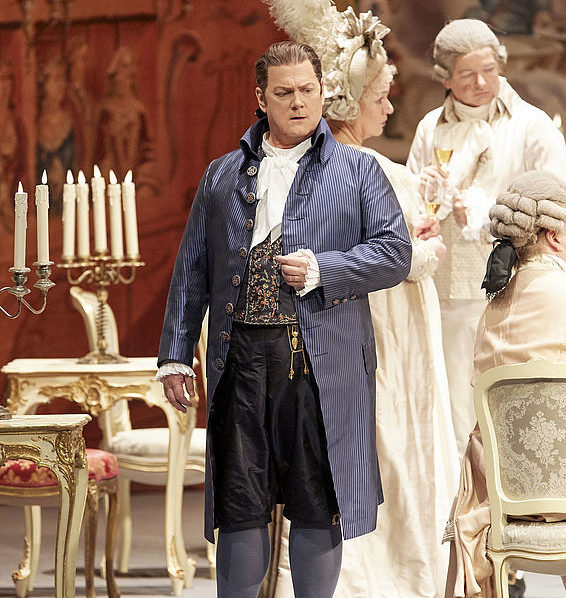
The performance was the 113th using Otto Schenk’s now classic production. Vienna is right to maintain these wonderfully detailed historical sets and costumes: from the lavish finery of Coigny’s soiree, the elegantly furnished palace in the final throes of the ancien regime; the square in front of the Cafe Hotte (where a police informer is trying to trap Bersi); and, Act 3, the Committee of Public Safety’s court room with its blood-thirsty spectators.
 The opening scene is the Comtesse Coigny’s palace- Schenk’s exquisitely painted sets- preparing for a rococo entertainment. But beneath the refinement, revolution is fermenting. We hear, almost immediately, an angry outburst form Gérard, (head butler, his father, a gardener, serf for fifty years.) Luca Salsi is impassioned in his aria, expressing his hatred of this gilded, artificial world. Your fate is sealed!
Meanwhile, the Comtesse (Lydia Rathkob) tells off her daughter, not yet dressed. Maddalena (Serjan) complains to her maid Bersi, how she hates her hideous petticoats; as if these artificial clothes, symbolising this way of life, are stifling her. Then we overhear the Abbé in conversation, talking about the revolution- supposed to be imminent – but nobody takes it seriously. The Comptesse asks the young poet Chénier (Kunde) to recite his poetry. He refuses; but Maddalana, who’s bet she’ll change his mind, annoys Chénier, expecting him to sing about love.
Kunde’s Chénier, a dour figure in black coat, is roaming in the background. Forgive my speaking up; I am a woman! She sings, Poetry is as capricious as love. He takes offence. His love is for his country. ‘I love you, divine beautiful fatherland,’ Then, in a tirade against the ancien regime (old order), a priest is happy to accept gifts, but deaf to an old woman begging for bread. And what does a nobleman do in the face of such pain and suffering? Beautiful woman, do not scorn a poet’s words: you know nothing of love, don’t deride it. (Beautifully sung by Kunde’s lyrical tenor, but the applause seemed inappropriate.) She asks his forgiveness. Chénier has caused a scandal. But Gérard listens in awe. He leads a crowd of peasants into the salon. The voice of suffering is calling him! He rips off his uniformed jacket- symbol of humiliation- and accuses the Comptesse of holding the celebration at the expense of the poor. He’s dismissed, and storms out. But, in the pastoral entertainment, the ladies sing in celestial harmony: ‘By tomorrow, they shall be far away.’ They resume dancing the gavotte the intruders interrupted.
The next tableau, Schenk’s atmospheric recreation of a Paris public square. The Revolution has degenerated into (Robespierre’s) reign of terror. Gérard has been promoted to the Chamber of Deputies. Yet, Chénier who had extolled the revolution, is now suspected as a counter-revolutionary, and under surveillance. Chénier meets his friend Roucher (Boaz Daniel) who tries to persuade him to leave Paris. Kunde sings in a moving aria of a mysterious power that guides him through life: a power that says to him, You shall be a poet. The name of my destiny is love! Believe in love, Chénier! Kunde’s tenor, powerful, but not incandescent.
He tells Roucher, he’s been receiving letters from an anonymous woman- elegant notepaper, rose-scented. Take the passport and forget the merveilleuse.
Bersi begs him to wait ‘for a woman in great danger’ They’re overheard by an informer (incroyable) hired by Gérard.
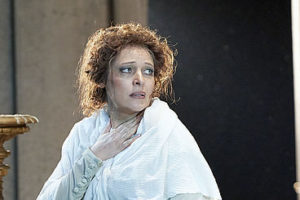 As Maddalena – alone, afraid disguised, before the altar- Serjan is in tremendous voice. Then, Chénier, Was it she who wrote the letter; recognises her, she he’d once rebuked, ‘You know nothing of love’? Serjan, her heart told her he would protect her, even the man she had affronted. You are my last hope. Their duet is ‘a marvelous moment of bliss.’ She’s washed away his last vestige of cowardice. We shall stay together even until death,they sing. Magnificent.
The Committee of Public Safety – long table, elegant chairs- the people surrounding the court sectioned off. Gérard, in a fiery speech calls on the people to make sacrifices: France is besieged. The old,blind Madelon, led on by her grandson, sings of her family’s tragedies. But she offers the young boy. Take him: he’ll fight and die. Kushpler’s aria is powerfully rendered in this most poignant vignette.
Chénier has been arrested; Gérard is expected to sign the charge. Which brings Gérard to a crisis of conscience. In Nemico della Patria Why does he hesitate: Chénier’s already listed, an enemy of the State. An old tale. A poet? He corrupts people’s minds. But Salsi, in Gérard’s aria, reflects how once he was immune to hate. Now he is still a servant. Gérard’s aria shifts to Maddalena. He sings of his life’s passion: his obsession from childhood, he uniformed and silent. She had driven him mad. He wanted to bury his hands in her blonde hair.
Maddalena turns up to plead for Chénier.( Maddalena’s aria is compared with Tosca’s Vissi d’arte. But, 1894, when Chénier originated, Tosca hadn’t been composed.) In Maddalena’s aria La mama morte Serjan sings with blistering intensity. They murdered her mother outside her room, who died to save her; saw her childhood home in flames. But love spoke to her: ‘Go on living: I am life!’ Serjan is overawed with feeling. Enormous applause. My body is that of a dying witch, Go take it! She’s no more than a corpse. Gérard, confounded, deeply impressed, will fight for Chénier.
In the trial, before the tribunal- ‘traitors’ taunted, derided as aristocrats- Chénier defends himself: as a poet, he used his pen in praise of his country. (His life is passing by, he will die soon, he muses.) Gerard admits his charge was a lie: Chénier deserves a laurel, not death. Kunde very good, somehow lacks that heroic stature.
In the prison of St.Lazarre, Chénier composes his last poem. He sings it to Roucher: a hymn to poetry, ‘kissed by a verse.’ So be it, sublime goddess! His last breath will finish in rhyme.
Maddalena will take Legray’s place to die by Chénier’s side. She welcomes destiny. O Maddalena, you make death seem noble, he sings. His soul is calm in her presence. In Chénier’s romance Come un bel di di maggio, before his execution, (reminiscent of Cavaradossi’s Tosca aria E lucivan ), Kunde doesn’t quite have that exceptional power. But Serjan, come to join him, has it. Hold me! Love me! Eternity! The orchestral playing, Vienna State Opera’s forces under Chaslin, was sublime. © PR. 2019
Photos: Gregory Kunde (Andrea Chénier); Luca Salsi (Gérard); Tatiana Serjan (Maddalena di Coigny)
© Wiener Staatsoper/ Michael Pöhn