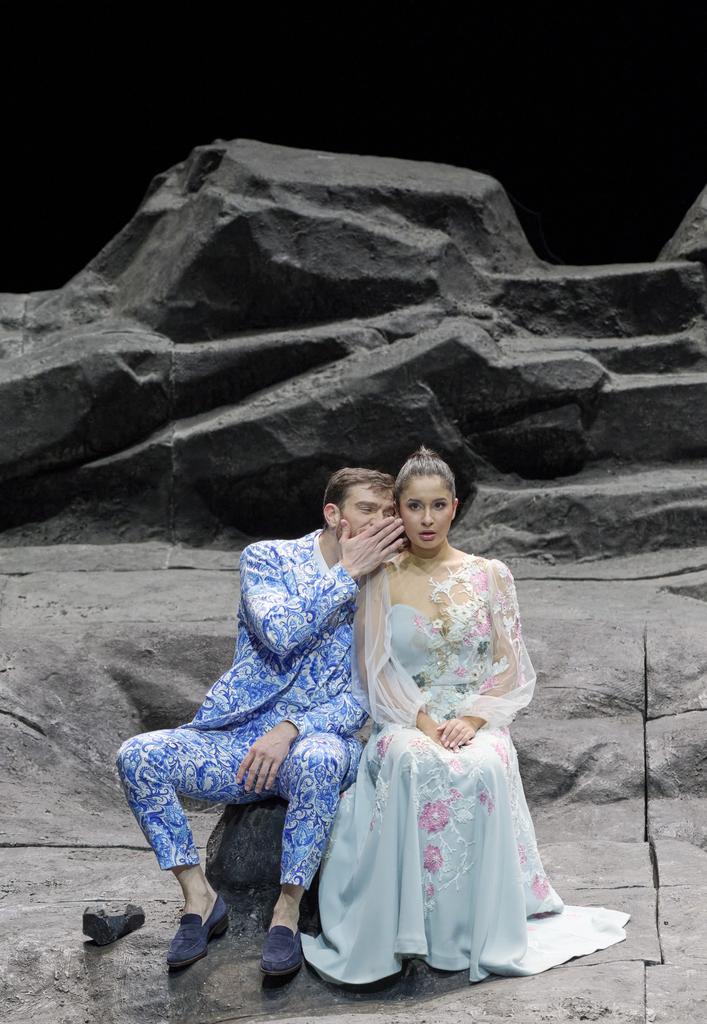
Mattia Olivieri (Don Giovanni), Anita Monserrat (Zerlina) © Wiener Staatsoper/ MIchael Pöhn
After the foreboding, grim opening chords of Mozart’s overture, (Vienna State Opera orchestra, Christoph Koncz), the scene is a deserted, rocky beach. Leporello (Philippe Sly) complains, he ‘longs to live the life of a gentleman’, not slave to his master Don Giovanni. ‘Oh what a charming and chivalrous man!’ The Don’s side-kick, Canadian bass-baritone Sly, is effectively the star of this production. Sly is witty, has the measure of mischief, to play along with his ruthless master. And has the best arias.
Mattia Olivieri’s Giovanni is dour, cool, less characterful, but exudes authority. Don Giovanni abuses his status to move freely amongst his peers. Probably to gain entry, as in the opening rape scene, when he takes Donna Anna (Adela Zaharia) by surprise, until he’s virtually raping her. Stopped only by her father, Commendatore (Tareq Nazmi), fatefully to the rescue, in this age of chivalry, (based on Molinari’s (1623) play ‘Don Juan‘.) ‘Let her go you scoundrel!’ The modern costumes are sober, formal. The ‘old man’ challenges the burglar in a black hoodie. Giovanni, abetted by his servant Leporello, they appear like petty criminals. These two chancers, hunting for women, are forever cracking jokes. This one rebounds.
 In other productions, they sword fight, by the rules. In Kosky’s, it’s more sordid. Olivieri’s Giovanni sticks the dagger in. The Commendatore, crisp, white shirt, blood-stained, feels his life ebbing away.
Donna Anna calls out to her servant, ‘Help me!’ ‘Monster!‘ she curses the unknown assailant. He mocks her, this ‘foolish woman’, the misogyny is typical. Don Ottavio, (Bogdan Volkov) her fiance, late-arriving, swears revenge. Much later-(Act 2)- Ottavio, even after the violation of his fiance, continues to be respectful to Giovanni. He cannot accept that one of his class would act other than as a gentleman.
Vienna’s ‘repertory’ cast for Kosky’s Mozart cycle are youthful-looking, sexy, dressed in glamorous (modern) outfits. They’re aristos -nobles. Except for Masetto (Andrei Maksimov), and bride Zerlina (Anita Monserrat), like (renaissance) rock-stars. They have the power that comes with rank, Giovanni, abetted by servant Leporello. The pace – rapidly changing scenes- is down to Kosky’s direction. Never a dull moment. But this streamlining of the text arguably doesn’t sacrifice the opera’s integrity; the cuts seamless. The costumes are designer, brilliant, jewel-coloured, luxurious satins and silks.
Vienna State Opera orchestra, under Koncz, sounded authentically period, without original instruments. Pared down to smaller number, they have a raw, urgent quality; orchestra tweaked to period-instrument sound.
But Mozart/Da Ponte’s libretto was not comfortable listening, but revolutionary; 1787, pre-French Revolution. As in Marriage of Figaro, the key protagonists, Don Giovanni and Count Almaviva, hunting for women, were transgressing the accepted moral code by consorting with servants. Also propagating immorality- promiscuous sex outside marriage. So Mozart/Da Ponte risked censorship by the Catholic Church, as well as offending powerful hereditary nobility. Don Giovanni abuses his seigneurial right to enjoy the bride on her wedding night; and can arrogantly beats up her fiance Masetto. It’s a ‘comedy’, and Masetto returns to Zerlina bruised-all-over. Hence her consoling aria. (She carries her soothing balm of love with her.)
Zerlina, however, is first, all-up for Giovanni’s seduction. They’re poor peasants, after all. Giovanni is born into status and privilege- a limitless platinum credit card. And she’s out for a good time. (Compare the incorruptible Susanna, who objects to Almaviva’s adjoining apartment to Figaro’s.)
Act 2, Giovanni’s come-uppance, opens on an arid beach, with a remarkable rock formation, like a modernist sculpture. A symbol of bleak existentialism. the violence of nature. The villains Giovanni, and Leporello, fallout, joust: as soon, vow friendship.  Elvira bestrides the rock. ‘Come down, my treasure’, Giovanni beckons her. La sua credulita The terrain looks as treacherous as the plotter she fancies. Act2, sticking with her unfaithful man to the bitter end, Elvira’s aria sings of conflicting emotions. Poor Elvira. Standing centre-stage, mezzo Tara Erraught’s voice drops. The ungrateful man has deceived me! She sings passionately, Ma tradita e abandonta. Infelice addio m fa.’.
Meanwhile, Donna Anna, enraged with the effrontery of her disguised assailant and father’s assassin, only belatedly discovers his identity. She sings, now sure it was Giovanni. Romanian soprano Zaharia is impressive, movingly singing to Ottavio of the deed. She reveals it was broad daylight. How Giovanni trapped her, one hand tightening his grip. Only by writhing and crawling was she able to escape. Then called for help. ‘Not enough to rob me of my maidenhood, but robbing me of my father.’ Anna’s aria is outstanding, sung by Zaharia with pathos and power.
What’s missing in Kosky’s minimalist production, with its grey monochrome sets, is the pageant. The colour on stage is provided by the brilliantly-coloured costumes. The exception is Zerlina/Masetto’s wedding, which is backed by the lush green of a vineyard.
For the wedding, we see guests descending the rock-strewn stage, women to the left, men right. Giovanni, as seigneur feels entitled to gatecrash. He’s already plotting for Zerlina. She’s star-struck, ‘Don’t fret, I’m in the hands of a gentleman’. But Masetto is already threatening; in a dull brown suit, suitably boring. But Giovanni has promised to make a lady of her, natural beauty, (British soprano Monserrat). ‘We’ve got rid of that idiot’, boasts the Don, feigning concern that ‘such a pretty face will be a servant forever.’ She trembles a little; perhaps he’s only toying with her? -Let’s go!. But they’re being watched from a distance by (Protector) Donna Anna; ‘The poor girl is infatuated.’ And Elvira is alongside.
Kosky’s production scores in the brilliant, fast-paced comedy, Giovanni and Leporello, always scheming and jesting. They exchange bravos 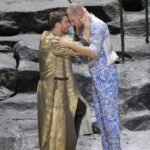 (Act2), ‘Any girls on the Square, bring them here!’ They swop outfits to outwit their prey. Leporello switches into DG’s louche dressing gown, disguised to protect his master. But there’s a violent side to the clowning. Masetto is beaten up by Giovanni. Zerlina will accept Masetto’s blows ‘like a lamb.’
Whereas, amongst the nobility, their social superiors… Donna Anna, ironically the victim of nobleman Giovanni, is comforted by Ottavio. ‘His peace of mind depends on her peace of mind.’ In their seminal duet, Volkov’s lyrical tenor is beautifully sung, but anodyne, like the ineffectual man he is. Yet poetic, full of pathos, he sits centre-stage, as if moved by his own rhetoric. It’s languorous, but beautiful. No use in these Machiavellian times against the scheming Giovanni.
Zerlina has made peace with Masetto (Maksimov). Crawling on his knees, ever-jealous Masetto hides under the table, in case Giovanni tries anything. But the Don sniffs him out, looming over the cringing Masetto. Inevitably (Act2)he’s floored by the Don. Where does it hurt then, asks Zerlina. The black humour’s always just below the surface.
A deep-bass voice is heard, end Act2, RIBALDO, AUDACE, LASCA A MORTA. Giovanni, Leporello are at the opening of a cave. There’s a pool of dark water. They splash about, sing of the Commendatore’s statue: ‘the good old fellow is coming to dinner’.
We hear Donna Anna’s demand to be avenged. You know how much I love you, and how faithful I am, Ottavio reassures her, in his sublime aria. Counterpointing the Commendatore’s demand Giovanni repent, Elvira’s appeal is wonderfully sung by Erraught. Leporello, ‘If Giovanni is unmoved, he has a heart of stone.’
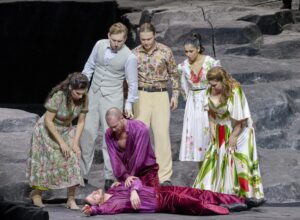
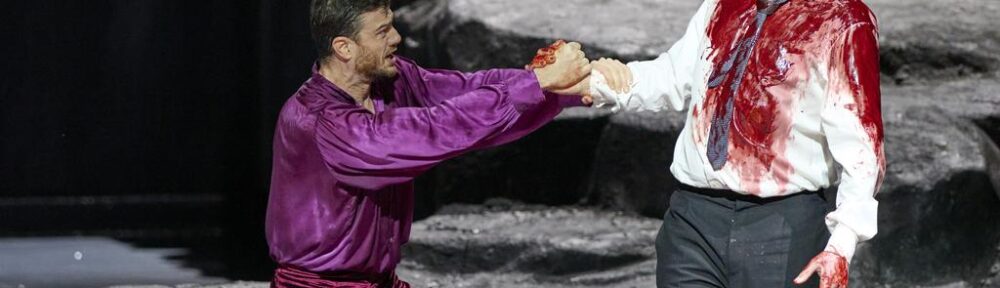
The ‘Halloween’ stuff you expect. But this is chilling. Commendatore, white shirt blood-splattered, grips Giovanni’s arm. Won’t let go. Repent!- Never.’-‘THE TIME HAS COME!’ The ‘Avengers’ gather backstage. Giovanni’s corpse is laid out, as if struck by lightening. ‘Now heaven has avenged us! they sing. Leporello walks on in zipper-jacket. ‘All wrongdoers will meet with such an end.’ But, curiously, Giovanni walks away, unnoticed, in his purple outfit. But in Kosky’s take, he has shown no remorse. © P.R. 7.11.2025
Photos: Mattia Oivieri (Giovanni), Tareq Nazmi, Philippe Sly (Leporello); Tara Erraught (Elvira); Mattia Olivieri, Phjlippe Sly; Ensemble, Maksimov, Monserrat, Erraught, Zaharia, Olivieri, Sly, Volkov; Featured Image: Mattia Oivieri, Tariq Nazmi
© Michael Pöhn/ Wiener Staatsoper