 The plot of Beethoven’s only opera, Fidelio, is complicated enough. Vienna State Opera’s classic Otto Schenk ‘period’ production- early 19th Century- realistically represented the grim horror of a ‘Napoleonic’ prison, in which Rocco, is the prison guard responsible for the incarcerated political prisoner Florestan (David Butt Philip). His wife Leonore (Marlin Bistrom) seeks to recue him, by posing, cross-dressed, assisting Rocco as a new prison guard. As Fidelio she wins Rocco’s trust, and as ‘one of the family’; also the love of Marzelline, who is besotted with him. She kicks out her fiance Jacqimo. (‘A wife will ruthlessly pursue her aim to implement her plan.’)
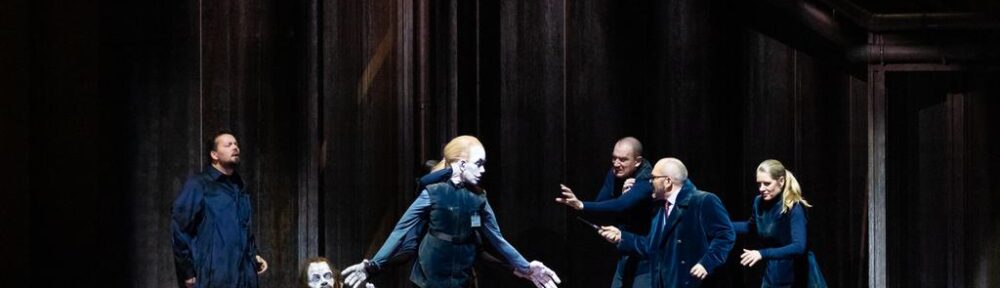
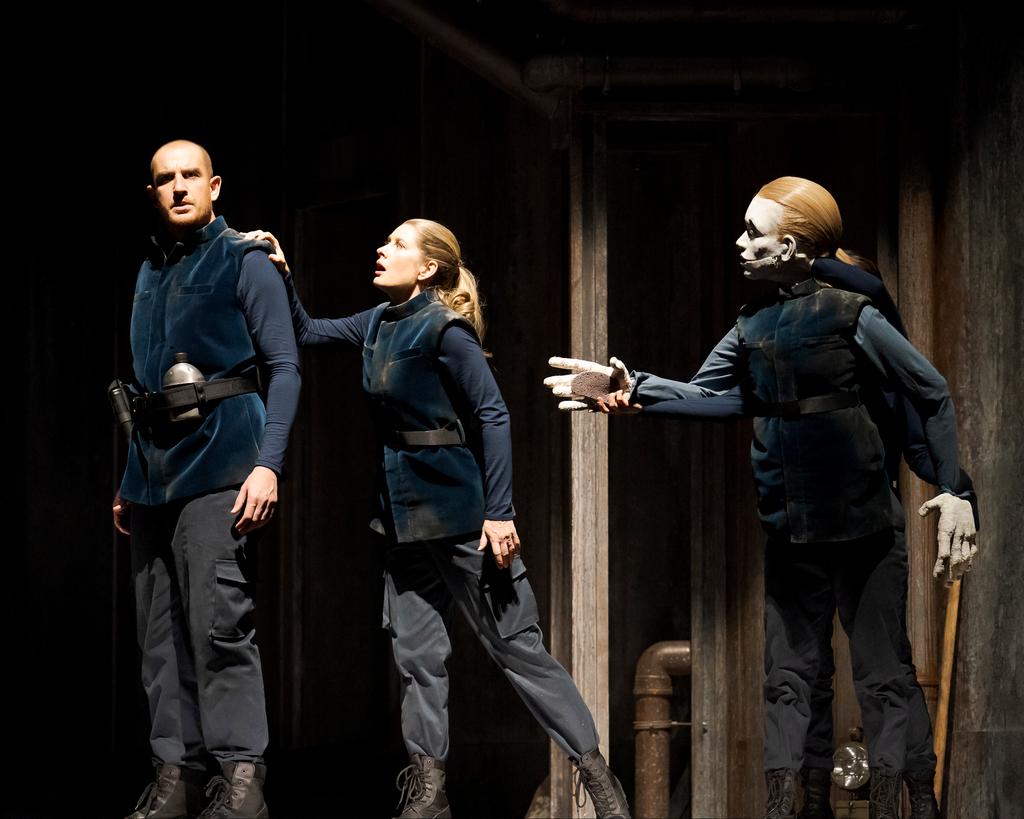
But as if this isn’t difficult enough for an audience, in Vienna’s director Julius Semmelmann’s production, Leonore and Florestan are respectively ‘doubled’ by puppets. To express their characters inner-thoughts, and in Leonore, her painfully repressed emotions, disguised as prison guard, visiting her husband.
Even for an opera lover who’s seen the opera before, you at first wonder what’s going on. Why is Butt Philip (Florestan) dressed in a formal black suit, but Florestan, the puppet, unruly long-haired, ragged, at death’s door. Is the puppet meant as alter-ego, representing a subconscious reality? The puppetry is ingenious, but it hinders our understanding of this complex opera, which doesn’t need special effects, and ventriloquism. Beethoven’s opera is concerned with the political repression and torture of his time. But political torture is very much of our time. But the garish bright colours of the stage are not appropriate, rather confusing and shocking to an audience. Florestan’s puppet shows the dehumanizing effects of torture, but the role needs to be sung, not mimed.
Christopher Maltman’s suave baritone, here white-haired, appears serenely commanding as Don Pizzaro in a navy coat; he sings of steel, victory is at hand. Video shows men in their cells behind bars; total surveillance, the all-seeing totalitarian state. Rocco is grilled by Pizzaro. Murder!! he exclaims. You’re trembling, are you a man, derides Pizzaro. -‘The State only wants quick disposal of the political prisoner’. But even the corruptible Rocco will have none of it. So Pizzaro will follow, and dig the grave. ‘One blow and he’s mine.’
The prisoner is led by the scruff of his neck by severe prison guards. This is the brutal context to Beethoven’s Fidelio, overture passionately played by Vienna State Opera Orchestra under Franz Welser-Möst.
 By contrast the petit-bourgeois subplot, the Rocco’s family life that Leonore inveigles herself into. The Rocco’s, garish colours, brilliant lighting, is in Habjan’s, a stage-within-a stage, like a pre-fabricated mobile home. The sexist Jacquino (Daniel Jenz) bullies his fiance Marzelline (Katharine Zukowsski), ‘I’ve chosen you for my wife, – Do you understand- already named the day.’ She’s his prey; but secretly she loathes him. She sings, she has chosen Fidelio; ‘to love him a great prize’. Vienna’s stage, with its kitsch baby-blue tiles against bright orange decor, hints at squalid boredom.
Meanwhile Rocco, the patriarch, is negotiating the terms of the marriage. Rocco later sings of his gold, gold hoarded stolen from prisoners, (that’s the corrupt character he is.)
But for Marzelline, since ‘Fidelio’ started to visit, everything’s changed. Hope follows her, she sings, with indescribably sweet desire. How happy she shall be. Mir ist so wunderbar, sings Marzelline. She feels exhilarated, ‘he loves me its clear.’ But Leonore’s Fidelio must ruthlessly scupper those dreams. In the realpolitik of recuing her man, Florestan being the victim of Pizzaro’s revenge plot. But we wonder why Fidelio’s face is whitened?
‘Today one will be set free’ for the elimination of another prisoner. The prisoners are standing to attention, like dummies. Meanwhile Leonore succeeds in granting the prisoners a glimpse of daylight. Out of the illuminated faces, she hopes to identify her man. (In vain.) There’s a glorious moment, a musical epiphany, as the stage bathed in heavenly gold light; immortalized by Beethoven’s steadily building climax surging triumphantly.
Leonore, Bystrom dressed in dark uniform as prison guard, ‘the blood quickens’ she sings, as if praying on her knees, ‘love will redeem me.’ Rocco describes his unknown prisoner: the man he’s given less and less to eat, up to the last moment.
Leonore, distressed, ‘Have you been ordered to kill him.?’- ‘No good lad’, Rocco replies to his ‘apprentice’. He’s ordered, to DIGI must see him even if it kills me.‘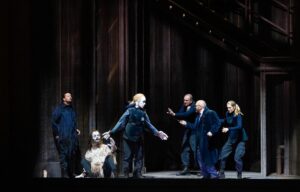
The cell, in Habjan’s production, appears clean white, white tiles, the prisoners nearby cleanly dressed, as if in a modern US Penitentiary. Not at all the horrid squalor, the purgatory suggested by Vienna’s classic: the bowels of the earth, living hell, men barely alive.
Rocco will do the deed himself. Meanwhile, Leonore’s Fidelio succeeds in granting the prisoners a glimpse of daylight. Out of the lit-up faces, she hopes to identify her man. In vain. There’s a glorious moment, a musical epiphany, as the stage is bathed in heavenly gold light. immortalized by Beethoven’s steadily building climax surging triumphantly.
‘Oh! What darkness!’ This poor beggar with long, unkempt hair-probably lice-ridden- at the end of existence- is led in by a black-suited figure, who sings Beethoven’s words, (libretto translated), ‘But there is sweet comfort in my heart. For I have done my duty.’ We hear David Butt Philips magnificent tenor, but the emaciated, dehumanized figure led on is in fact a puppet, (mouthed by actor Max Konrad). It is moving, but ultimately doesn’t quite ring true. The puppetry is artifice, this being opera, the role of Florestan, tragically human, needs to be sung, elevated by Beethoven’s heavenly music.
So’ for Florestan, there are two entities: the voice of Butt Philip’s tenor, and the haggard living corpse, played by an actor Max Konrad. Florestan sings, heaven has sent them to him. Rocco gives the poor man, (his prisoner) a bit of bread. And Rocco confronts (Duke) Pizzaro, insisting the man should be allowed a little dignity. Leonore, (disguised as Fidelio), enacted with an unearthly white mask, looks like an alien from another planet. Yet, it’s confusing. Is this her double?
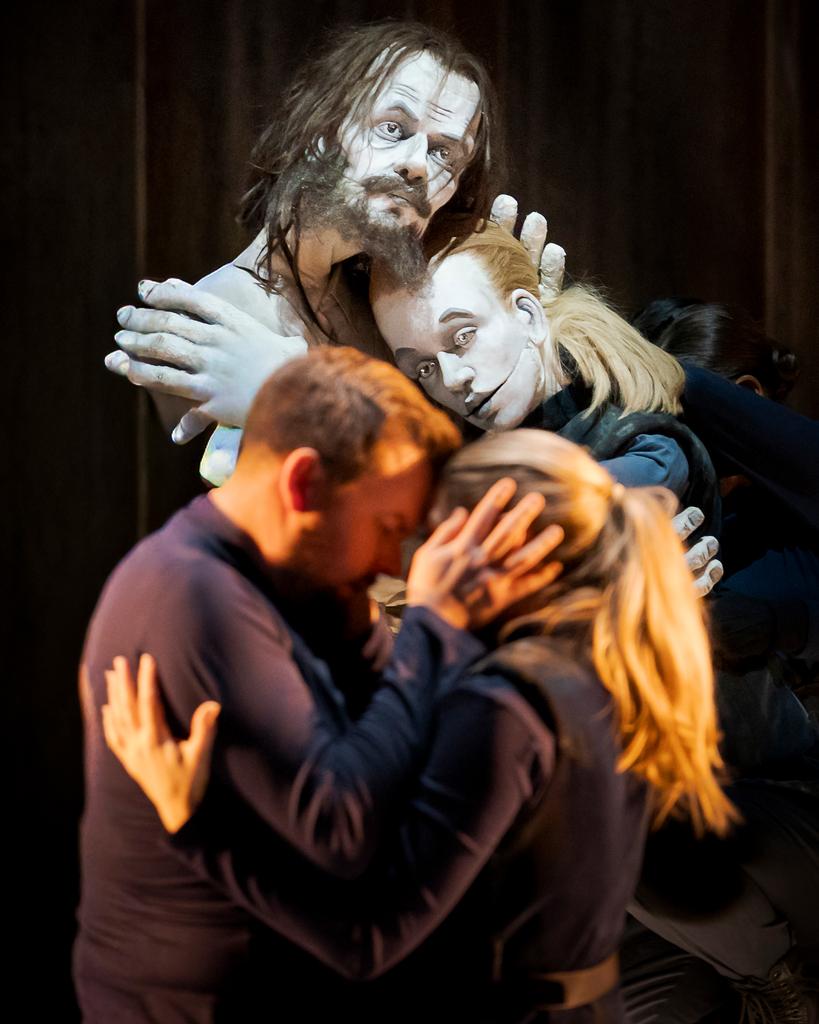 An iconic trumpet gloriously sounds out, signaling the arrival of the Minister, and freedom for the prisoners. Leonore, as Fidelio, it is who can now loosen the prisoner’s chains, free her own husband. Pizzaro is arrested. Shall I tremble?…The hour of vengeance strikes. You are to be saved! Leonore and Florestan embrace. Such suffering, sobs of joy!
But there’s another overture? Leonore III. This might arguably interrupt the dramatic tension. But maybe the high drama on stage demands a musical counterbalance? It’s played beautifully by Mosts Vienna State opera orchestra, inspiring, but to an empty stage? That can’t be right. It needs some visuals, props, even black/white video, (to express the the triumph of the human spirit over political repression.) Deserved applause for Vienna Orchestra.ndermined
Now the view of empty cells, the prisoners, freed, line the front of stage. Others Umarmen, embrace their comrades. Fernando( , the Kings envoy, (Simonas Sradas) sings, ‘A brother seeks his brother and will help who he can. Hail the day and the hour!’ To Leonore and Florestan, May heaven help this couple in chains. Pale he stands before us. Leonore’s deed will be sung out, a symbol of freedom, virtue and courage.
Rousing music, Vienna State Orchestra and Chorus splendid; with fine performances in the key roles. But disappointing staging. Beethoven’s inspiring tribute to human courage, a woman prevailing against political repression, is undermined by Habjan’s radical staging and distracting puppetry. © PR.30.12,2025
Press photos © Wiener Staatsoper/ Werner Kmetisch, Stephan Bruechler; Kathryn Bukowaski (Marzelline)
Nazmi, Malin Bystroem (Florestan) © Bruechler; Butt Philip (Florestan), Nazmi, (puppet), Maltman, Bystrom; David Butt Philip, Malin Bystroem