
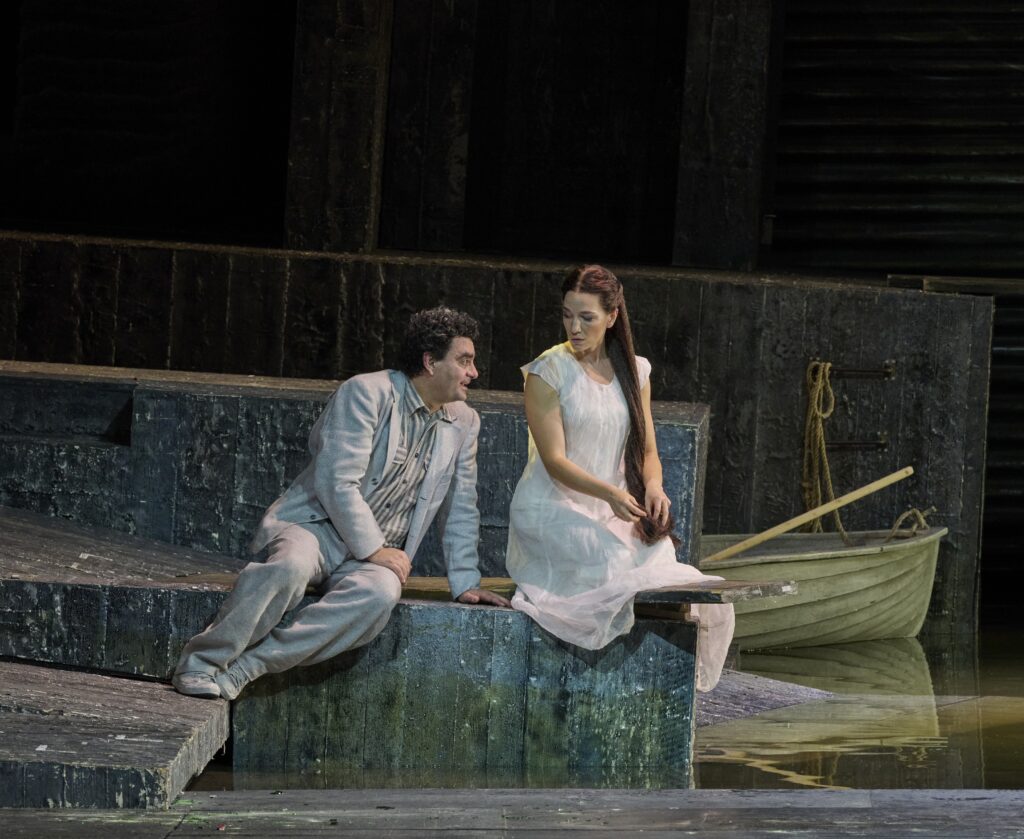
Rolando Villazon (Pelleas), Kate Lindsey (Melisande) (c) Wiener Staatsoper/Michael Poehn
In the misty opening scene, Golaud, a hunter, (baritone Simon Keenlyside), who’s lost his way, comes across a young woman, sitting by a spring, distressed but refusing help. Only reluctantly giving her name, Mélisande. Debussy’s text, in co-operation with symbolist playwright Maurice Maeterlinck, resembles the opening of a gothic story. There’s even a castle, Golaud’s ancestral family home, three generations ruled over by patriarch Arkel (Jean Teitgen).
Debussy’s ‘impressionistic’ music evokes an atmosphere of mystery, even the supernatural, in its inventory of oriental instruments, (Vienna State Opera Orchestra and Chorus are expertly directed by Alain Altinoglu.)
It’s when Keenlyside’s Golaud appears, carried on stage on a stretcher -a hunting accident- that this performance really takes off. Keenlyside’s rich, seasoned baritone is arguably the star performance. He confronts his half-brother, Pelléas, whom he suspects of an affair with Mélisande (mezzo-soprano Kate Lindsey.) Gollaud presses Mélisande, she ‘no longer a child’. Do you want to leave me. Is it Pelléas?
Gollaud sings to Melisande of Pelléas. He does not talk much? – He will change.- Can you not get used to the gloomy life here?
Rolando Villazon is curiously cast as the introspective Pelléas. You expect an ascetic Pelléas, after Adrian Eroed’s (2017) performance. But Villazon, still a super-tenor- swaggering, extrovert- is perhaps miscast, for the role.
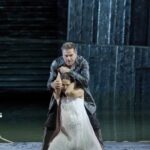 Whereas Keenlyside’s, authoritative, experienced Gollaud, really inhabits this rather brutal character. He questions Mélisande. She complains, you can never see the sky here. -Is that why she’s crying?- She sings, the people here are old, the countryside sombre.
Debussy/Maeterlinck’s libretto is surprisingly modern in its preoccupation with ‘existential’ questions, and in Mélisande’s depression. Golaud’s ‘interrogation’ of his wife over the missing wedding ring has shades of Othello, in his insidious obsession.’ She tells him she lost it in the ‘grotto by the sea.’ Which may explain the water on stage. ‘You must go and look for it’. Golaud sings, he shan’t sleep until he has the ring.
It now makes more sense- the water everywhere. Pelléas steers the rowing boat through the underground labyrinths, searching for the ring. Do they frighten her? They come across indigent locals, some still asleep.
Villazon’s Pelléas- after the dour spiritual Eroed – is the sensual hedonist. And very expressive in body language. Villazon wears light-blue silk suits; his tenor is fruity and rhetorical.
Opening Act 3, Debussy’s music is magical, like a woven tapestry, revealing its golden threads. She, Mélisande, is reclining on a white table, or is it a bed? Lindsey is quite enchanting, ‘singing like a bird from a foreign land.’ She stands, raising her arms; it was a warm enchanted night.
Pelléas effuses over her beauty, especially her erotic, flowing hair. But Villazon’s Pelléas, dressed in a white suit, seems chubby, stumbling, awkward.
She can’t lean any further down. Her hair falls down to him; he’s holding it in his hands, Pelléas passionately entangled in her hair. Golaud creeps up on them; surprises them, scolding them for their ‘childish games’. No, he won’t, can’t, release her. With remnants of Maeterlinck’s original text, ‘he’s tying her hair to the willow bushes.’
‘The plot’ is unstructured, in Debussy’s Pelléas et Mélisande, it’s ‘modernist’. Episodic, emotionally charged scenes are structured by the music
Golaud takes Pelléas down to the ‘cisterns of death’, dungeons beneath the castle (to get him to confess.) ‘They tread carefully’, Golaud leading Pelléas through, we imagine, the stagnant waters. Villazon still in his light suit, admits he was entranced. Shuddering, he escapes from the claustrophobia, the stifling air, into a glorious Debussy epiphany. Now he can breathe a fresh breeze. Pelléas sings of the scent of wet flowers risen up.
Pelleas again meets Melisande, but with foreboding. Golaud appears out of the darkness, and warns Pelléas. He knows ‘they were just playing’, but it mustn’t happen again: he must avoid her. The set, sharply rugged, cliff-like, could be that of a 1920s expressionist movie.
In Act 3, Golaud, consumed with jealousy, questions his son, Yniold (Hannah-Theres Weigl) about Pelleas and Melisande, and tells him to spy on them. ‘Tell me, she often spends time with uncle Pelléas. They often quarrel, is that right?- About the door, because it won’t open. Soprano Weigl, delicate, waif-like, gives a haunting performance.- Papa, you’re hurting me’ Keenlyside gruffly manhandles his son.- ‘Do they kiss?- ‘Yes, once, when it was raining.’ Yniold is lifted up to spy on his mother-in-law and Pelléas.- ‘And the bed?’
There are other memorable cameo roles: bass Jean Teitgen’s Arkel, the grandfather, comments, they whispered behind closed doors. ‘It was time’. He implored Pelléas to leave immediately. ‘The young and beautiful create beauty of their own around them.’ He’s ‘been breathing death all his life.’
Arkel looks at Mélisande close-up. Lindsey’s portrayal is a revelation- mature, composed- her soprano, febrile, expressive. Described early on, ‘she’s a quite little thing, so timid and silent.’ Physically, Lindsey, with her auburn hair, is a lithe beauty. In contrast to her powerful husband Golaud, who, in one scene, manhandles her- ‘Don’t try to escape’- brutally forcing her down.
Keenlyside, in a worn leather jacket, is ruggedly sexy.’ I am too old’, he complains. Yet Mélisande whines, he no longer loves me.
Arkel comments profoundly, ‘If I were God, I would have pity on the hearts of men.’
Lindsey enacts her tragic role sensitively, a vulnerable figure, buffeted by stronger men.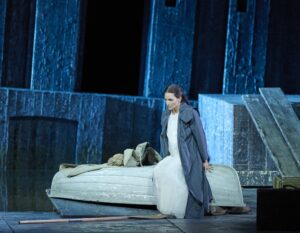 Mélisande packs her bag ready to leave. She lays her head on her bed, as if remembering the love that once was with Golaud.
She must see Pelléas just on last time! In their last meeting- a series of intense emotional outbursts- it’s all mystery. Today is the last time he will see her, he sings. ‘I love you’, ‘She too! They exchange parting sentiments. In the plot, the gates shut, they appear ready to run away together. In the attempt to thwart them, Mélisande is wounded.
‘Come close’, Lindsey sings it in a voice that comes from the end of the world. Villazon, in a light suit, a little chubby, sings of ‘Heavy chains!’ The imagery harks back to the medieval story that inspired Maeterlinck/Debussy. They’re locked out. They embrace. In the narrative, Golaud is hidden behind a tree. In Marelli’s curious update the boat capsizes. And she’s powerless, weakened by a pregnancy, (we learn of.)
In the last Act (5), Lindsey is lying left-stage on a couch, her sick-bed. ‘You have not killed her,’ remarks Arkel. Mélisande ‘has never felt better’. She senses Golaud, still trying to get to the truth. Why doesn’t he come closer? He’s grown thinner and older to her. Keenlyside sings, ‘Mélisande, do you forgive me’. She, ‘Yes I forgive you, but for what?’
The truth. La Vérité . -‘Do you love Pelléas?- I did love him.’-A forbidden love?’ No they were not guilty of anything. She utters, ‘I am dying!’ Golaud, where are you? She has already slipped too far away from them.
The stage is now filled with ghostly Mélisande look-alikes. Lindsey on her death bed, they approach through the water, as if to claim her. ‘She was quite a little thing’. Video of blue, shimmering water is projected back stage. © PR.30.10.2025
Photos: Kate Lindsey (Melisande), Simon Keenlyside (Golaud); Kate Kindsey (Melisande) © Michael Pöhn/ Wiener-Staatsoper
–